20 Modern Living Room Designs That Feel Warm, Not Cold
Modern living rooms have a reputation for feeling a little cold, and it’s usually not the style itself that’s the problem — it’s the execution. Clean lines and a neutral palette can look striking and considered, or they can look like an empty showroom, and the difference almost always comes down to warmth: wood, texture, layered lighting, and a few pieces that feel collected rather than purchased as a set.
The twenty designs below cover the full range — furniture, materials, color, layout, and lighting — and each one goes beyond “add this item” to explain why it works and how to actually pull it off without the room tipping into stark or generic. Work through the ones that fit your space and your existing furniture rather than trying to apply all twenty in one room.
20 Modern Living Room Designs
1. Create a Warm Neutral Modern Living Room
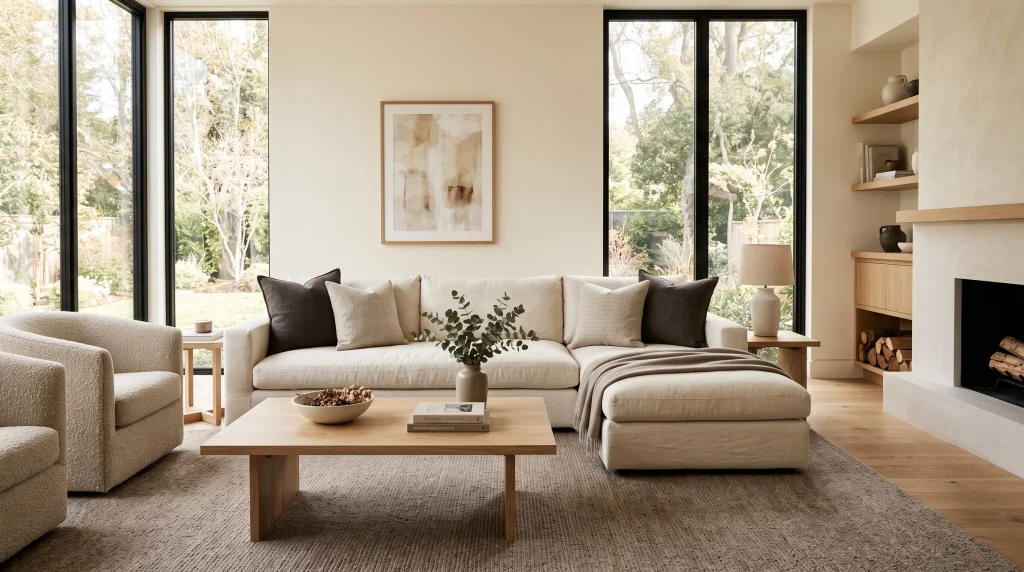
A warm neutral palette — cream, oatmeal, warm white, soft taupe — gives a modern living room the clean, calm backdrop the style is known for, without tipping into the stark, clinical feeling that a cooler gray-and-white palette can create. It works because warm neutrals still photograph as modern and minimal while reading as inviting in person, which is the balance a lot of modern rooms miss.
Keep the palette to two or three tones total, with the warmest one on the largest surfaces — walls, a sofa, a rug — so the room doesn’t drift toward beige-on-beige monotony. A single deeper accent color, introduced through pillows or art, keeps a warm neutral room from feeling flat. The trap to avoid is treating “neutral” as “colorless” — warmth comes from undertone, not just from avoiding bold color entirely.
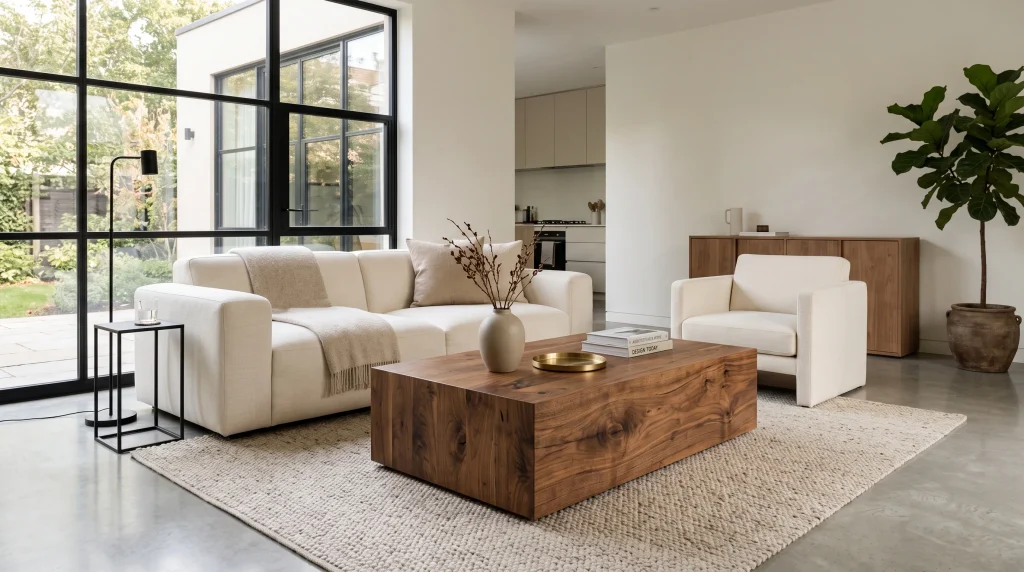
2. Use Natural Wood to Soften Clean Lines
Warm oak or walnut can soften the clean, often sharp-edged lines of modern furniture, which is one of the most reliable ways to keep a contemporary room from feeling cold. Wood introduces grain, warmth, and a sense of natural imperfection that pure metal, glass, and painted surfaces don’t have on their own.
Pair one substantial wood element — a coffee table, a media console, an accent chair frame — with neutral upholstery and simple decor, rather than filling the room with matching wood pieces from the same collection. A single strong wood piece looks more intentional than wood scattered evenly across every surface, and it gives the eye a clear anchor rather than competing wood tones fighting for attention around the room.
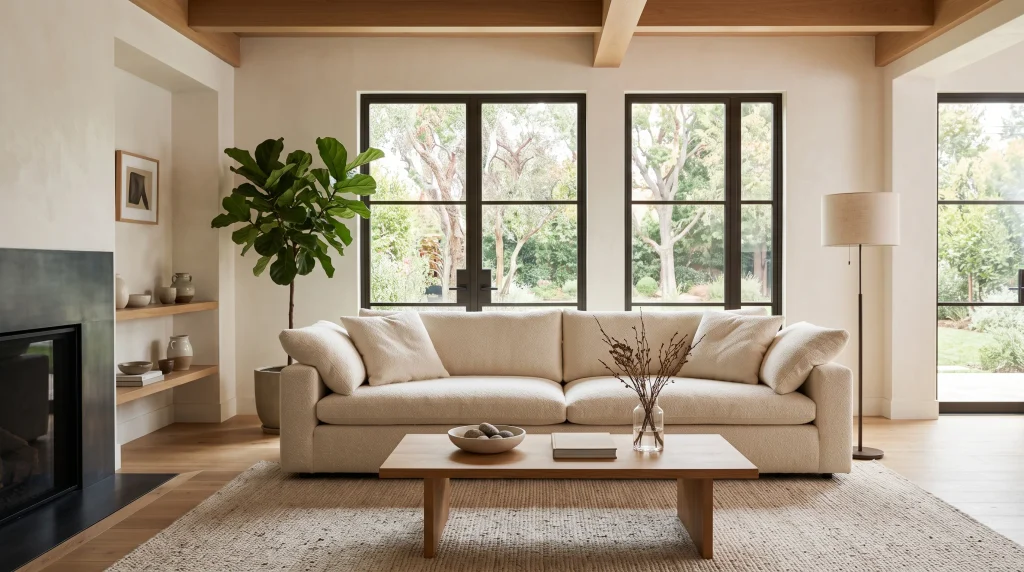
3. Choose a Low-Profile Modern Sofa
A low-profile sofa, with a lower back and seat height than a traditional silhouette, is one of the clearest visual signals of a modern living room, and it does real spatial work too — a lower sofa opens up sightlines across the room and can make a space feel larger, particularly under a lower ceiling.
Depth matters as much as height here: a deep-seated, low sofa feels relaxed and lounge-worthy rather than stiff, which helps counter the sterile feeling low-profile furniture can sometimes create on its own. Boucle, linen, or a substantial woven fabric on a low sofa adds texture that keeps the clean silhouette from feeling too austere — a low sofa in a smooth, tightly upholstered fabric can look more like a display piece than something meant to actually be sat on.
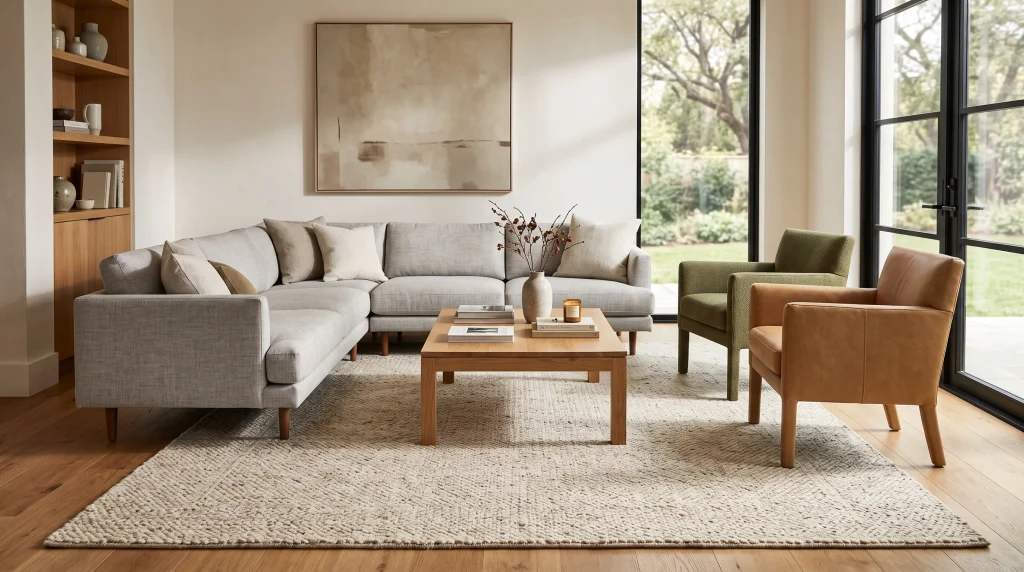
4. Make a Large Rug the Foundation of the Room
A rug sized too small is one of the most common mistakes in an otherwise well-designed modern living room, and it undercuts the whole layout more than people expect — furniture ends up looking like it’s floating on bare floor rather than anchored as a cohesive seating area. A properly sized rug should extend under at least the front legs of the main seating pieces.
In a modern room, a rug with subtle texture or a low-contrast pattern generally works better than something busy or high-contrast, since the goal is grounding the space rather than adding another competing visual element. A natural-fiber or wool rug in a warm neutral tone does the foundational job while still contributing to the room’s overall warmth, more so than a flat, synthetic rug in a stark white or gray.
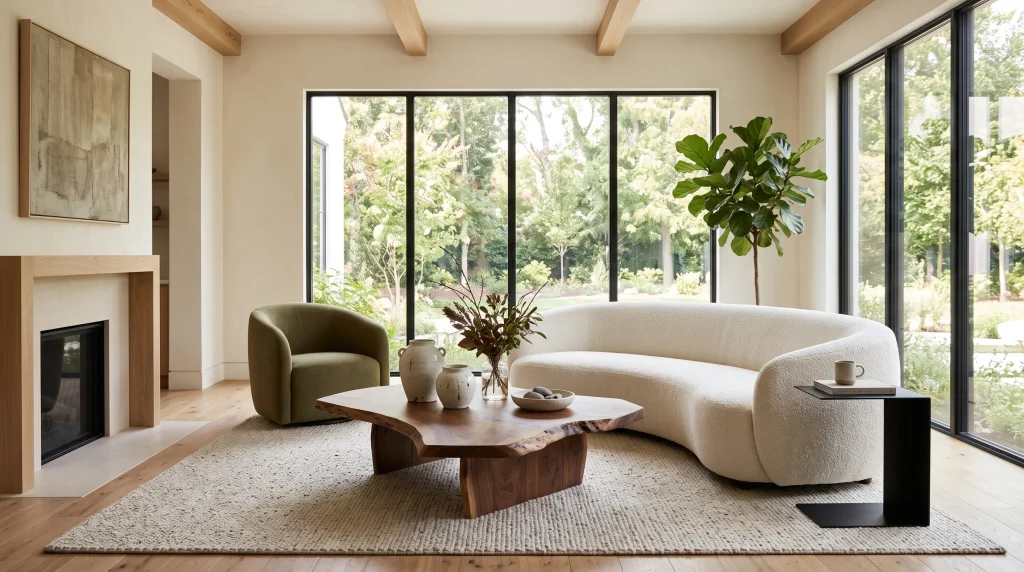
5. Try an Organic Modern Living Room
Organic modern softens the harder edges of a fully contemporary room by leaning into curved furniture, natural materials, and irregular, hand-crafted-feeling shapes rather than the sharp angles typical of a more austere modern style. A curved sofa, a freeform coffee table, or ceramics with an irregular, hand-thrown quality all fit this direction.
The style works because it keeps modern’s clean, uncluttered sensibility while removing the rigidity that can make a fully geometric room feel a little clinical. Mix one or two curved pieces with otherwise straight-lined furniture rather than making everything rounded, since an entirely curved room can start to feel indecisive rather than intentional. This direction pairs particularly well with warm wood and boucle, both of which reinforce the same soft, organic feeling.
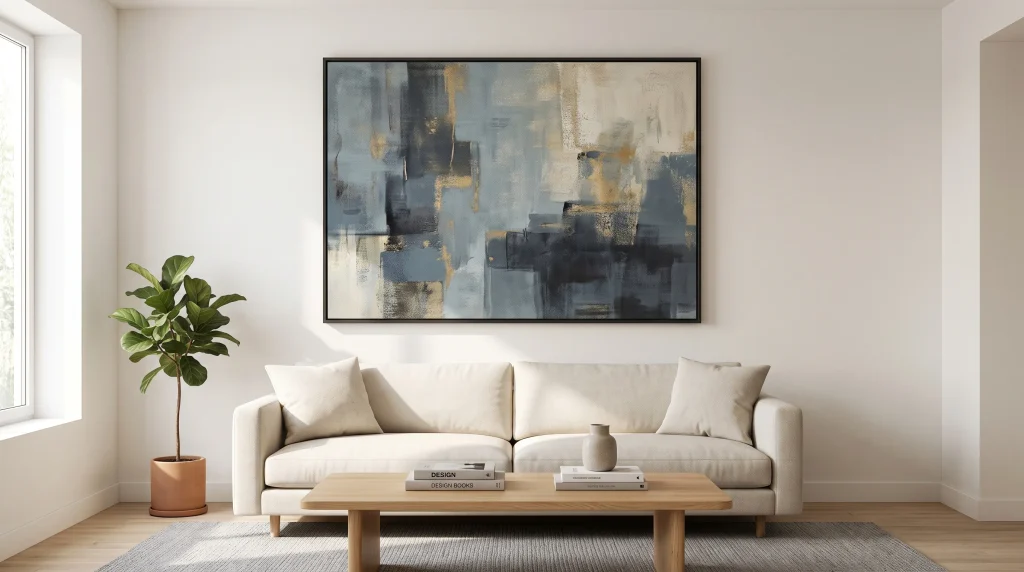
6. Add One Oversized Piece of Artwork
A single large piece of art does more for a modern living room’s wall than a gallery of smaller framed pieces, and it fits the style’s preference for fewer, more considered choices over a busy collection of decor. Scale matters here specifically: art hung above a sofa should span roughly two-thirds of the sofa’s width to look proportional rather than undersized.
One statement piece also gives the room’s decor a clear focal point without needing much else on the walls, which suits modern design’s general instinct toward restraint. If you’re drawn to more than one piece, consider a diptych or triptych — a single artwork split across two or three panels — which comes across as one cohesive statement rather than a scattered gallery wall, while still giving you more visual real estate than a single canvas would.
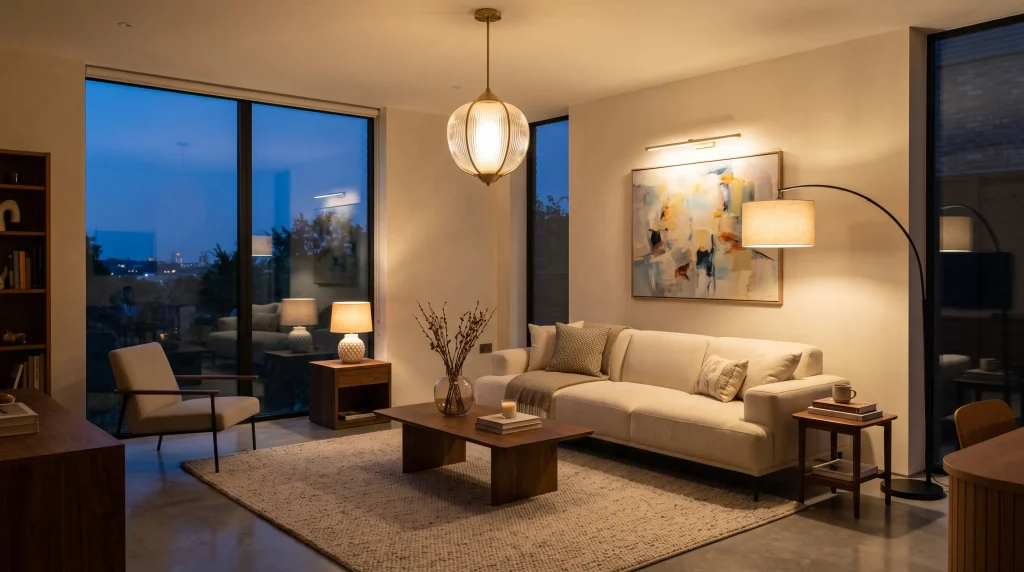
7. Layer Different Types of Lighting
A modern living room lit by one overhead fixture, however striking, will still feel flat and a little sterile in the evening, since a single light source can’t create the depth and mood that multiple smaller sources provide. Layering ambient, task, and accent lighting — a statement fixture, a floor lamp, a table lamp, maybe a picture light — matters as much here as it does in any other room.
A sculptural floor lamp or pendant doubles as both a functional light source and a piece of decor, which fits modern design’s preference for objects that do more than one job. Dimmers are worth prioritizing wherever the budget allows, since they let a bright, clean-lined room scale down into something warmer and more relaxed for evening use rather than staying at one uniform brightness all day.
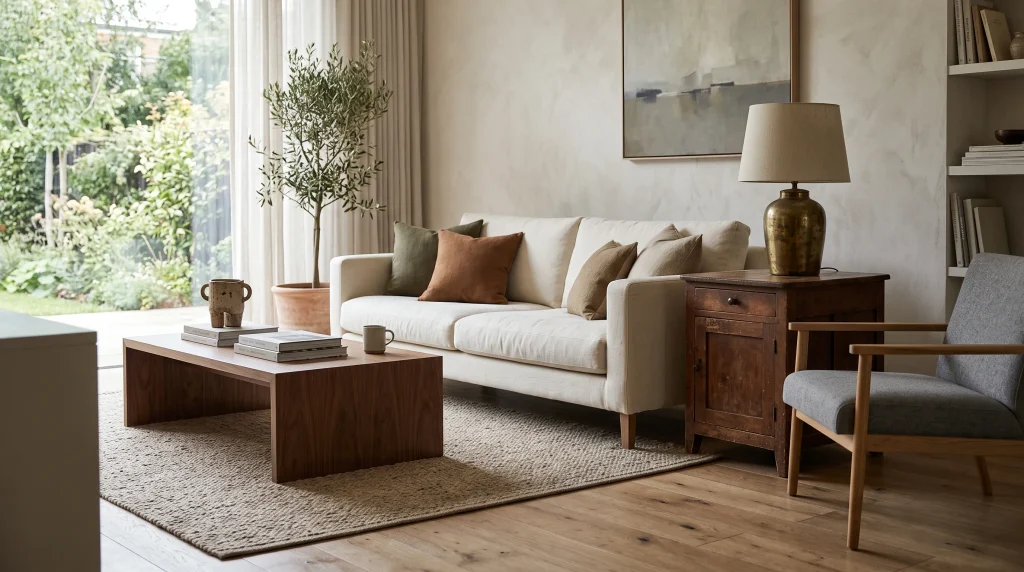
8. Mix Modern Furniture With Vintage Pieces
A living room furnished entirely from one modern collection can start to look like a showroom rather than an actual home, which is where a vintage or secondhand piece earns its place — an older wood side table, a vintage brass lamp, a found ceramic piece mixed in among newer, cleaner-lined furniture.
The contrast is the point here, not something to smooth over: a room that’s too uniformly modern loses personality, while one piece with real age and history gives the space a sense of having been collected over time rather than bought in a single order. Keep the vintage piece loosely compatible in tone or material with the rest of the room — a warm wood vintage table generally blends better into a modern room than something ornately carved or heavily gilded, which can clash with cleaner surrounding lines.
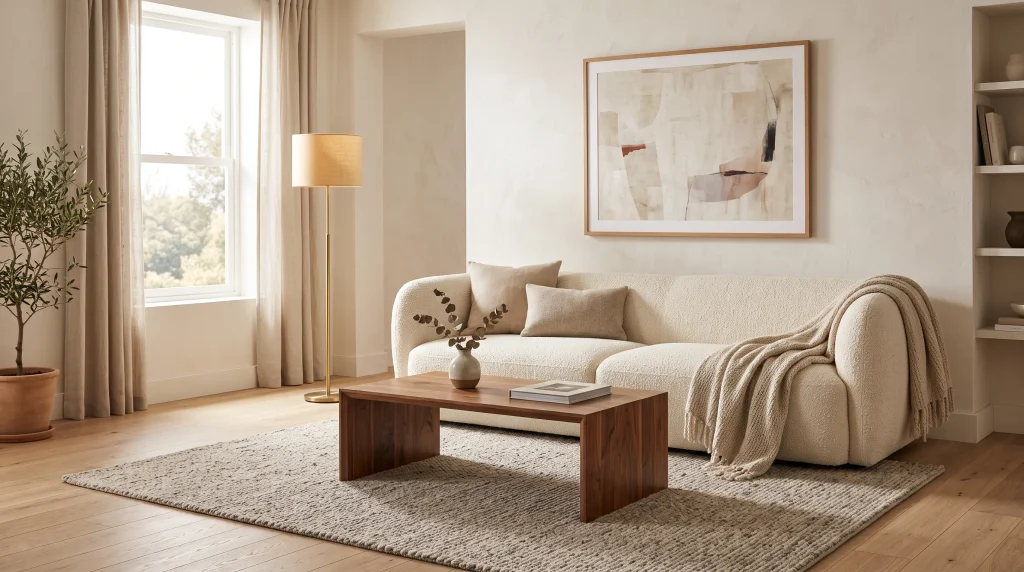
9. Create a Minimalist Living Room Without Making It Stark
Minimalism and starkness get confused constantly, but they’re not the same thing — a well-executed minimalist living room still feels warm and considered, while a stark one just feels empty. The difference usually comes down to texture and material quality rather than the actual quantity of items in the room.
Fewer pieces, chosen well, is the actual minimalist principle: one substantial sofa in a textured fabric, one well-made coffee table, a single piece of art, rather than a room stripped of everything down to bare furniture. Warm lighting and at least one soft textile element — a throw, a textured pillow, a plush rug — keep a minimal room from tipping into cold, even with very little decor overall. The goal is restraint, not deprivation.
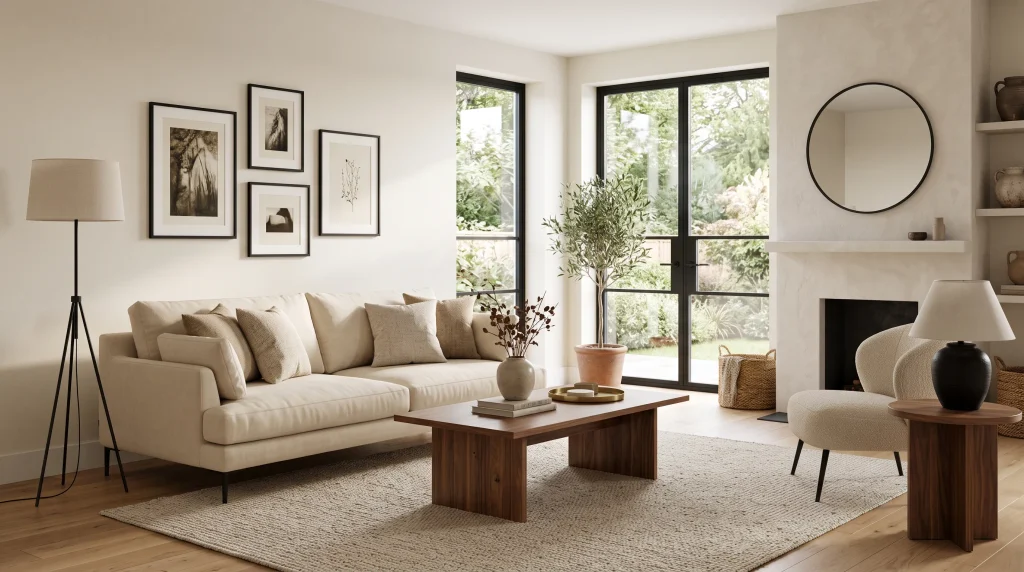
10. Use Black Accents for Contrast
A small amount of black — window frames, light fixtures, furniture legs, picture frames — gives a modern living room definition and contrast that an all-neutral palette can lack on its own. Black in small, consistent doses feels intentional and grounding rather than heavy, which is the balance worth aiming for.
The trap is overusing it: a room with too much black furniture and too many black accents can start to feel dark and closed-in rather than sharp and modern, especially in a room that doesn’t get much natural light. A common approach is repeating black in two or three spots — a light fixture, a side table, some hardware — rather than concentrating it in one large piece of furniture, which spreads the contrast evenly through the room instead of creating one heavy visual block.
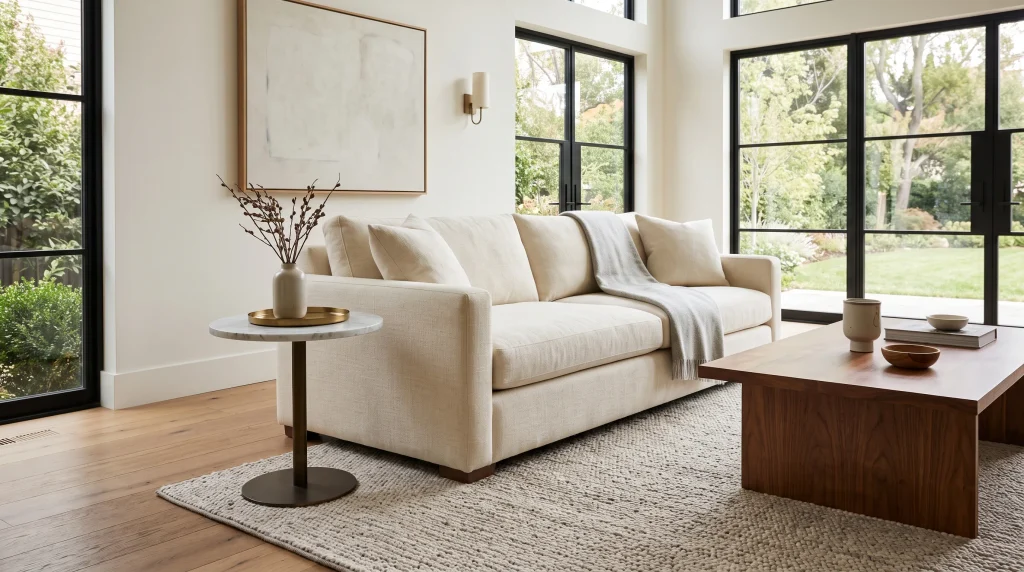
11. Bring in Stone or Marble for a Luxe Touch
Stone or marble — a coffee table, a fireplace surround, a side table — adds a cooler, harder material that contrasts nicely against warmer wood and soft textiles, and it’s one of the more reliable ways to give a modern living room a truly elevated, luxe feel without much additional decor.
Real marble is porous and can stain or etch with regular use, so a smaller stone accent piece, rather than a full stone coffee table that sees daily wear, is often the more practical entry point if you’re not ready to commit to sealing and maintaining a larger surface. Engineered stone or a quality marble-look laminate gets a similar visual effect with considerably less upkeep, which is worth considering for a piece that’ll see regular daily use rather than occasional display.
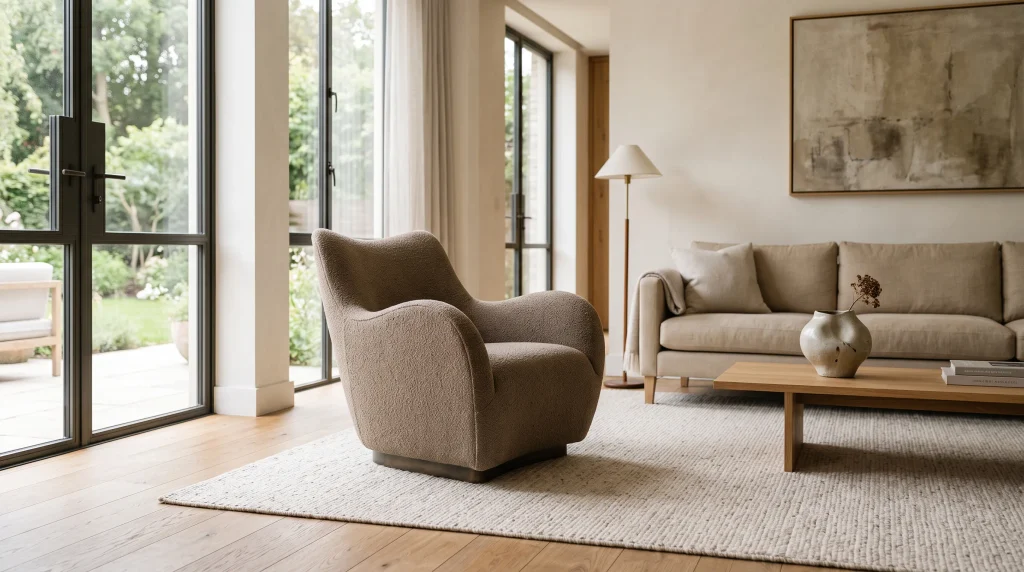
12. Add Sculptural Furniture and Decor
A piece with a genuinely sculptural shape — a curved chair, an abstract side table, a ceramic vessel with an unusual silhouette — gives a modern living room a real point of visual interest, functioning almost like a piece of art that also happens to be furniture. This fits modern design’s general preference for fewer, more considered objects over many small decorative items.
One sculptural piece is usually enough to make its point; a room with several competing sculptural elements can start to feel busy rather than curated, undercutting the very restraint that makes any single piece stand out. Position it somewhere with enough surrounding negative space to actually be seen and appreciated — a sculptural piece crowded next to several other items loses the visual impact it’s meant to have.
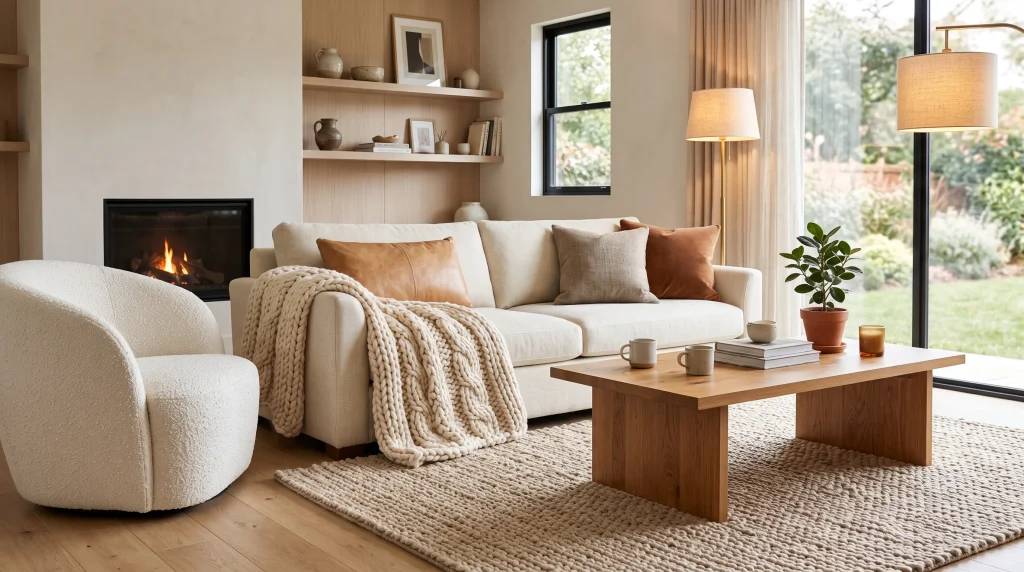
13. Create a Cozy Modern Living Room With Texture
Texture is what separates a cozy modern living room from a cold one, since color and shape alone rarely account for how warm a room actually feels to sit in. Boucle, chunky knit throws, a substantial wool rug, and linen upholstery all bring in tactile variation that smooth, hard modern surfaces don’t provide on their own.
Mix at least three different textures rather than relying on just one — a smooth leather chair, a boucle throw pillow, a woven rug — since that variation is what feels intentionally layered rather than a single soft item dropped into an otherwise hard room. This matters just as much in a fully neutral color scheme as in a more colorful one; texture alone can carry a room’s warmth even without any bold color at all.
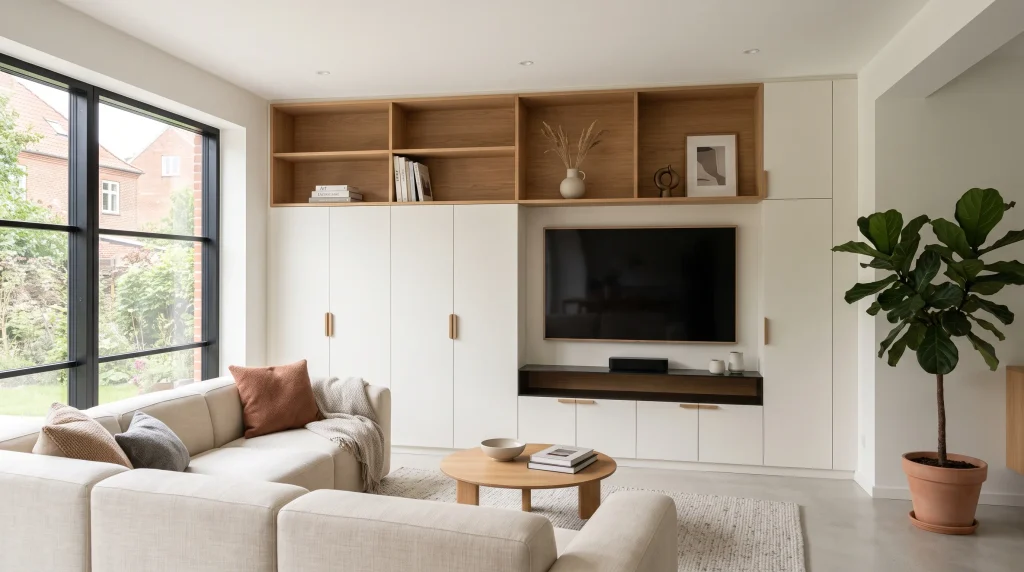
14. Use Built-In Storage to Keep the Room Clutter-Free
Visible clutter undercuts a modern living room’s clean-lined aesthetic faster than almost anything else, which makes built-in or closed storage genuinely important to the style rather than just a nice-to-have. Built-in shelving with closed cabinet sections below and open display space above lets you keep everyday items — remotes, chargers, mail — out of sight while still having room to display a few chosen decor pieces.
A media console with closed storage for electronics and cables does similar work for the room’s main entertainment area, keeping cords and equipment hidden rather than visible. If built-ins aren’t in the budget, a few well-chosen storage baskets or a cabinet with doors, rather than fully open shelving, achieves a similar effect — modern design generally favors storage you don’t see over storage that’s constantly on display.
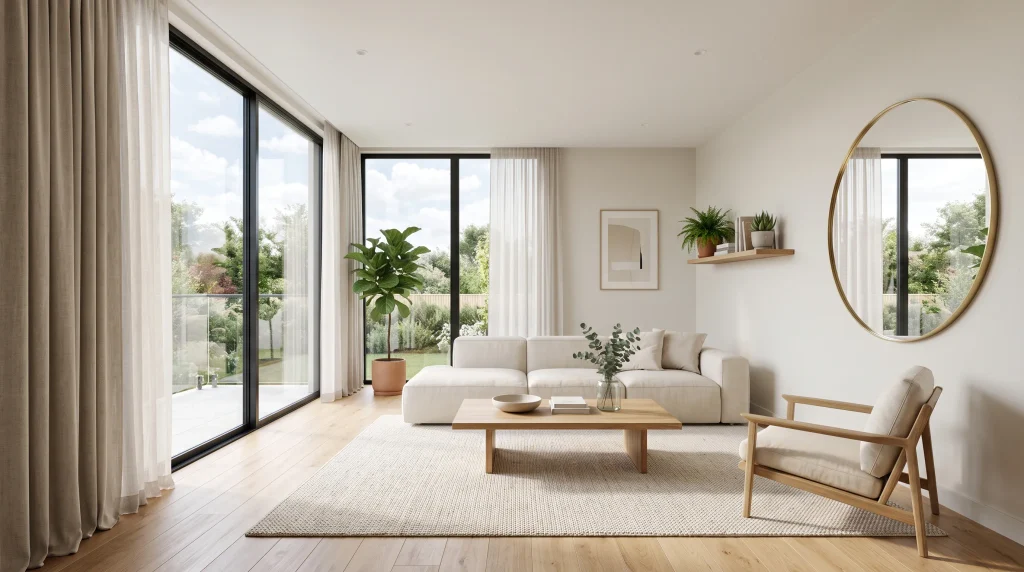
15. Design a Modern Living Room Around Natural Light
Natural light does real decorating work in a modern living room, and the style tends to photograph and feel its best in a bright, sunlit space rather than a dim one. Keeping furniture, especially anything tall, away from windows lets light travel further into the room, and lighter wall colors bounce daylight rather than absorbing it.
Sheer curtains let light filter through during the day while still offering some privacy, and can be paired with a heavier curtain or blind that closes only when needed for full privacy or light control. A large mirror positioned to reflect a window can meaningfully brighten a room that doesn’t get quite enough natural light on its own, which matters more in a modern room than a more traditionally styled one, since the style relies so much on a bright, open feeling to avoid looking sterile.
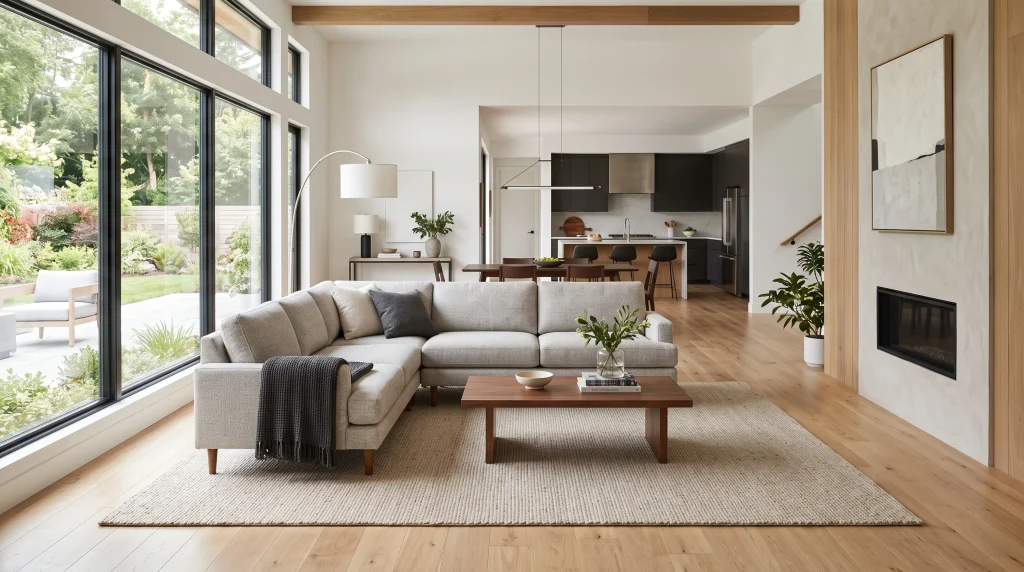
16. Try a Modern Sectional in an Open Layout
In an open-plan living space, a sectional sofa does real work defining the seating area without needing a wall to anchor it, which makes it a particularly good fit for a modern, open-concept layout. The L-shape or U-shape naturally creates a conversation area, even in a room that flows directly into a dining or kitchen space with no physical boundary.
Scale the sectional to the room rather than maximizing size for its own sake — an oversized sectional in a moderately sized open space can dominate the room and block natural walkways, while one sized appropriately still defines the zone without overwhelming it. Positioning the sectional to face the room’s best feature — a fireplace, a window, a piece of art — gives the layout a clear focal point rather than leaving the seating area feeling directionless within a larger open floor.
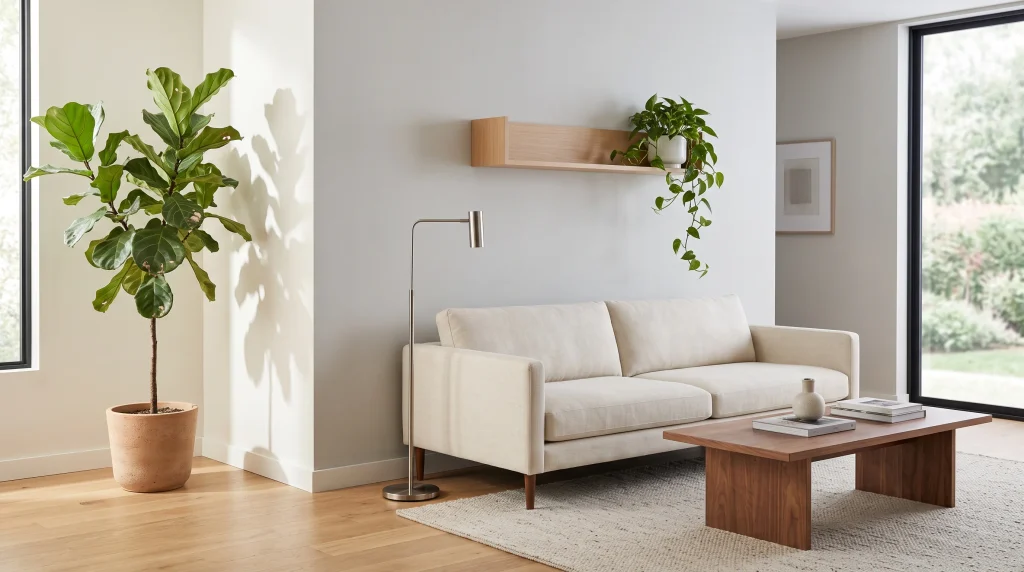
17. Add Greenery Without Overdecorating
Plants bring a genuine sense of life into a modern living room that can otherwise lean heavily on hard, static materials — wood, stone, metal, glass — all of which benefit from something that grows and changes alongside them. One or two substantial plants generally do more for a room than several small pots scattered across different surfaces.
A tall floor plant in an underused corner, or a trailing plant on a high shelf, adds greenery without cluttering the room’s surfaces, which matters in a style built around restraint and clean lines. Match the plant to the room’s actual light conditions rather than what looks best in photos; a struggling plant undercuts a carefully designed room faster than having no plant at all, and a well-made faux option is often the more practical choice in a room with limited natural light.
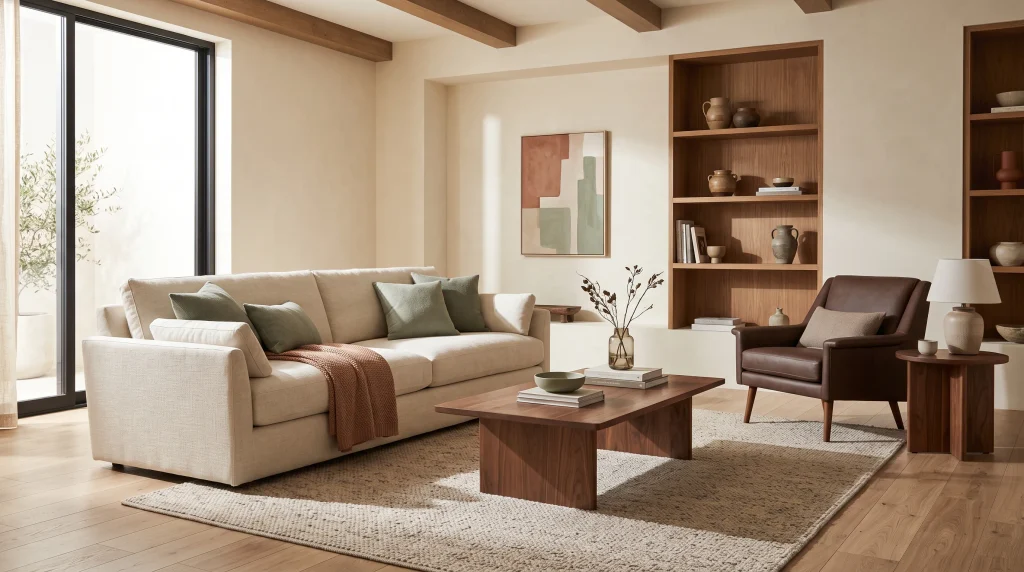
18. Mix Cream, Brown, and Earthy Tones
An earthy palette built from cream, warm brown, and muted tones like sage or clay gives a modern living room genuine warmth while staying within the restrained, cohesive color story the style favors. This combination has become one of the more consistently popular modern color directions because it avoids both the coldness of a stark white-and-gray palette and the visual chaos of a room with too many competing colors.
Layer the tones through upholstery, rug, and wall color rather than concentrating brown entirely in the furniture and cream entirely on the walls — some overlap between the two, through pillows or a throw, ties the palette together more convincingly. One deeper accent, like a rich chocolate brown or a muted terracotta, used sparingly, keeps an otherwise light, earthy room from feeling too uniformly pale.
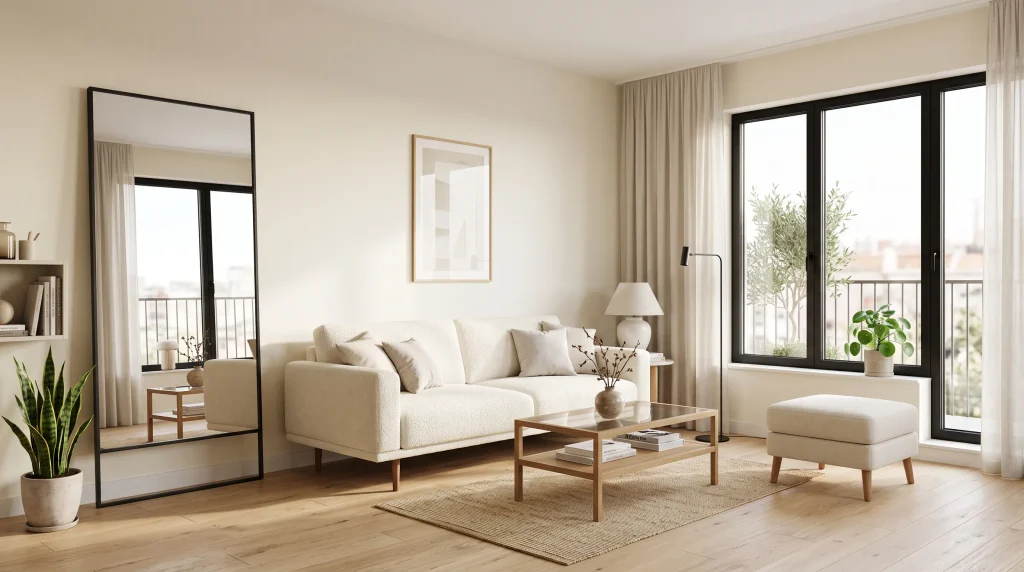
19. Make a Small Living Room Feel More Spacious
A small modern living room benefits from many of the same principles as a small bedroom: furniture with visible legs rather than pieces that sit flush to the floor, a light and cohesive color palette, and multifunctional furniture that does more than one job in a limited footprint — a coffee table with storage, an ottoman that doubles as extra seating.
Keeping the floor as visible as possible matters more in a small room than a large one, since an open floor feels like more space even when the room’s actual square footage hasn’t changed. A large mirror and layered lighting both help too, bouncing light around a room that has less natural light to work with per square foot than a larger space would. Fewer, better-scaled furniture pieces almost always beat several smaller ones crammed into the same footprint.
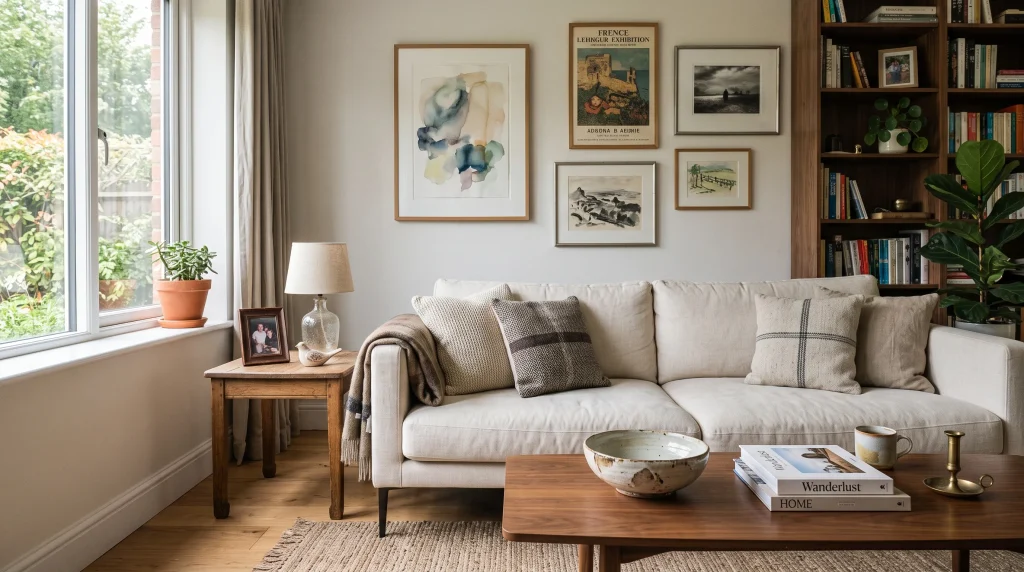
20. Mix Modern and Personal Pieces for a Lived-In Look
The detail that separates a modern living room that feels like a home from one that feels like a showroom is usually personal: a piece of art from an actual trip, a handmade ceramic object, a family piece mixed in among the room’s cleaner-lined furniture. These pieces don’t need to match the room’s palette or style to belong there — their personal significance is what gives them a place.
Rather than furnishing the room entirely from a single modern collection, mix in whatever meaningful objects you actually own, even if they don’t perfectly fit the aesthetic on paper. The slight tension between a mass-produced modern piece and a one-of-a-kind personal object is often what makes a room feel genuinely lived-in rather than staged for a photo, which is the difference most generic “modern living room” advice misses entirely.
How to Make a Living Room Look Modern
Making a living room look modern comes down to a handful of consistent choices working together: clean-lined furniture, a restrained and cohesive color palette, minimal visible clutter, and a few well-chosen statement pieces rather than many small decorative items. Fewer, better-considered pieces almost always feel more modern than a room packed with decor.
Material quality matters as much as shape here — a low-profile sofa in a cheap, flat fabric doesn’t read as modern the way the same silhouette in boucle or a substantial linen does. Start with whichever element is furthest from this direction in your current room, often color palette or visible clutter, and build outward from there with furniture and lighting changes as budget allows.
How to Make a Modern Living Room Cozy
Coziness in a modern living room comes almost entirely from texture and lighting rather than color or furniture shape — a room can be fully modern in its lines and still feel warm if it’s layered with boucle, wool, warm wood, and multiple soft light sources instead of one bright overhead fixture.
Adding at least one substantial soft element — a chunky throw, a textured rug, upholstered seating rather than hard surfaces alone — does more for a modern room’s coziness than almost any other single change. Warm-white lighting and dimmers matter here too, since a bright, cool-toned overhead light works against the relaxed mood a cozy room needs, regardless of how warm the furniture and materials are.
How to Arrange Furniture in a Modern Living Room
Furniture arrangement in a modern living room generally centers on one clear conversation area, anchored by a rug, with seating that faces the room’s best feature — a fireplace, a window, a piece of art, or a media console — rather than furniture scattered without a clear focal point.
Leave enough walking space around the main seating area, generally at least 30 inches for comfortable circulation, so the room doesn’t feel cramped even when the furniture itself is appropriately scaled. In an open-plan space, a sectional or a rug can define the living area’s boundaries without needing a wall, which matters more in modern layouts than in more traditionally divided homes. Floating furniture away from the walls, rather than pushing every piece flush against them, generally creates a more intentional, considered layout than a room where everything hugs the perimeter.
Frequently Asked Questions
How do I make my living room look modern?
Focus on clean-lined furniture, a restrained color palette, and minimal visible clutter, choosing a few well-considered statement pieces rather than filling the room with many small decorative items.
How do I make a modern living room feel cozy instead of cold?
Layer in texture — boucle, wool, warm wood — and multiple warm light sources rather than relying on one overhead fixture; texture and lighting do more for a room’s warmth than color or furniture shape alone.
What colors work best in a modern living room?
Warm neutrals like cream, oatmeal, and taupe work as a base, often paired with earthy accents like sage or terracotta, or a small amount of black for contrast — the key is keeping the palette restrained rather than scattered across many colors.
How do you arrange furniture in a modern living room?
Anchor the seating area with a properly sized rug, orient furniture toward the room’s best feature, and leave enough walking space around the main seating area so the layout doesn’t feel cramped even when scaled appropriately.
What furniture works best for a small modern living room?
Low-profile furniture with visible legs, multifunctional pieces like a storage ottoman, and fewer, better-scaled items generally work better in a small space than many smaller pieces competing for the same limited footprint.
How do you keep a modern living room from feeling sterile?
Add warm materials like wood and stone, layer in texture through textiles, mix in at least one vintage or personal piece, and use warm lighting rather than relying entirely on cool-toned, bright overhead light.
What is organic modern design?
Organic modern softens a fully contemporary room’s sharp lines with curved furniture, natural materials, and irregular, hand-crafted-feeling shapes, keeping modern’s clean sensibility while removing some of its rigidity.
Final Thoughts
A modern living room reads as warm rather than cold when it leans on real texture, natural materials, and a few personal or vintage pieces rather than relying on clean lines alone to do all the work. Start with whichever design here solves the actual problem your room has — coldness, clutter, poor lighting, or a layout that doesn’t quite work — and build outward from there. The rooms that feel the most successfully modern are almost never the most minimal or the most matched; they’re the ones with enough warmth and personality layered into a clean, considered structure.