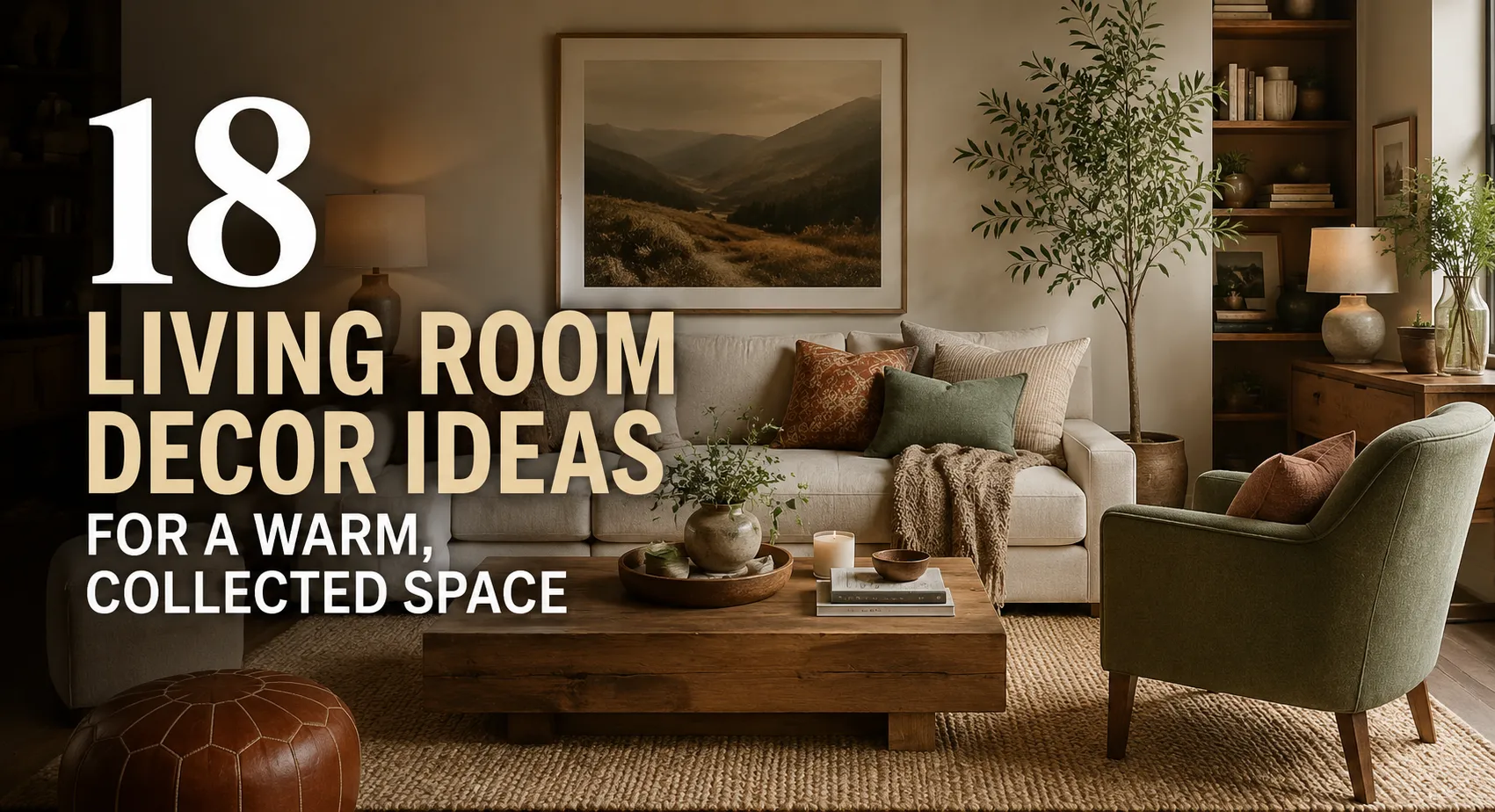
18 Living Room Decor Ideas for a Warm, Collected Space
A living room that feels flat usually isn’t missing decor — it’s missing layers. Color alone, or furniture alone, rarely makes a room feel inviting; it’s the combination of texture, light, scale, and a few personal touches working together that turns a functional space into somewhere people actually want to sit.
The eighteen ideas below cover color, furniture, texture, lighting, and layout, and each one goes beyond “add this” to explain why it works, how to actually use it, and the trade-off worth knowing before you commit. Work through the ones that solve the specific problem your room has — whether that’s feeling cold, cluttered, boring, or just a little disconnected — rather than trying to apply all eighteen at once.
18 Living Room Decor Ideas
1. Layer a Neutral Color Palette
A neutral palette — warm white, cream, taupe, soft gray — gives a living room a calm, cohesive base that almost any furniture or decor style can sit on top of comfortably. It works because it keeps the eye from bouncing between competing colors, letting texture and shape carry more of the room’s visual interest instead.
The trick is layering, not flattening: use two or three related neutral tones rather than one single shade everywhere, so the walls, sofa, and rug feel related but not identical. If your room already leans neutral and feels a little flat, the fix usually isn’t more color — it’s more variation in tone and texture within the neutral family you’ve already got.
2. Add Warmth With Natural Wood
Warm oak, walnut, or reclaimed wood softens a living room the way almost nothing else can, especially in a space with a lot of hard surfaces like tile floors, glass, or metal furniture. Wood introduces grain and natural imperfection, which keeps a clean, modern room from feeling sterile.
You don’t need to fill the room with wood furniture — one substantial piece, a coffee table or a media console, does more than several smaller wood accents scattered around. The mistake to avoid is mixing too many different wood tones in the same sightline; keep new wood pieces in a similar warm family to whatever’s already in the room, or the mix starts to look accidental rather than intentional.
3. Make the Sofa the Starting Point
The sofa is almost always the largest piece in a living room, and it makes sense to choose or arrange everything else around it rather than treating it as one item among equals. Its scale, color, and fabric set the tone the rest of the room either supports or fights against.
If you’re not replacing the sofa, work with what you already have — a slipcover, a few well-chosen pillows, or simply reorienting it toward the room’s best feature can change how the whole space feels without a full furniture swap. A sofa pushed flush against the wall in a room with enough square footage to float it slightly can look more like an afterthought than an anchor; a few inches of breathing room behind it often comes across as more intentional.
4. Anchor With a Large Rug
A rug that’s too small is one of the most common living room mistakes, and it undercuts furniture arrangements that are otherwise perfectly reasonable — pieces end up looking disconnected rather than grouped into a cohesive seating area. The front legs of the main seating pieces should sit on the rug for the room to feel properly anchored.
Texture and color matter here too: a natural-fiber or wool rug in a warm neutral tone grounds the room while adding real warmth underfoot, more so than a flat synthetic rug in stark white or gray. In a small room, a rug sized appropriately for the actual seating area, rather than scaled down to “fit” the room, still does its job better than an undersized one squeezed to leave more visible floor.
5. Add an Accent Chair
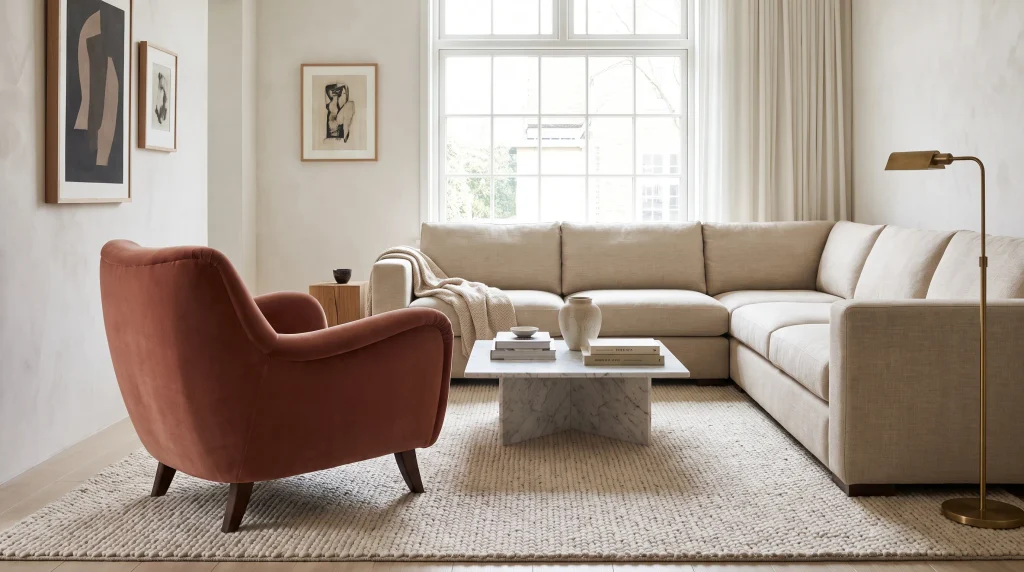
An accent chair gives a living room a second seat with real personality, and it’s often the easiest place to introduce a bolder color, pattern, or texture without committing the whole room to it. A single chair in a rich color or an interesting shape can do more for a room’s character than several smaller decor changes combined.
Position it to actually support conversation — angled toward the sofa rather than facing away into a corner — so it functions as real seating rather than a decorative object nobody sits in. If your room already has a fairly bold sofa or rug, keep the accent chair simpler; it’s the contrast between one expressive piece and a calmer supporting cast that comes across as considered, not multiple loud pieces competing for attention.
6. Use Throw Pillows to Add Texture and Color
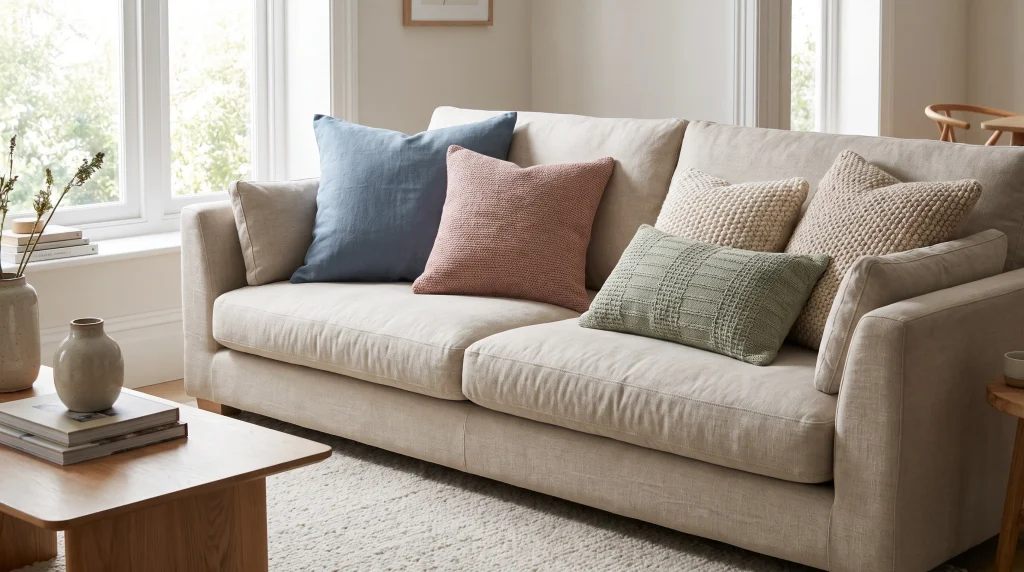
Throw pillows are the lowest-cost, most flexible way to introduce texture, pattern, or seasonal color into a living room, since they’re easy to swap out without committing to anything permanent. A mix of sizes and at least two different textures — a smooth linen alongside a chunkier knit — does more for the sofa’s visual depth than several pillows in the same fabric.
A little goes a long way here: three to five pillows generally feels intentional, while a sofa buried under a dozen can tip into cluttered rather than cozy. If the room already has a patterned rug or artwork, keep the pillows more solid and textural rather than adding another competing pattern into the same sightline.
7. Hang Oversized Artwork
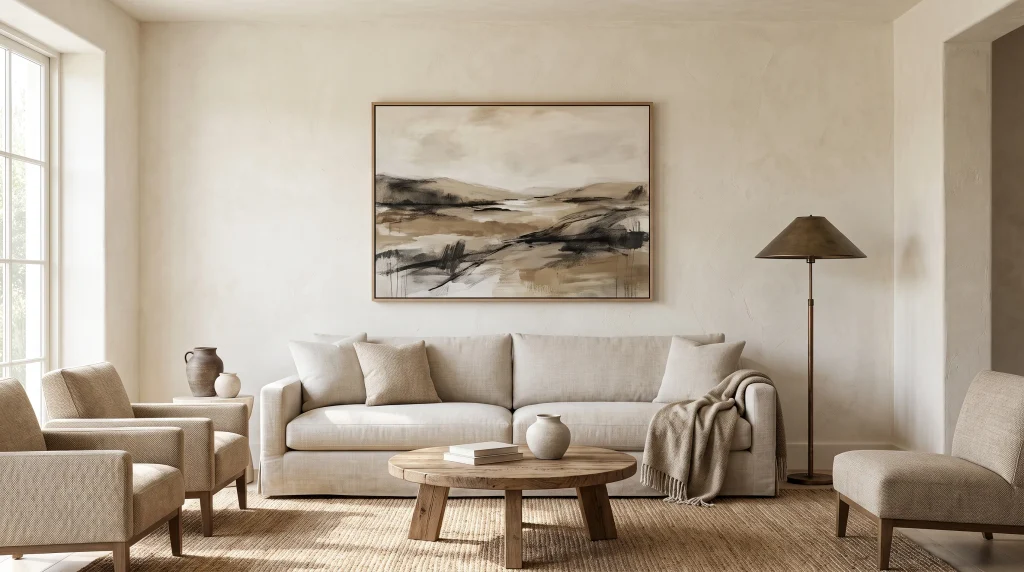
A single large piece of art does more for a living room’s wall than several small framed prints scattered across the same space, and it fits the general design principle that fewer, more considered choices feel more intentional than a busy collection. As a rough guide, art hung above a sofa should span roughly two-thirds of the sofa’s width to look properly scaled.
This is one of the easiest ways to fill an empty wall without overcomplicating it — one striking piece, hung at the right height, gives the eye a clear focal point instead of leaving the wall feeling unfinished. If you’re drawn to multiple pieces, a diptych or triptych comes across as one cohesive statement rather than a scattered arrangement, while still giving you more visual space than a single canvas.
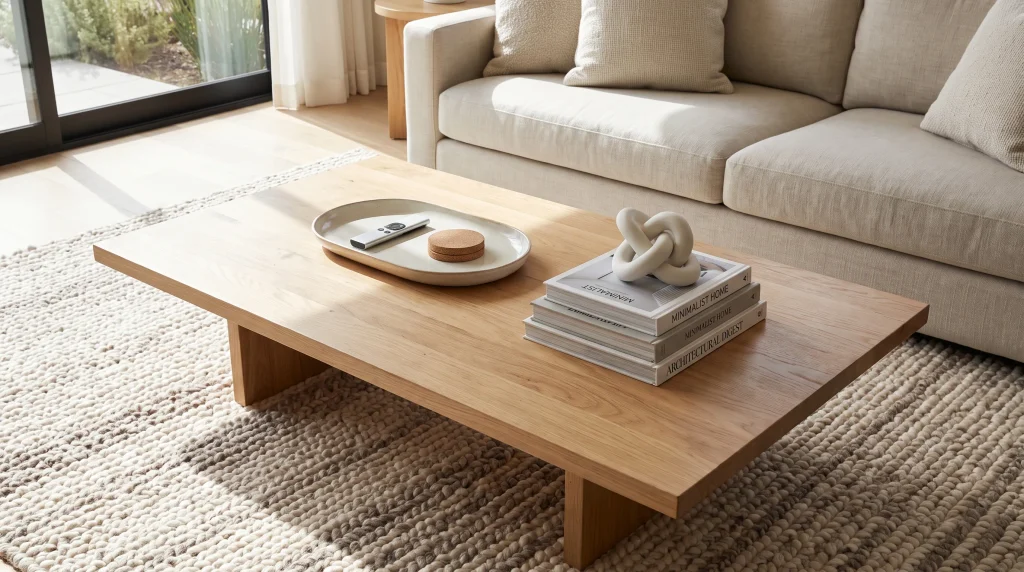
8. Style the Coffee Table With Intention
A coffee table covered in remote controls and mail undercuts an otherwise well-designed room fast, since it sits at the visual center of the whole seating area. Styling it doesn’t need to be elaborate — a stack of books, a tray for everyday items, one small decorative object, and a bit of open space is usually enough.
The trick is leaving genuine negative space rather than filling every inch of the surface; a coffee table styled at about seventy percent capacity looks more curated than one packed edge to edge. A tray is worth the small investment here specifically, since it contains the inevitable functional clutter — coasters, a remote — without it spreading across the whole surface.
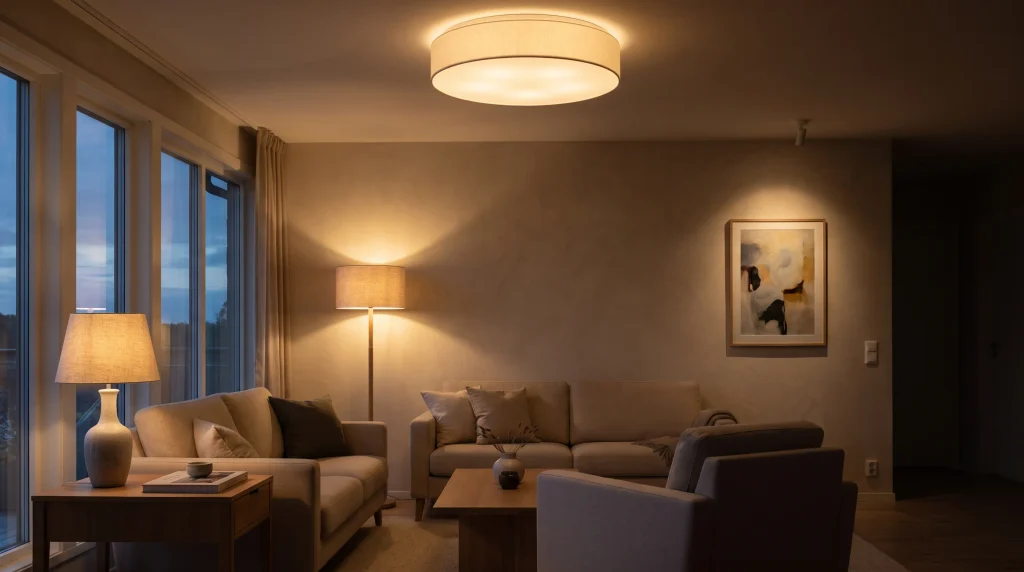
9. Layer Living Room Lighting
A living room lit by one overhead fixture, however nice, tends to feel flat and a little institutional once the sun goes down. Layering ambient, task, and accent lighting — the overhead fixture, a floor lamp, a table lamp, maybe a picture light — creates depth that a single light source simply can’t.
Warm-white bulbs generally soften the room in the evening far more effectively than cool-white ones, which can make even a beautifully decorated space feel closer to an office. Dimmers are worth prioritizing wherever the budget allows, since they let the room shift from bright and functional during the day to warm and relaxed at night without needing a separate set of lamps for each mood.
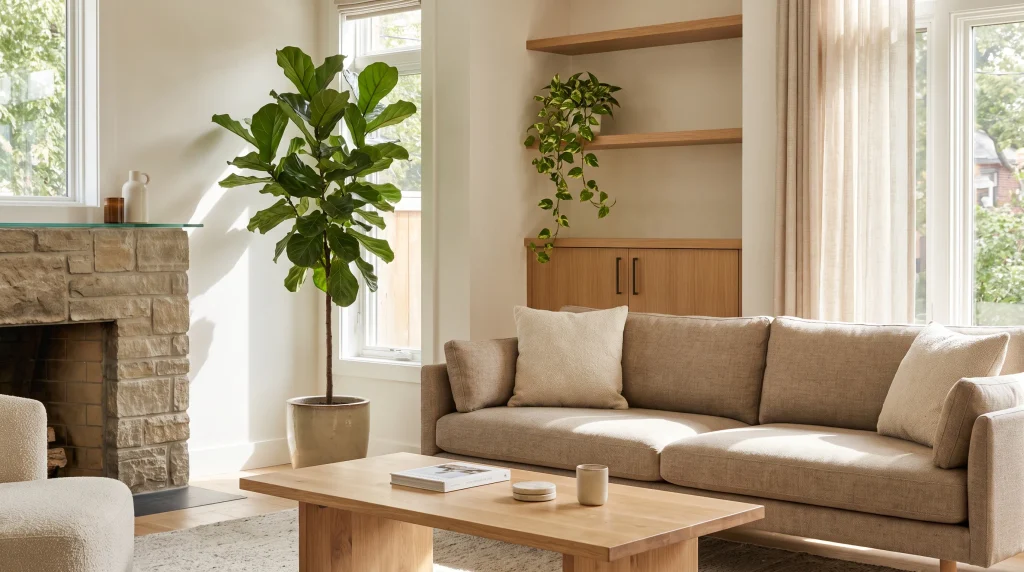
10. Bring in Greenery
Plants add a sense of life to a living room that static decor can’t replicate, and even one or two well-placed plants can soften a room full of harder surfaces — wood, stone, glass — considerably. A tall floor plant in an underused corner or a trailing plant on a high shelf both work without cluttering the room’s surfaces.
Choose plants according to the actual light in the room, not just what looks good in inspiration photos — a low-light space will keep a pothos or snake plant alive far more reliably than something that needs bright, direct sun. A struggling plant undercuts a well-designed room faster than having no plant at all, so a well-made faux option is a reasonable substitute in a room with truly limited natural light.
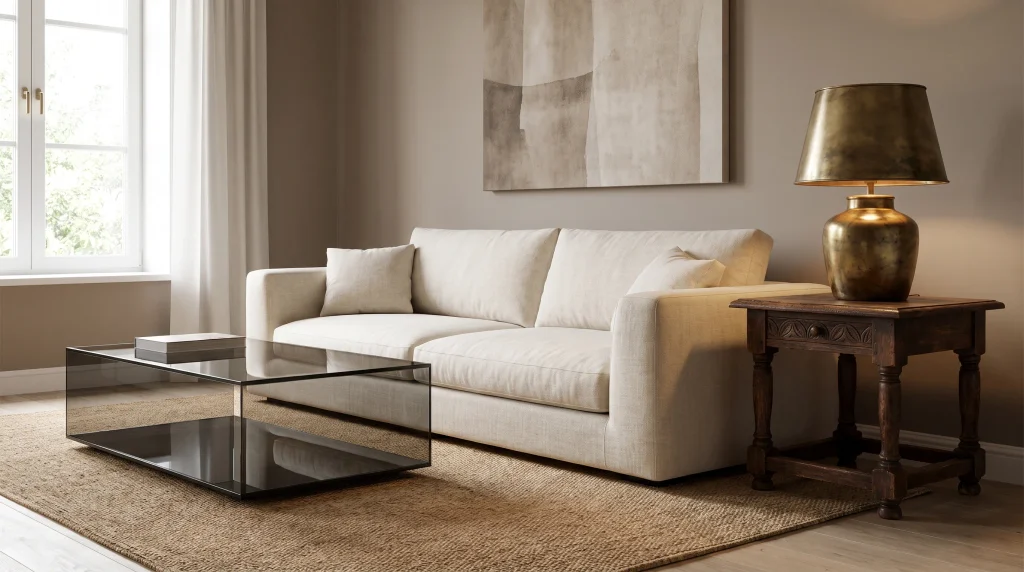
11. Mix Modern and Vintage Furniture
A living room furnished entirely from one collection can start to feel like a showroom rather than an actual home, which is where a vintage or secondhand piece earns its place — an older wood side table, a vintage brass lamp, mixed in among newer furniture. The contrast is the point, not something to smooth over.
This works especially well when the vintage piece has real material character — visible wood grain, natural wear, an interesting original detail — rather than something that just looks generically old. Keep it loosely compatible with the rest of the room’s tone; a warm wood vintage piece generally blends more easily into a mostly neutral room than something ornately carved or heavily finished.
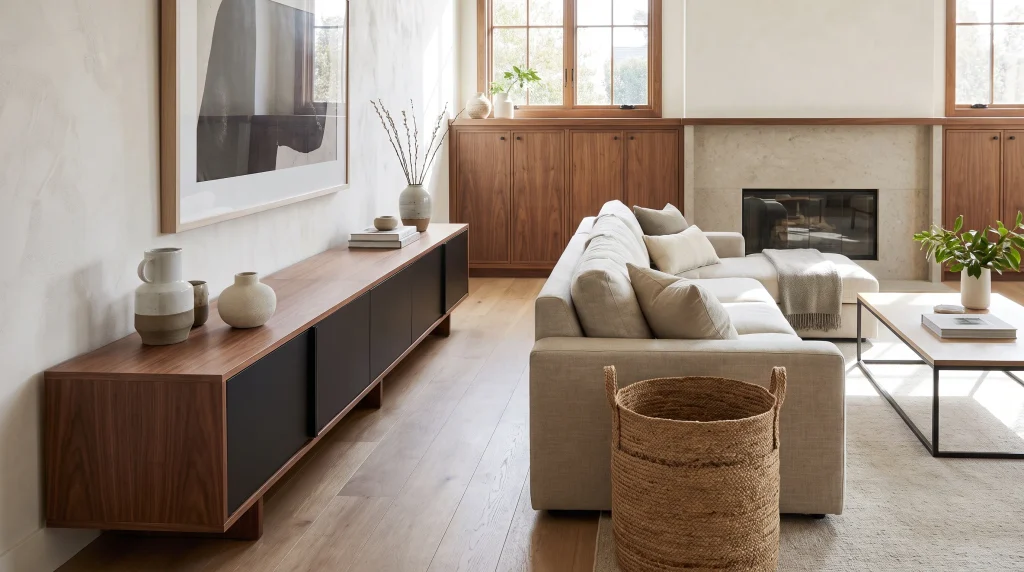
12. Add Closed Storage to Reduce Clutter
Visible clutter undercuts even a beautifully decorated living room faster than almost anything else, which makes closed storage worth prioritizing rather than treating it as an afterthought. A media console with doors, a storage ottoman, or a cabinet with closed shelving lets you keep everyday items — chargers, remotes, mail — out of sight while still displaying a few chosen decor pieces.
The goal isn’t hiding everything; it’s giving frequently used items a specific home so they’re not accumulating on open surfaces. If built-in storage isn’t in the budget, a few matching closed baskets on open shelving achieve a similar effect for a fraction of the cost, combining open and closed storage rather than relying entirely on one or the other.
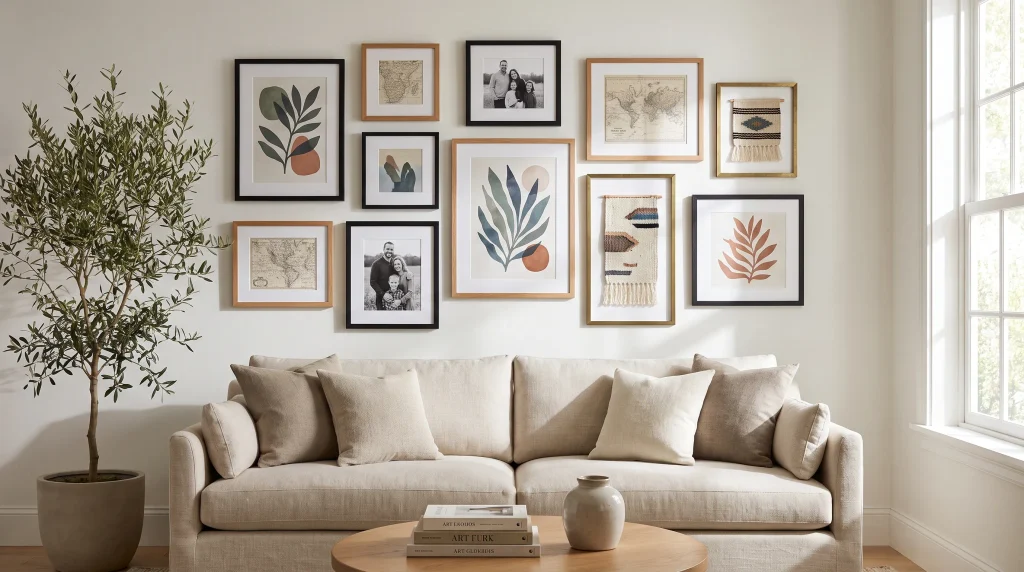
13. Create a Gallery Wall
A gallery wall gives an empty wall real personality and works particularly well when you have several smaller pieces of art, photos, or objects you want to display together rather than choosing just one. Unlike a single oversized piece, it lets you tell a more layered story across the wall.
Plan the layout on the floor before hanging anything, and keep consistent spacing — roughly two to three inches between frames generally looks intentional rather than crowded. Mixing frame sizes and a couple of different frame finishes looks more collected than an entirely matched set, though it’s worth keeping at least one unifying element, like a shared color palette across the mats or frames, so the wall doesn’t feel entirely random.
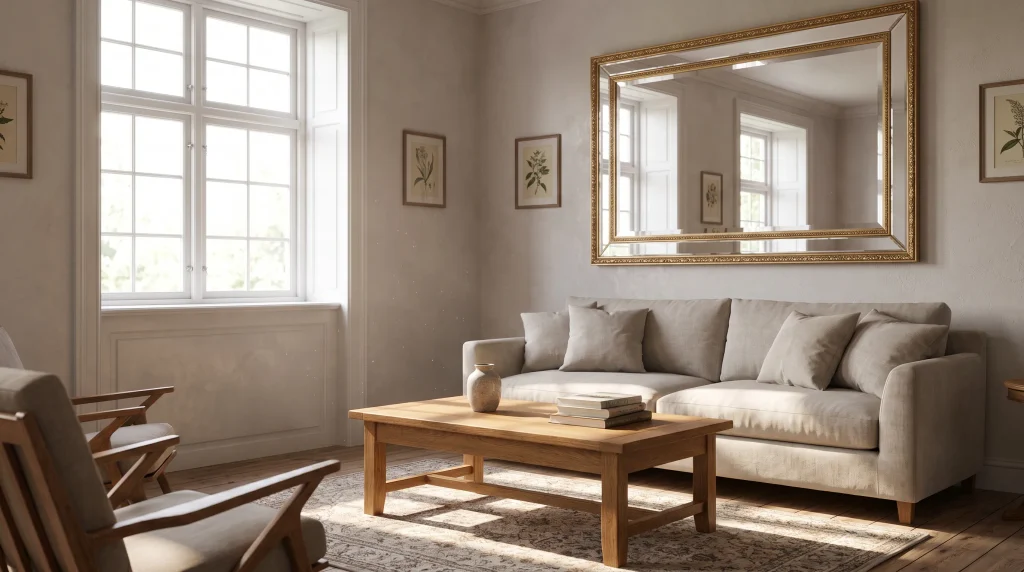
14. Use Mirrors to Add Light and Depth
A mirror does real functional work in a living room beyond decoration — positioned to reflect a window, it bounces natural light further into the room and can make even a modestly sized space feel more open. A large, well-placed mirror often does more for a room’s brightness than an additional lamp would.
Placement matters more than size here: a mirror facing a blank wall does very little for the room’s light, while the same mirror angled toward a window meaningfully brightens the space. In a smaller living room especially, one substantial mirror generally has more impact than several small decorative ones scattered around.
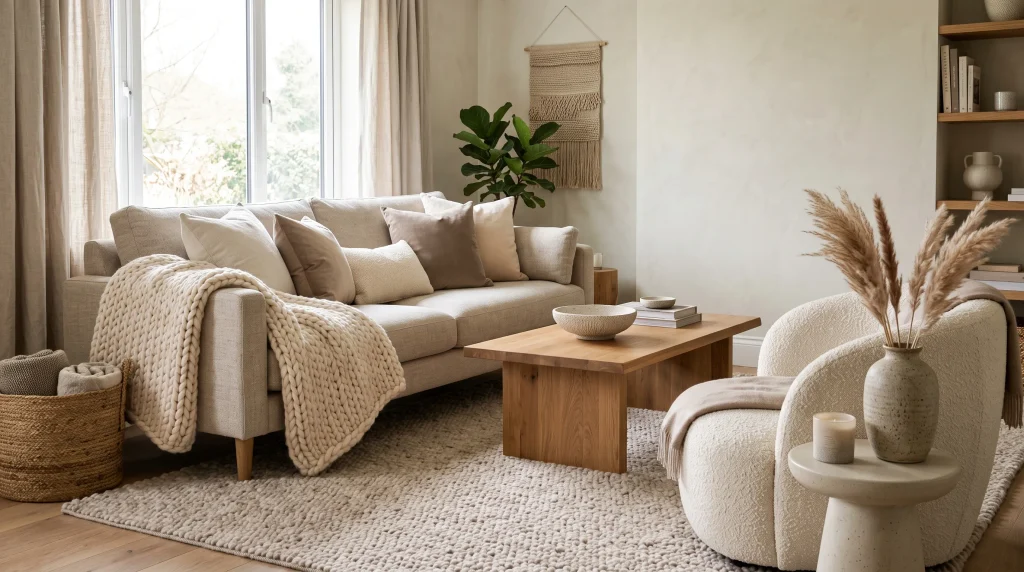
15. Add Soft Textures Throughout the Room
Texture is often what separates a living room that feels genuinely inviting from one that just looks nice in photos — a room built entirely from smooth, hard surfaces can look fine but feel a little flat to actually sit in. Linen, wool, boucle, and a chunky knit throw all soften hard surfaces and add real tactile depth.
Mix at least two or three different textures rather than relying on just one, since that variation is what makes a room feel layered instead of a single soft item dropped into an otherwise hard space. This matters as much in a fully neutral room as a colorful one — texture alone can carry a lot of a room’s warmth even without any bold color at all.
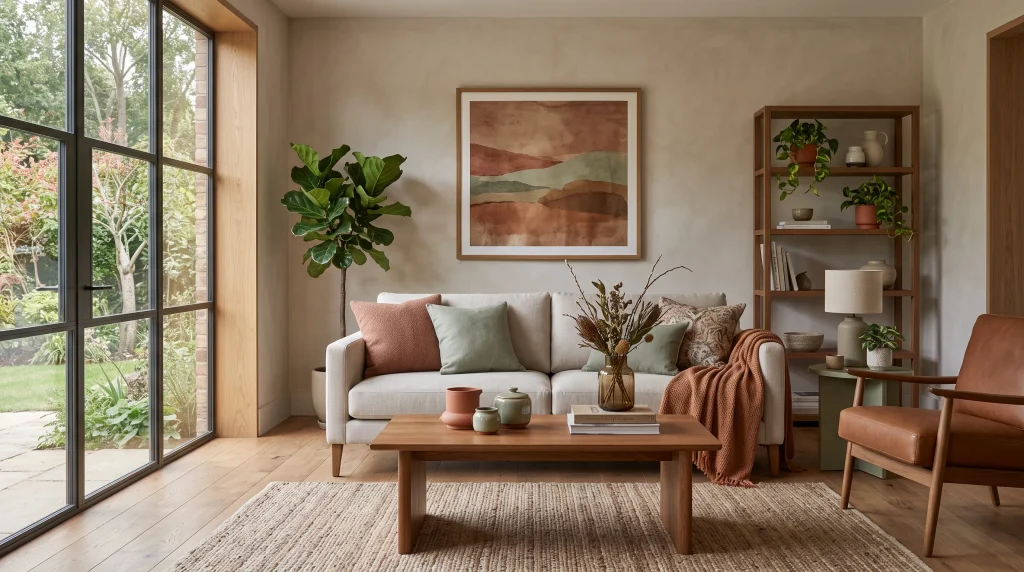
16. Try Earthy Colors for Warmth
If a fully neutral room feels a little flat, earthy accent colors — terracotta, sage, warm brown, muted clay — add depth without pulling the room away from a cohesive, calming palette. These tones read as pulled from nature rather than a paint chip, which keeps them feeling grounded even when used with some boldness.
Introduce earthy colors through smaller, easily changed items first — pillows, a throw, a piece of art — before committing to a full accent wall, since it’s a lower-risk way to test whether the tone actually suits your room’s light and existing furniture. One or two colors used consistently across a couple of items looks more intentional than several different earthy tones each appearing once.
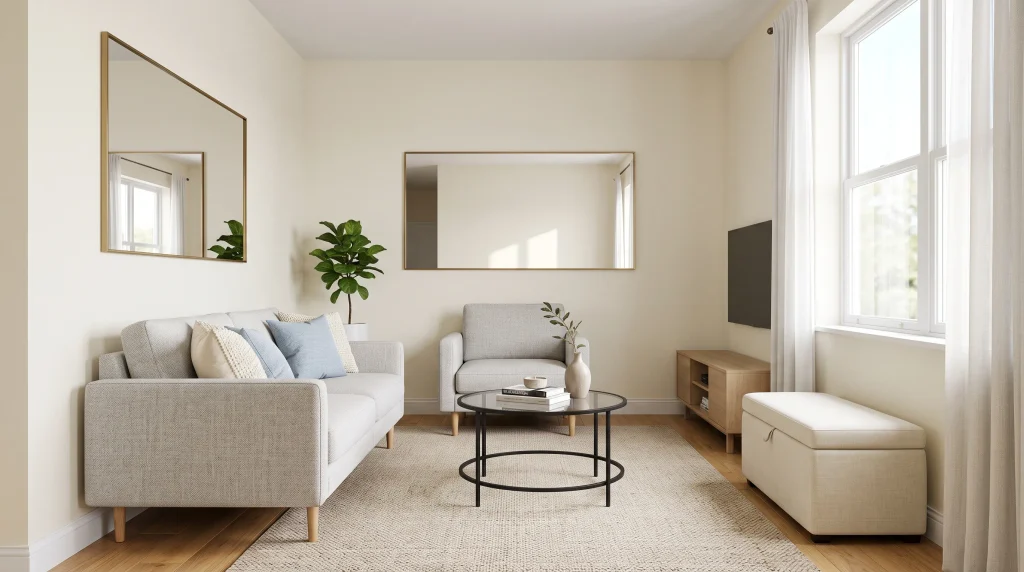
17. Make a Small Living Room Feel Bigger
A small living room benefits from furniture with visible legs rather than pieces that sit flush to the floor, since visible floor space reads as more room even when the actual square footage hasn’t changed. Multifunctional furniture — a storage ottoman, a coffee table with a shelf — also matters more here than in a larger space, where every piece has to earn its footprint.
Keeping the color palette light and cohesive, rather than introducing several bold colors, helps a small room feel more open. A large mirror and layered lighting both help too, bouncing available light around a room that has less of it per square foot than a bigger space would. Fewer, better-scaled pieces almost always beat several smaller ones crammed into the same footprint.
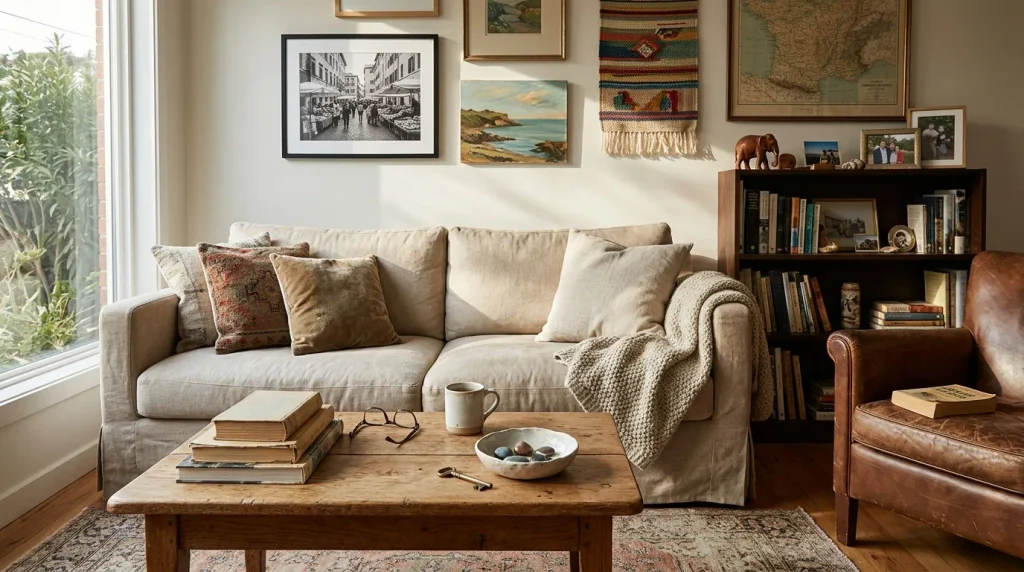
18. Add Personal Pieces for a Lived-In Feel
The detail that separates a living room that feels like a home from one that feels staged is almost always personal — a piece of art from an actual trip, a handmade object, something with real history rather than bought purely to complete a look. These pieces don’t need to match the room’s palette to belong there.
Rather than furnishing the room entirely from one collection or one store, mix in whatever meaningful objects you actually own, even if they don’t perfectly fit the aesthetic on paper. That’s genuinely the detail most generic “living room ideas” content misses — the room that feels most inviting is rarely the most perfectly coordinated one; it’s the one that feels collected and unmistakably yours.
How to Decorate a Living Room
Decorating a living room well comes down to layering a handful of elements rather than making one dramatic change: a cohesive color palette, furniture scaled properly to the room, texture through textiles and materials, layered lighting, and a few personal pieces mixed in among everything else.
Before buying anything new, it’s worth working with what you already have — rearranging furniture, swapping pillow covers, adding a lamp — since a surprising amount of a room’s feel comes from arrangement and lighting rather than new purchases. Start with whichever element is missing most obviously, often lighting or texture, and build outward from there.
How to Make a Living Room Cozy
Coziness in a living room comes almost entirely from texture and warm lighting rather than color or furniture style alone — a room can be quite minimal in its shapes and still feel cozy if it’s layered with soft textiles and multiple warm light sources instead of one bright overhead fixture.
Adding at least one substantial soft element — a chunky throw, a textured rug, upholstered seating — does more for a room’s coziness than almost any single decor purchase. A warm color in the palette, even just as an accent, and dimmable lighting for the evening round out the formula; none of these elements does the job alone, but combined they reliably make a room feel warmer.
Small Living Room Decor Ideas
A small living room needs the same warmth and layering as a larger one, just applied with more attention to scale — furniture that’s appropriately sized rather than scaled down to the point of looking sparse, and fewer, more considered decor pieces rather than many small ones competing for limited wall and surface space.
Vertical storage, wall-mounted shelving, and multifunctional furniture matter more here, since floor space is the scarcest resource in a small room. A light, cohesive color palette and a well-placed mirror both help the space feel more open, and keeping walking paths clear — rather than pushing furniture into every available corner — does more for how spacious a small living room feels than any single decor choice.
Living Room Decor on a Budget
Several of the highest-impact changes in this list cost very little. Rearranging furniture to create a proper conversation area, swapping in warmer lightbulbs, and decluttering visible surfaces are all free or nearly free, and they genuinely change how a room feels without a single purchase.
When there is a budget to spend, concentrating it on one or two higher-impact pieces — a good rug, a substantial piece of art — tends to do more than spreading it across many small decor items. Secondhand furniture is worth prioritizing too, especially for anything with real material character, since a solid vintage piece often costs less than a comparable new item while adding more warmth to the room.
Frequently Asked Questions
How do I decorate a living room?
Layer a cohesive color palette, properly scaled furniture, texture through textiles, and layered lighting, then add a few personal pieces — the combination of these elements matters more than any single decor purchase.
How do I make my living room cozy?
Prioritize texture — throws, textured pillows, a substantial rug — and warm, layered lighting over a single overhead fixture; these two changes do more for coziness than color or furniture style alone.
How do I make a living room look more expensive?
Focus on scale and restraint: one well-chosen large piece of art or a properly sized rug generally has more impact than several smaller decor purchases at the same combined cost.
How do I arrange living room furniture?
Anchor the seating area with a properly sized rug, orient furniture toward the room’s focal point, and keep walking paths clear rather than pushing every piece against the walls.
How can I make a small living room look bigger?
Choose furniture with visible legs, keep the color palette light and cohesive, and use a large mirror to bounce available light around the room rather than filling every surface with decor.
How do I decorate an empty living room wall?
One large piece of art, sized to roughly two-thirds the width of the furniture below it, generally fills a wall more effectively than several small prints, unless you’re specifically building a gallery wall.
How do I choose a living room rug?
Size it so the front legs of your main seating pieces sit on it, and choose a texture and tone that complements rather than competes with your existing furniture and any other patterns in the room.
Final Thoughts
A living room comes together through layers, not a single big change — color, texture, light, and a few personal pieces working together to make the space feel warm and considered rather than staged. Start with whichever problem your room actually has, whether that’s feeling cold, cluttered, or a little impersonal, and build outward from there. The rooms that feel the most inviting are rarely the most perfectly matched; they’re the ones that feel collected, a little imperfect, and unmistakably lived-in.