
10+ Small Bedroom Storage Solutions That Make Every Inch Count
Most small bedrooms aren’t actually short on storage potential — they’re short on storage that’s been noticed. The floor is spoken for the moment the bed goes in, but the wall above the headboard, the six inches under the frame, the back of the door, and the dead air above the wardrobe are usually sitting completely empty. Once those spots start counting as storage instead of blank space, a cramped room can hold a lot more than it first appears to.
That’s the angle behind the eleven ideas below: not “buy more bins,” but “look somewhere you haven’t looked yet.” A few of these solve the same underlying problem from different angles — under-bed storage and a storage bed frame both work with the space beneath the mattress, for instance — so you won’t need all eleven in one room. Each section covers not just what to do, but the specific measurements, trade-offs, and situations (renting versus owning, budget versus splurge, closet versus no closet) that change how you’d actually apply it, so you can figure out which ones genuinely fit your room instead of guessing.
10+ Small Bedroom Storage Solutions
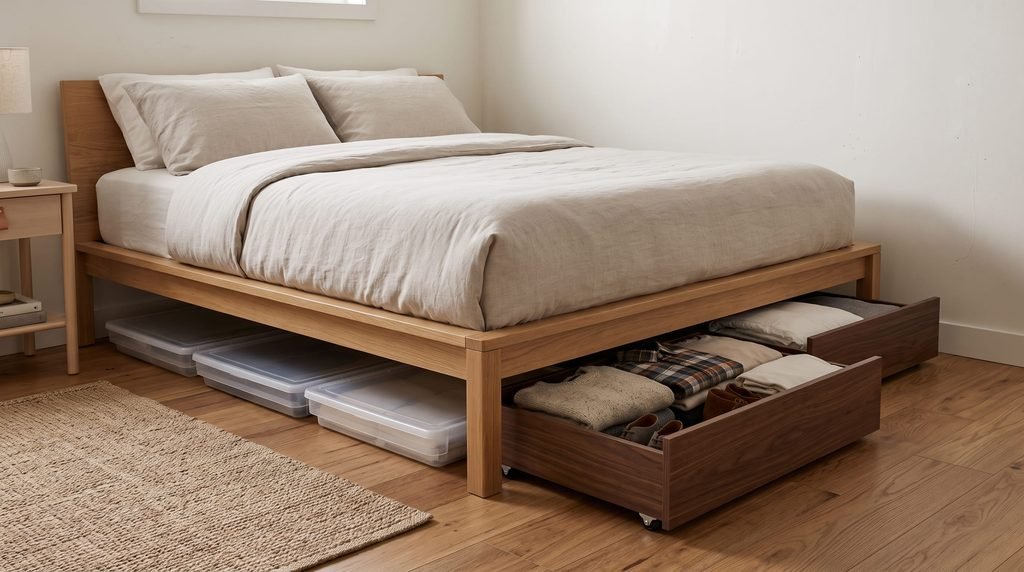
1. Turn the Space Under Your Bed Into Storage
The floor beneath a bed frame is one of the biggest single storage areas in most bedrooms, and it’s almost always sitting empty. Low-profile bins, flat rolling drawers, or a platform bed built with storage in mind can take off-season clothing, spare bedding, or shoes completely out of the room’s visible footprint — often 15 to 20 square feet of usable space that most people never touch.
Clearance is the first thing to check, and it varies more than people expect. A standard bed frame with a box spring often only clears six to eight inches, which limits you to flat, low-profile bins — the kind sold specifically as “under-bed storage” rather than general storage totes, which usually stand too tall. A platform bed without a box spring sometimes clears more, closer to ten to twelve inches, which opens up rolling drawer units with real depth. If you’re not sure what your frame allows, measure before you buy anything; a bin that’s an inch too tall is a wasted purchase.
Bed risers are the cheap fix if the frame itself isn’t going anywhere — they slide under each leg and typically add two to five inches of height, which is often the difference between “nothing fits under there” and a proper storage bin sliding in with room to spare.
They work on most standard frames, though a few designs with very thin or angled legs aren’t compatible, so it’s worth checking the leg shape first. For what to actually store under there: off-season clothing and shoes hold up fine long-term, but anything you need weekly — like everyday shoes — is worth keeping in a bin with a lid you can open without pulling the whole thing out, or you’ll stop using the system within a month.
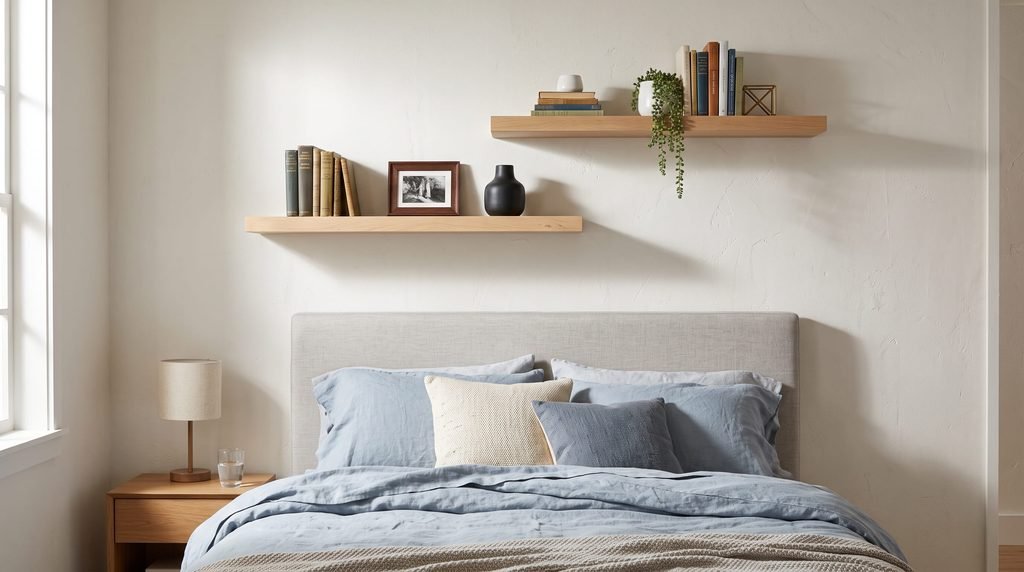
2. Add Floating Shelves Above the Bed
The wall above a headboard does almost nothing in most bedrooms beyond holding up a piece of art. A couple of floating shelves there put that space to work — books, baskets, small display objects — without touching the floor or crowding the nightstands on either side.
Depth and placement both matter more than people expect before ordering. Shelves that stick out past six to eight inches can start to feel like they’re hovering over the bed, both visually and as a practical safety consideration if anyone sits up quickly — keep the lowest shelf at least 12 to 16 inches above the top of the headboard. Weight capacity is worth checking too: most floating shelves are rated for a specific load, and stacking hardcover books on a shelf rated for light decor is how they eventually sag or pull loose. Installation into a stud, rather than just drywall anchors, matters even more here since the shelf sits directly above where someone sleeps.
Two or three shelves staggered at slightly different heights, instead of one long uniform shelf, tends to look more deliberate and gives more flexibility for mixing taller and shorter items — a stack of books on one, a small plant or lamp on another. If you’re renting and can’t drill, a slim wall-mounted rail system with hooks, or a leaning ladder shelf that doesn’t require anchoring into the wall, gets you a version of the same vertical storage without any permanent installation.
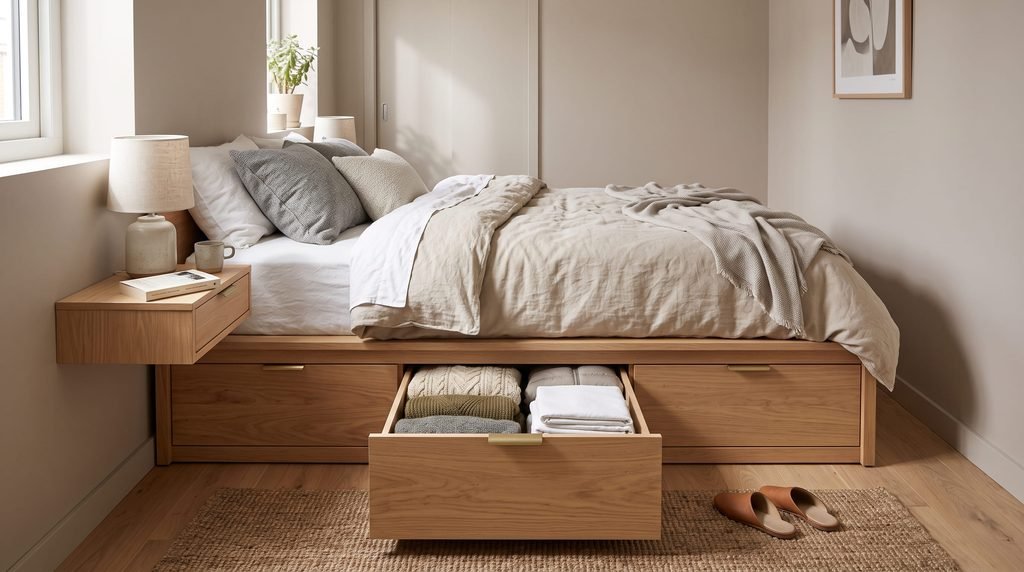
3. Choose a Bed With Built-In Drawers
A platform bed with drawers in the base gets you the same storage as under-bed bins, minus the part where you’re on your knees dragging a container out from under the frame. For a truly tight bedroom, this is one of the higher-value furniture purchases you can make, since it can effectively replace a dresser rather than just supplement one — a real consideration if the room doesn’t have space for both.
Not every storage bed is built the same way, and the differences actually matter for a small room. Some have two drawers on one long side only, which is fine against a wall but means you lose access entirely if that side faces the wall. Others have drawers on both sides, or at the foot of the bed instead of the sides — worth choosing based on how the bed will actually sit in your specific layout, not just what looks good in a product photo.
Before buying, check there’s enough clearance in front of the drawer side to actually pull them open fully; a bed with 18 inches of drawer clearance needed but only 12 inches of floor space to the nearest wall or dresser means the drawers physically can’t open all the way.
Capacity-wise, a storage bed typically holds noticeably less per drawer than a real dresser drawer, since bed drawers are wide but shallow to clear the frame. That makes them better suited to folded items — sweaters, extra sheets, off-season clothes — than to anything you’re hanging or that needs more vertical room. If your storage needs lean more toward hanging clothes than folded ones, this solves a different problem than a wardrobe would, and it’s worth being honest about that before assuming one storage bed replaces your entire dresser and closet setup.
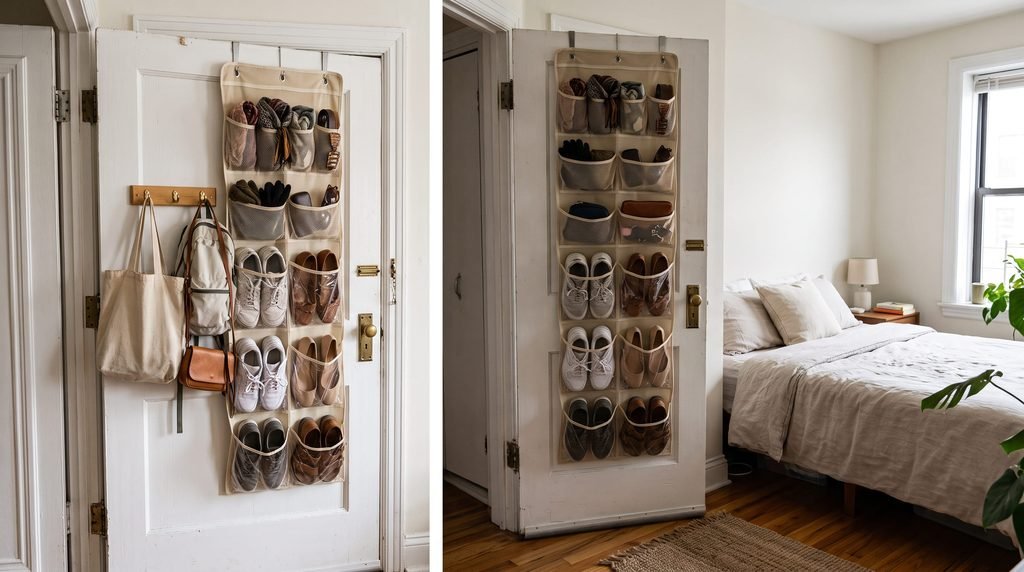
4. Use the Back of Your Bedroom Door
The back of a bedroom door gets overlooked constantly, mostly because nobody thinks to shop “for the back of a door” specifically. An over-the-door organizer, a row of hooks, or a hanging shoe rack turns that space into real storage without touching the floor or a single shelf.
The options split by what you’re storing. Over-the-door shoe organizers with clear pockets typically hold 12 to 24 pairs and work well for shoes, but they’re also genuinely useful repurposed for small accessories, rolled scarves, or even cleaning supplies if shoes aren’t the issue in your room. A simple row of adhesive or over-the-door hooks handles bags, robes, and jewelry with less bulk than a full organizer, and takes up almost no visual space. For heavier use — coats, towels — a proper over-the-door hook rack with a mounting bracket holds more weight than adhesive versions, which tend to peel under sustained load.
It’s a solid option for renters in particular, since most of this hardware needs no drilling and comes off cleanly when the lease ends — check that any adhesive hooks are rated for the door’s actual finish, since painted wood, hollow-core doors, and finished veneer all hold adhesive differently. Don’t stop at the main door, either — a closet door works just as well and gets skipped even more often. One thing to watch for: a door that swings into a tight space can make a bulky organizer awkward to live with day to day, so measure the swing clearance before hanging anything with real depth to it.
5. Go Tall With Narrow Storage Furniture
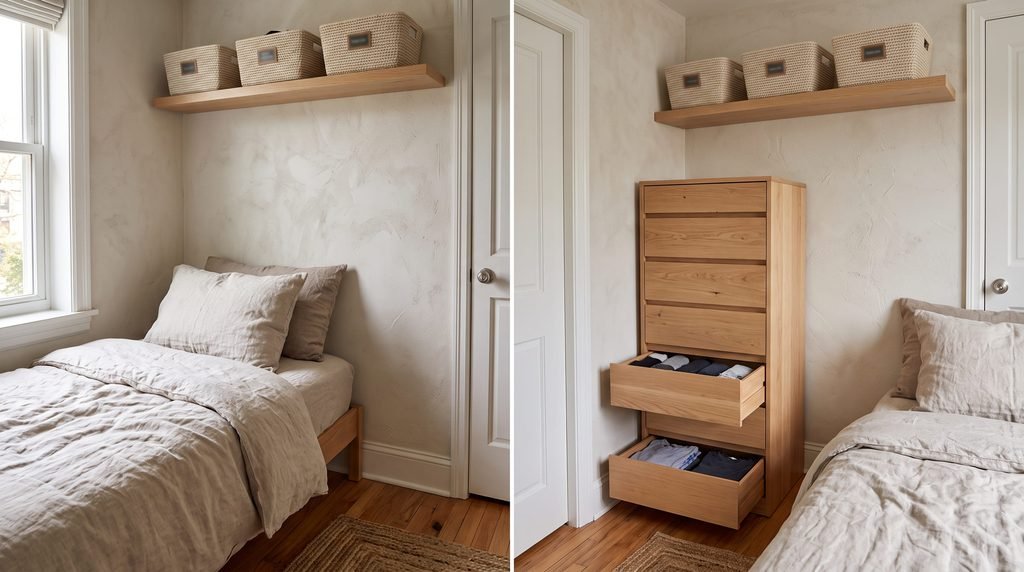
When the floor is the scarce resource, height is where the extra storage actually lives. A tall, narrow dresser or bookcase holds roughly what a wider, shorter version would, while claiming a lot less of the floor a small bedroom can’t spare.
The comparison worth actually running before buying: a wide dresser might be 60 inches across and 32 inches tall with six drawers, while a tall narrow version could be 28 inches wide and 52 inches tall with the same six drawers, just stacked differently.
The narrow one uses less than half the floor footprint for comparable capacity. The trade-off is reach — the top drawer or shelf on a tall piece may be above eye level, which matters if you’re shorter or the piece will hold things you need daily rather than occasionally. For anything you’re not reaching for often, that’s a non-issue; for everyday items, keep those in the lower, more accessible drawers and let the top ones hold seasonal or less-used things.
The space above doors and windows deserves the same logic and is one of the more consistently ignored spots in a typical layout. A shelf mounted there, roughly 10 to 12 inches deep, holds folded items or baskets without competing for anything at eye level — just be realistic that anything stored up that high should be things you access rarely, since a step stool becomes part of the routine either way. Ceiling height matters here too: in a room with standard eight-foot ceilings, there’s less usable gap above a door than in an older home with nine- or ten-foot ceilings, so measure what’s actually available before planning around it.
6. Choose a Storage Headboard
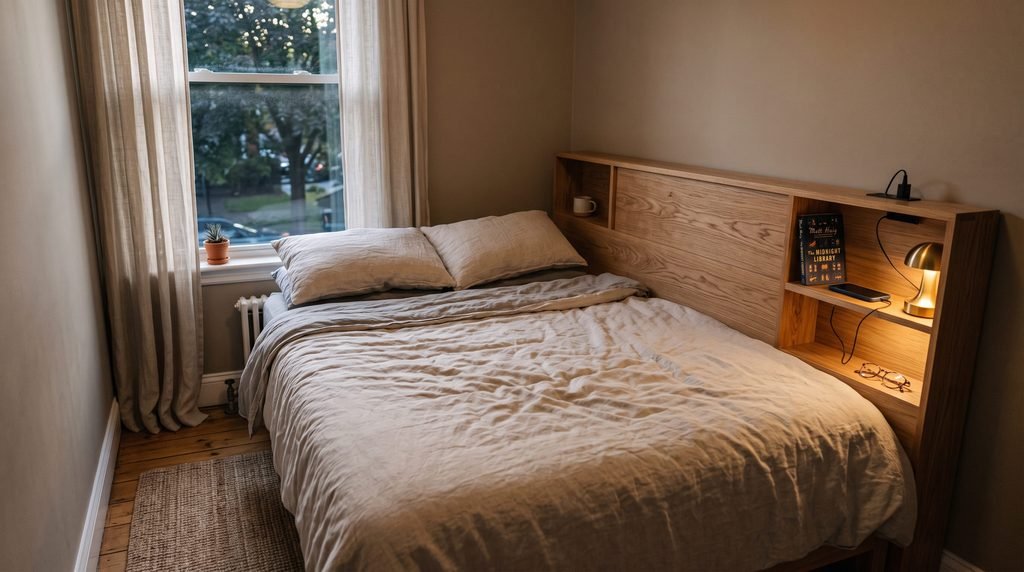
A headboard with built-in shelving or cubbies takes a piece of furniture that’s normally purely decorative and puts it to work — books, a phone charger, glasses, a small lamp can all live there instead of on a separate nightstand. In a room too small to fit standard nightstands on both sides, that’s a real advantage, since the storage is absorbed into a piece the bed needed anyway.
Storage headboards generally fall into two types: shallow ones with open cubbies, which are mostly useful for a book and a phone rather than anything bulky, and deeper ones with enclosed shelving or small doors, which hold more but add real depth to the whole bed.
That depth is the trade-off worth measuring before buying — a headboard with six to eight inches of storage depth pushes the entire bed frame that much further into the room, and in a tight layout, that can eat into more floor space than the storage actually saves elsewhere. Measure the distance from where the headboard would sit to the nearest wall or doorway with the added depth factored in, not just the bed frame’s listed dimensions.
For anyone not ready to buy a whole new bed, a floating shelf mounted directly above where the headboard sits, at a height reachable from lying down, gets a similar effect without replacing the frame. It won’t hold as much as a purpose-built storage headboard, but it solves the same core problem — somewhere for a book and a charger that isn’t a bulky nightstand — for a fraction of the cost and effort.
7. Make Your Small Closet Work Harder
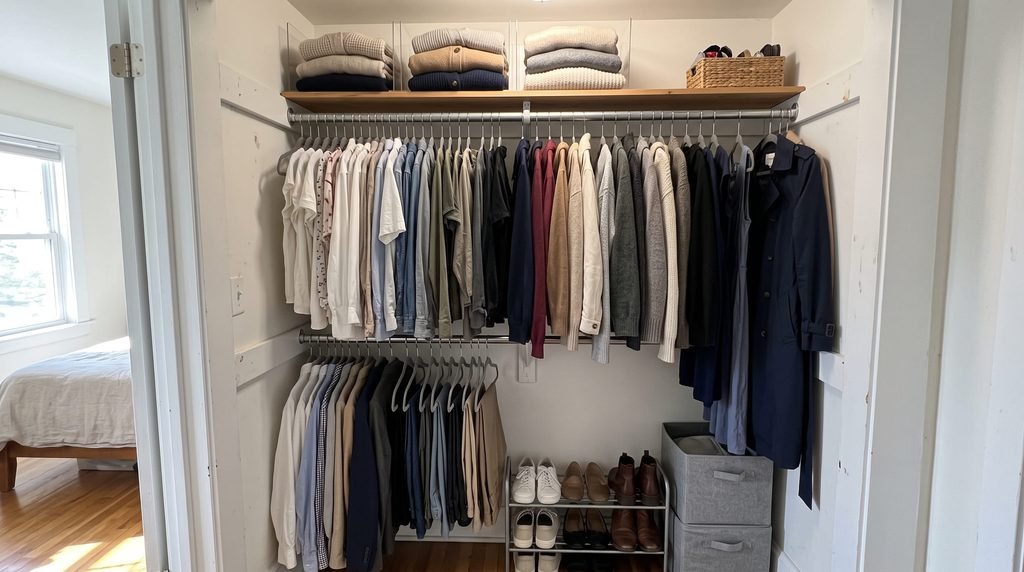
Most small closets aren’t actually too small — they’re underused. A single hanging rod with empty air above and below it is the default in a lot of bedrooms, and it’s wasting most of the closet’s actual volume. A second, lower rod for shorter items like shirts and folded pants can roughly double the usable hanging space without changing the closet’s footprint at all — this works well for shirts, jackets, and folded pants, but won’t work for dresses or long coats, which need the full rod height, so plan the split based on what’s actually in your wardrobe.
Shelf dividers stop folded stacks from collapsing into each other and are worth adding to any existing closet shelf, even a single one — a shelf holding four unstable stacks of sweaters usually only fits half of what the same shelf holds once dividers keep each stack upright and contained. Switching to slim, uniform hangers instead of a mismatched pile of bulky wooden or wire ones frees up real rod space per garment — the difference between wire and slim velvet-flocked hangers alone can reclaim two to three inches of rod space per ten items, which adds up across a full closet.
The closet floor counts too: stackable bins or a shoe organizer there uses space that otherwise just collects loose shoes and stray bags, and an over-the-rod hanging shelf organizer can add several more cubbies without needing any wall-mounted hardware at all. If you have no closet at all rather than a small one, a freestanding wardrobe, an open clothing rack paired with fabric bins underneath for folded items, or a wall-mounted coat rack combined with under-bed storage for out-of-season pieces are the realistic substitutes — a closet reorganized around its actual volume, not just its rod, usually holds noticeably more than the same closet left exactly as it came.
8. Turn Empty Corners Into Storage
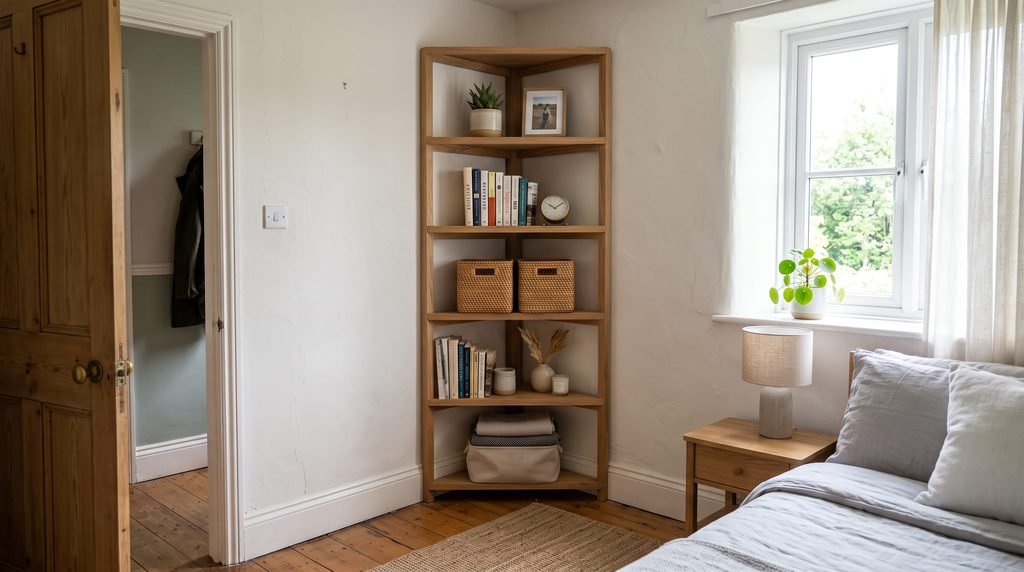
Corners are some of the most reliably wasted space in a bedroom, mostly because standard furniture is built to sit flush against a flat wall, not tuck into an angle. A corner shelf unit, a corner-specific wardrobe, or even a slim corner desk can hold books, baskets, folded clothes, or display items in a spot that would otherwise stay empty regardless of how the rest of the room is arranged.
It’s worth checking corners even in a bedroom that already feels fully furnished — they get skipped precisely because nothing obvious seems to fit there, which is exactly why they’re often still open once everything else has found a place. Corner shelving units typically come in triangular or curved designs that follow the actual angle of the room rather than a rectangular piece awkwardly wedged in, and they range from small decorative units holding a few books to full-height corner wardrobes that rival a standard closet in capacity.
One thing worth checking before committing to a corner solution: door swing and window placement. A corner near where a door swings open, or directly under a window, limits what you can put there — tall furniture blocking a window cuts natural light noticeably, which matters more in an already small room where light helps the space feel bigger. For a corner near a door swing, a shorter unit that clears the door’s arc, or open shelving instead of a solid wardrobe, avoids the furniture becoming an obstacle every time the door opens.
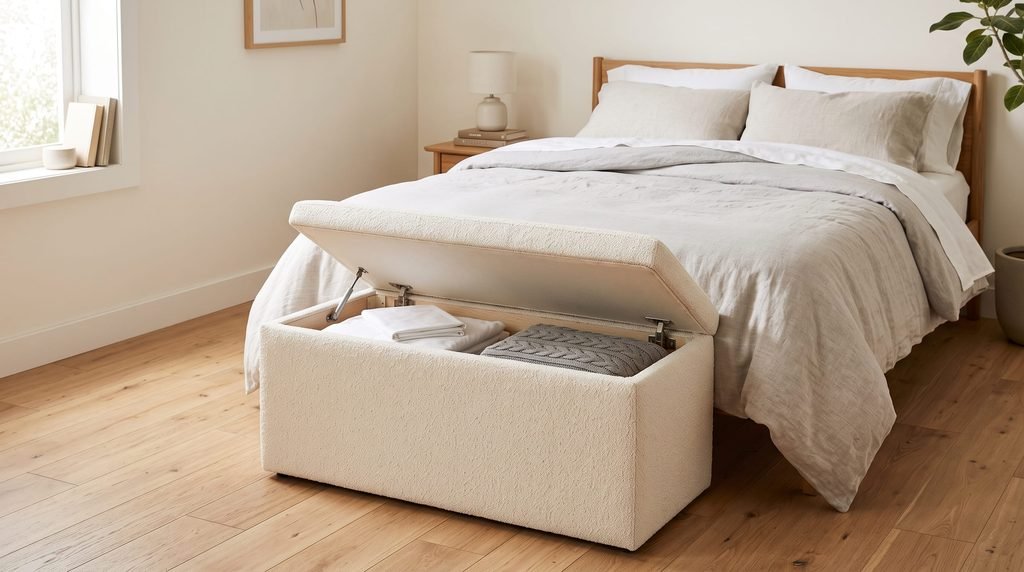
9. Add a Storage Bench or Ottoman
A bench or ottoman with a lift-up lid does two jobs from one footprint — seating and storage — which matters in a small bedroom where every piece ideally earns its keep more than once. At the foot of the bed or beside the closet, it can hold spare bedding, out-of-season clothes, or anything else you don’t need on a daily basis.
Size relative to the bed matters for this to actually work in a small room — a bench wider than the bed frame it sits against will stick out past the sides and become something you bump into, so measure the bed’s width first and choose a bench at or slightly narrower than that. Interior capacity varies a surprising amount between models that look similar from the outside; a bench listed with “storage” might hold a single folded blanket or several, so checking the actual interior dimensions, not just the exterior size, avoids disappointment.
The catch is access: lift-lid storage means moving whatever’s sitting on top before you can get in, so it works better for things you reach for occasionally rather than every day. Hinges matter here too — a soft-close or gas-strut hinge keeps the lid from slamming and is worth the small price difference over a basic hinge, especially with kids or pets in the house. If there’s simply no room for both a proper bench and a chair, a storage ottoman is a reasonable stand-in for either, since it can pull double duty as extra seating when guests are over, though it won’t be as comfortable for sitting for long stretches as an actual upholstered chair would be.
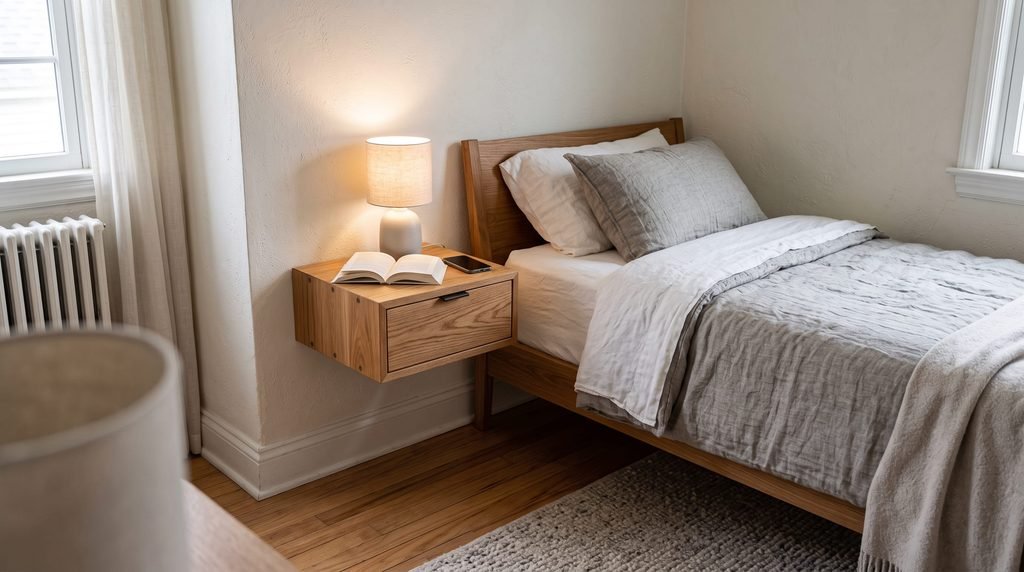
10. Replace a Bulky Nightstand With a Floating One
A standard nightstand — legs, solid base, drawer — takes up more physical and visual floor space than it usually gets credit for until it’s actually gone. A wall-mounted floating version holds the same lamp and phone charger while leaving the floor beneath it completely clear, which can make a small bedroom feel noticeably more open even though the storage itself hasn’t really changed.
Weight capacity is the detail most people skip and shouldn’t. A floating nightstand needs to be anchored into a stud whenever possible — drywall anchors alone are typically rated for much less weight than a stud mount, and a lamp plus a stack of books plus whatever else ends up there can exceed that limit faster than expected. If a stud doesn’t line up where you need the shelf, heavy-duty toggle anchors rated specifically for the shelf’s intended load are the safer substitute, not standard plastic anchors meant for lighter picture frames.
Floating nightstands come in two main styles worth knowing about: an open shelf with no storage beyond the surface, or a small floating drawer or cubby version that adds a bit of concealed storage back.
If you rely on a drawer for daily items — glasses, medication, chargers — the open-shelf version alone may not replace what a traditional nightstand did, so it’s worth pairing it with a small tray or basket on the shelf to keep loose items contained rather than scattered. In a narrow bedroom especially, swapping even one side table for a floating one can visibly open up the path around the bed, where a few extra inches of clearance genuinely change how the room feels to move through.
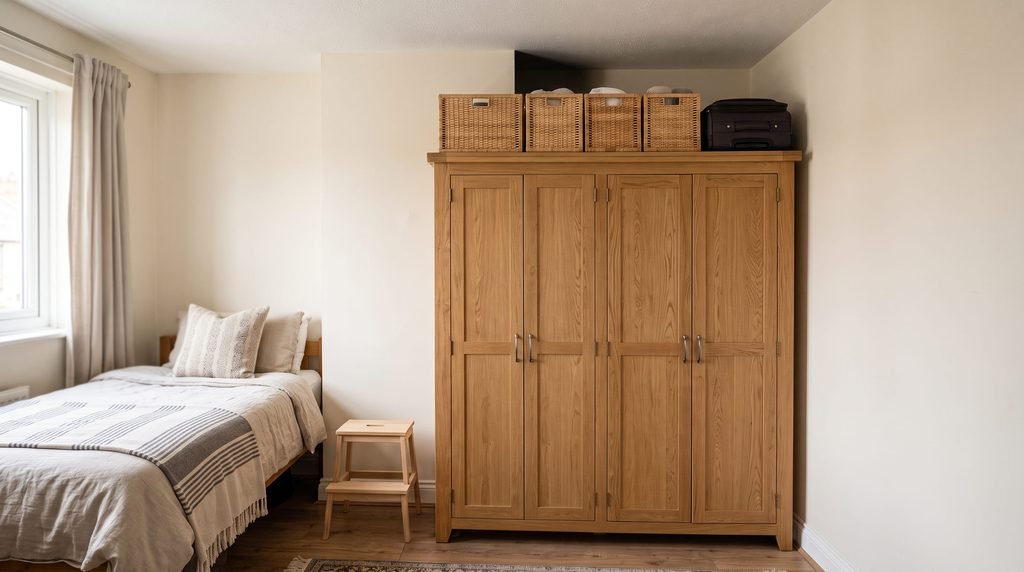
11. Use the Space Above Your Wardrobe
The gap between the top of a wardrobe and the ceiling sits unused in most bedrooms, mainly because it’s awkward to reach for anything you’d need on short notice. That actually makes it well suited to the kind of storage that’s fine being a little inconvenient — labeled bins for seasonal clothing, spare bedding, luggage that only comes out a handful of times a year.
How much this space can hold depends heavily on ceiling height and the wardrobe’s own height, which varies more than people account for. In a room with standard eight-foot ceilings and a wardrobe that’s already close to six and a half feet tall, there may only be a foot or so of usable gap — enough for one row of flat bins, not much more. In an older home with higher ceilings, that gap can be two feet or more, enough to stack bins two deep. Weight is worth considering too: check what the top of your specific wardrobe is rated to hold, since not all are built to support heavy, tightly packed bins without the top panel flexing over time.
A step stool basically becomes part of the system here, since this storage is meant for occasional access, not daily. Matching, uniform bins or baskets look considerably more finished than a stack of random boxes, and labeling each one — contents and rough season — saves you from pulling three down just to find the one you actually need. It’s one of the highest-capacity, lowest-effort storage spots in a small bedroom, precisely because almost nobody uses it by default.
How to Maximize Storage in a Small Bedroom
Maximizing storage in a small bedroom is rarely about one big fix — it’s usually two or three smaller changes working together, chosen based on what your specific room actually has room for. A room with a deep closet but no wall space to spare leans toward closet optimization and under-bed storage; a room with bare walls and a shallow closet leans toward floating shelves and vertical furniture instead. Matching the solution to the room’s actual shape matters more than following a generic list top to bottom.
The overlooked spots do a lot of the heavy lifting regardless of layout: the back of the door, the space above the wardrobe, an empty corner. Before buying anything new, it’s worth walking the room specifically looking for flat, unused surfaces — vertical wall space, the tops of tall furniture, the inside of closet doors — because those spots often solve more of the problem than another purchase would, and they’re free. It’s also worth sequencing the work: declutter and measure clearances first, tackle the free or near-free fixes (door storage, rearranging what’s under the bed, shelf dividers in the closet) second, and save any furniture purchase for last, once you actually know what gap is left to fill.
Small Bedroom Storage Mistakes to Avoid
The most common mistake is buying new storage before dealing with what’s already cluttering the room. Piling more bins and shelves into a space that’s full of things that could just be sorted, donated, or moved elsewhere usually adds visual noise rather than solving anything. Decluttering first often reveals that the room needed less new storage than it looked like it did — and it’s free, unlike most of the fixes that follow it.
Measurement mistakes come up constantly and are entirely avoidable: under-bed bins bought without measuring the actual clearance first, floating shelves ordered without checking stud placement, a storage bed chosen without confirming the drawers have room to open fully once it’s against the wall.
A five-minute measurement before ordering prevents most of these. Shelves hung too high to be practical for everyday items, and every visible surface filled with baskets until the room feels busier than the mess it was meant to fix, are the other two that show up again and again — a small bedroom with storage that’s technically full but visually chaotic often feels more cramped than one with less storage overall. Closed, matching containers read as calmer than an open shelf of mismatched bins, so when the budget allows, spending it on a few uniform bins rather than whatever mismatched containers are on hand usually pays off in how the room actually feels.
Frequently Asked Questions
How do I maximize storage in a small bedroom?
Combine a few smaller solutions rather than betting on one big purchase — under-bed storage, vertical shelving, and one multifunctional piece like a storage bed or ottoman usually add up to more usable space than a single large dresser would on its own. Match the specific combination to your room’s actual layout rather than applying every idea at once.
How do I organize a very small bedroom?
Declutter what’s already there before adding new storage, then prioritize vertical and under-used spaces — walls, the back of the door, above the wardrobe — over floor-based furniture that eats into walking space. Measure clearances before buying anything, since a bin or shelf that doesn’t fit the exact space is a wasted purchase.
What is the best storage for a small bedroom?
A bed with built-in drawers or a headboard with shelving tends to offer the best return, since both add real storage without needing any floor space beyond what the bed already occupies. Which one works better depends on whether you need more folded-clothing storage (a storage bed) or more surface-level storage for books and daily items (a storage headboard).
How can I store clothes in a small bedroom without a closet?
A tall, narrow wardrobe, an open clothing rack paired with fabric bins for folded items, and under-bed bins for off-season pieces can cover most of what a closet would otherwise hold. A wall-mounted coat rack or a row of hooks handles outerwear and frequently worn items that don’t need to be folded or hung in an enclosed space.
What should I put under my bed for storage?
Flat, low-profile bins work best for off-season clothing, spare bedding, and shoes — things that don’t need frequent access, since getting items out from under a bed frame is naturally less convenient than an open shelf. Measure your actual clearance first; a standard frame with a box spring often only allows six to eight inches, which rules out anything taller than a purpose-built under-bed bin.
How can I use vertical space in a small bedroom?
Floating shelves above the bed or a desk, tall narrow furniture instead of wide low pieces, and the space above doors, windows, and wardrobes are all functional vertical storage most small bedroom layouts leave completely untouched. Anchor anything load-bearing into a stud where possible, and reserve the hardest-to-reach spots for items you only need occasionally.
How do I keep a small bedroom clutter-free?
Give every category of item a specific, closed storage spot instead of leaving things on open surfaces, and check what’s under the bed and above the wardrobe periodically — out-of-sight storage is where clutter tends to build up unnoticed. A quick rule that helps: if a new item comes in and there’s no assigned spot for it, that’s usually a sign something else needs to be decluttered first.
Final Thoughts
A small bedroom almost always has more usable storage than it looks like it does — it’s just distributed across spots that don’t get treated as storage by default: under the bed, above the wardrobe, behind the door, up near the ceiling. Start with whichever solutions actually fit your room’s layout and the way you actually use your things, measure before you buy anything, and prioritize the vertical and overlooked spaces before adding more floor-based furniture. The real fix is almost always a combination of two or three smaller, well-matched changes rather than one large purchase.