20 Bedroom Lighting Ideas That Make Your Space Feel Cozy & Beautiful
Most bedrooms that feel flat or a little cold aren’t actually a decor problem — they’re a lighting problem. A single ceiling fixture, however nice, lights a room evenly and does nothing to create depth, which is why so many well-furnished bedrooms still feel more like a hotel hallway than somewhere you’d want to unwind. The fix usually isn’t new furniture. It’s more light sources, placed with more intention, at a warmer temperature than most rooms default to.
The twenty ideas below cover the full range — from the foundational habit of layering light instead of relying on one fixture, to specific placements like pendants over nightstands and lighting for a vanity or closet.
Each one goes into the actual details that make it work: where to place it, roughly how bright it should be, and the trade-offs worth knowing before you commit. A few of these involve hardwiring — chandeliers, recessed lighting, some sconces — and for those, hiring a licensed electrician is worth the cost; miswired fixtures are a genuine fire and shock risk, not just an inconvenience if it doesn’t work.
20 Bedroom Lighting Ideas
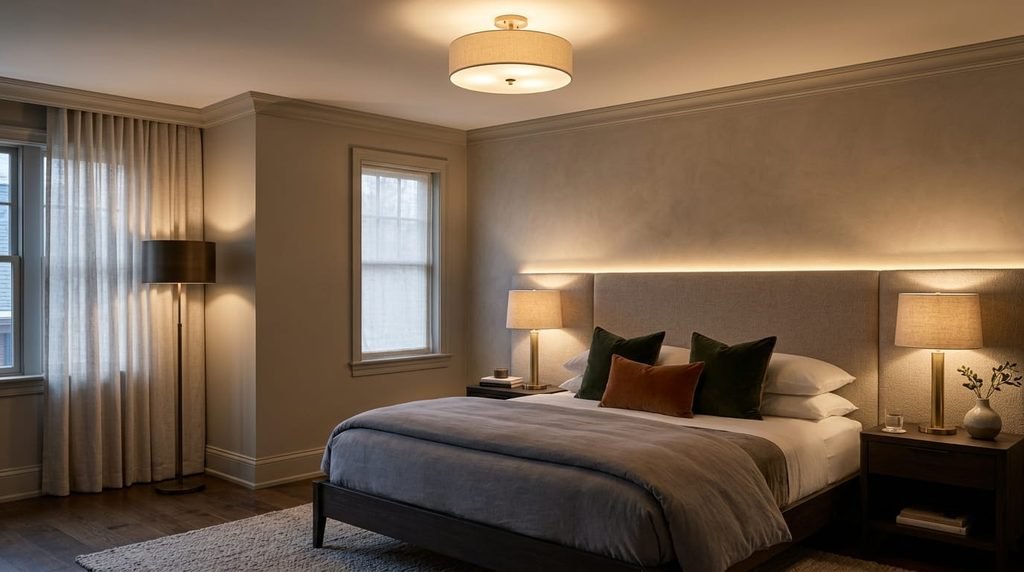
1. Layer Your Lighting Instead of Relying on One Fixture
This is the foundational idea the rest of this list builds on. A bedroom lit by a single overhead fixture has one brightness setting and one mood, and it’s rarely the mood you want at 9pm. Layering means combining ambient light (general room lighting), task light (something bright enough to read or get dressed by), and accent light (smaller, decorative sources like a lamp or LED strip) so you can dial the room’s feel up or down depending on the time of day.
In practice, that usually means three to five light sources total in an average bedroom: the ceiling fixture, two bedside lamps or sconces, and one additional accent source — a floor lamp in a corner, LED strips behind the headboard, or picture lighting.
You don’t need to install all of them on day one. Start with adding one warm bedside lamp if you’re currently relying only on an overhead light; that single change does more for a room’s evening atmosphere than almost anything else on this list, and it’s the cheapest entry point into the whole layering approach.
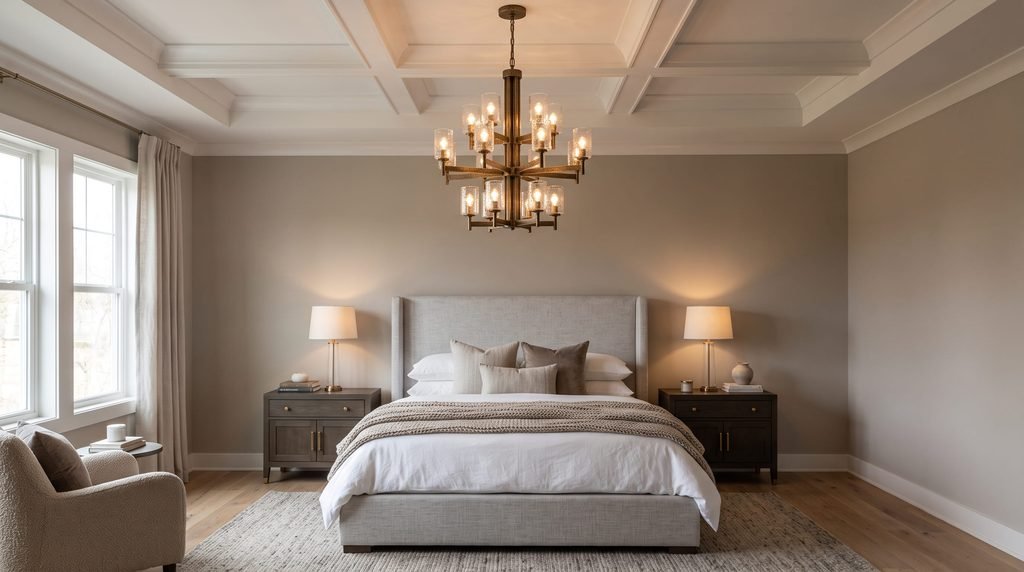
2. Add a Statement Chandelier
A chandelier does double duty in a bedroom — it’s the main ambient light source and a genuine piece of decor, which matters in a room where the ceiling fixture is often the least considered element. In a primary or master bedroom with reasonable ceiling height, a chandelier gives the space a level of polish that a plain flush mount can’t match.
Ceiling height is the real constraint here. As a general guideline, a chandelier needs at least seven and a half feet of clearance from its lowest point to the floor to avoid becoming a hazard anyone walks under, which rules it out for a lot of standard eight-foot-ceiling bedrooms unless the fixture itself is quite compact.
Scale matters too — a chandelier that’s too large for the room overwhelms it, while one that’s too small looks like an afterthought; a common sizing guideline is adding the room’s length and width in feet together and using that number in inches as a rough diameter target. Because this involves rewiring an existing ceiling box or running new wiring, it’s a job for a licensed electrician rather than a DIY project, especially if you’re changing the fixture’s location rather than just swapping what’s already there.
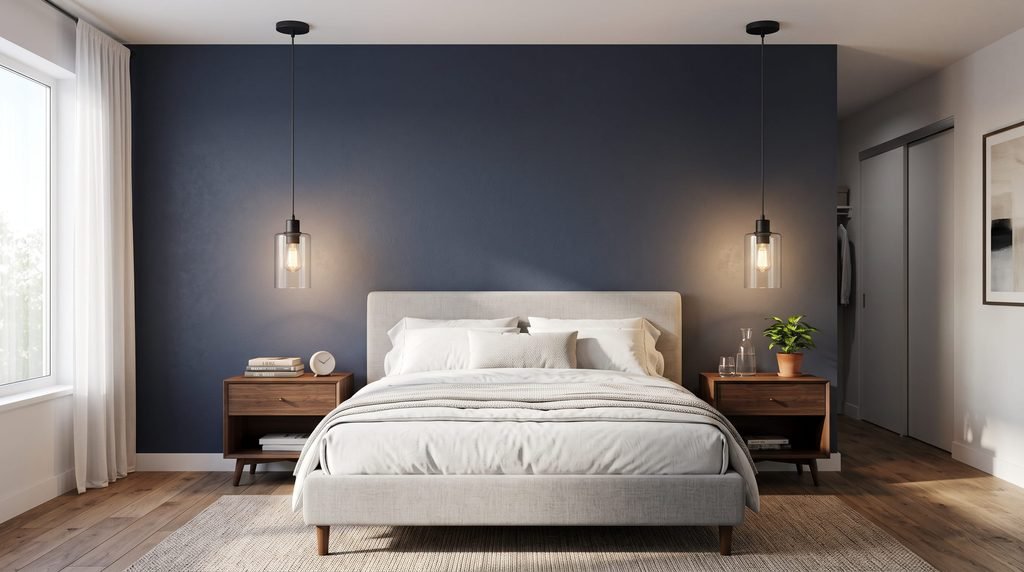
3. Hang Pendant Lights Over Your Nightstands
Pendant lights hung above each nightstand free up the surface itself, which is one of the more underrated benefits of this option — no lamp base taking up space that could hold a book or a glass of water. They also add a distinct visual element that a pair of table lamps can’t quite replicate, since the light source hangs at a different height than anything else in the room.
Hanging height matters more here than with most fixtures: position the bottom of the pendant roughly 20 to 24 inches above the nightstand surface, low enough to actually function as reading light but high enough not to hit anyone in the head reaching for a glass of water in the dark.
This requires either an existing ceiling junction box in the right spot or new wiring run to that location, so it’s worth planning during a renovation rather than trying to retrofit it into a finished room, unless you’re comfortable with visible surface-mounted cord and a plug-in pendant kit instead of a hardwired one.
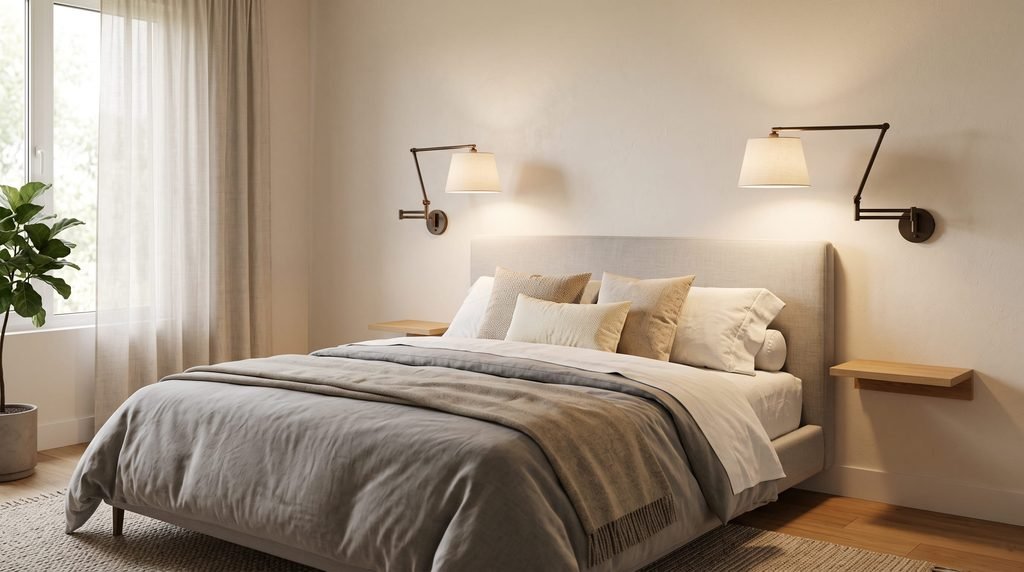
4. Install Wall Sconces Beside the Bed
Wall sconces solve the same problem as bedside lamps — light for reading, light for the room — without using any nightstand surface at all, which matters a lot in a smaller bedroom where every inch of surface space counts. They also free up the nightstand for actual storage or decor instead of a lamp base.
Mounting height is the detail worth getting right: a common guideline is roughly 24 to 28 inches above the top of the mattress, or about eye level for someone sitting up in bed, so the light is close enough to be useful for reading without shining directly into your eyes when lying flat. Swing-arm sconces add real flexibility here, since you can adjust the light’s direction and distance from the bed rather than being locked into a fixed position. Like pendants, hardwired sconces need an electrician unless you choose a plug-in version with a cord run along the wall — a fine compromise for renters who can’t have new wiring installed.
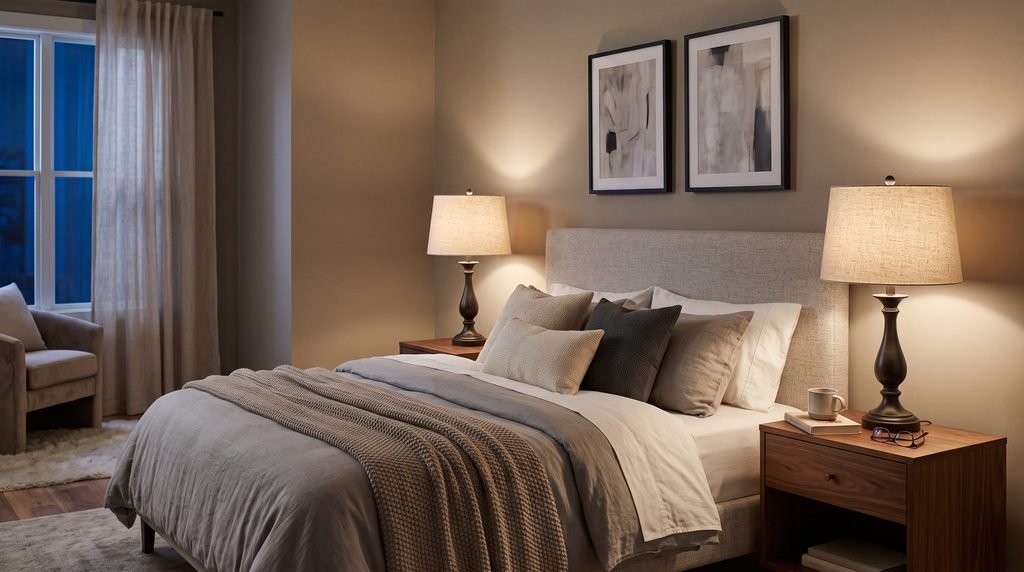
5. Choose Warm Bedside Table Lamps
Bedside lamps are the simplest, lowest-commitment item on this entire list, and often the single highest-impact one if your bedroom currently relies only on an overhead light. A pair of matching lamps creates symmetry and balance on either side of the bed, while two different lamps with a shared color or material can look more collected and less like a matched showroom set.
Bulb choice matters as much as the lamp itself. Warm-white bulbs, generally in the 2700K to 3000K range, give off a softer, more relaxing glow that suits a bedroom far better than the cooler, bluer light common in kitchens and offices — cooler bulbs can make even a beautifully decorated bedroom feel closer to a waiting room. If you read in bed regularly, look for a lamp with a shade that directs light downward and outward rather than straight up, since that’s what actually illuminates a page rather than just glowing decoratively.
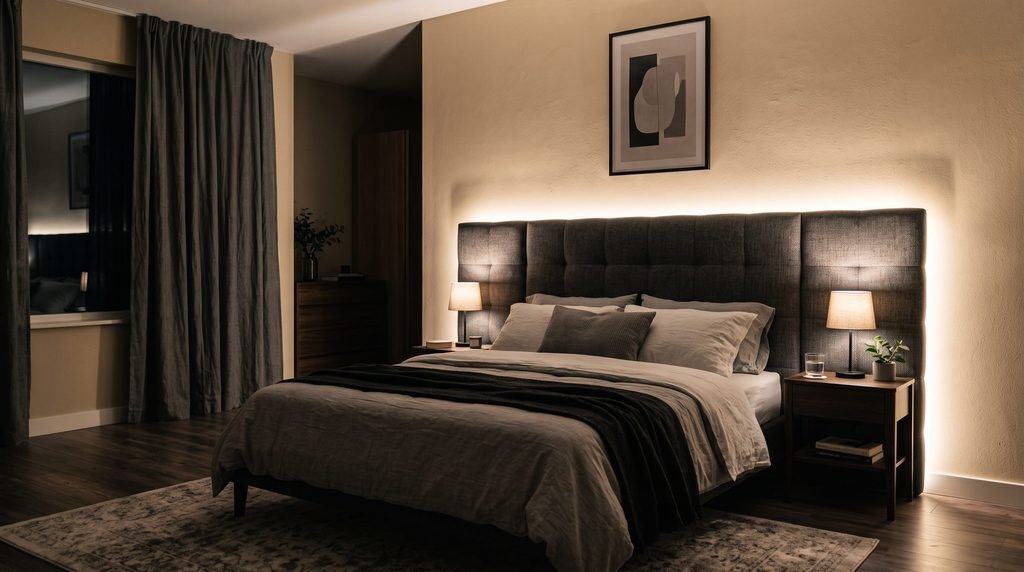
6. Add LED Strip Lighting Behind the Headboard
LED strips mounted behind or around the headboard create an indirect glow that outlines the bed without any visible light source, which looks considerably more polished than the strip itself would suggest. It’s one of the more dramatic-looking upgrades on this list relative to how little effort it actually takes to install.
Most LED strip kits are adhesive-backed and battery- or plug-powered, making this one of the few ideas here that’s fully renter-friendly with zero wiring involved. Look for a warm-white strip, ideally with a remote or app that lets you adjust both brightness and color temperature, since a strip stuck on one bright, cool-white setting can undercut the cozy effect you’re going for. Placement matters: mounting it on the back of the headboard so the light washes onto the wall behind, rather than shining forward into the room, gives the softest and most flattering result.
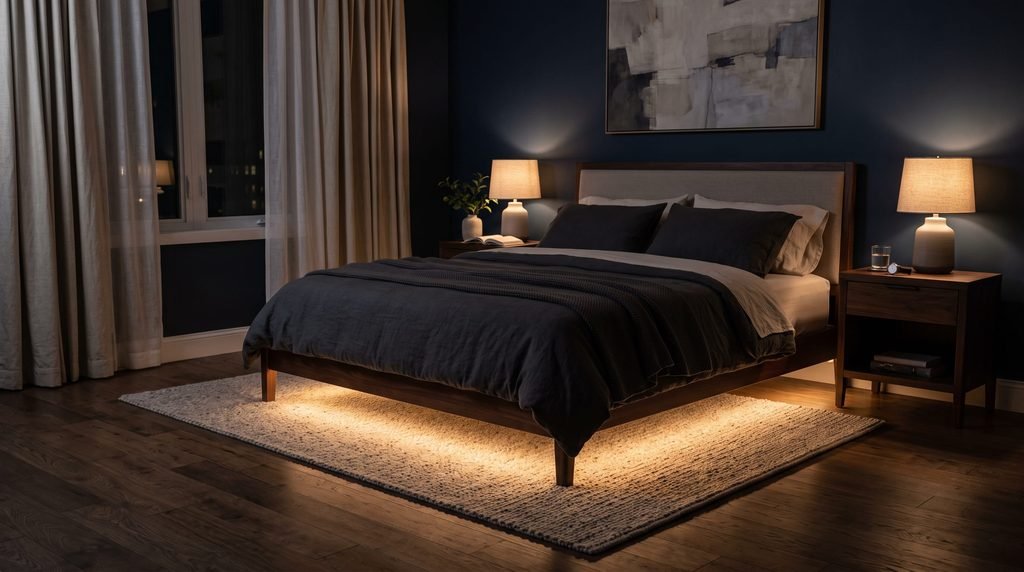
7. Try Under-Bed Lighting
LED strips mounted along the underside of the bed frame create a soft glow at floor level, which works as both a subtle style statement and a real help for low-light navigation if you get up during the night without wanting to flip on a bright overhead light. It’s a detail that photographs well and functions well, which is a fairly rare combination.
Motion-sensor strips are worth the small extra cost here specifically, since they turn on automatically when you swing your legs out of bed and turn off after a set period, rather than needing you to fumble for a switch in the dark.
Battery-powered kits skip any wiring concerns entirely, though they’ll need occasional battery changes; plug-in versions run more reliably long-term if there’s an outlet within reach. Keep the brightness low and warm-toned for this one in particular — it’s meant to be a soft glow, not a second ambient light source, and too bright a strip under the bed can look more like a nightclub than a bedroom.
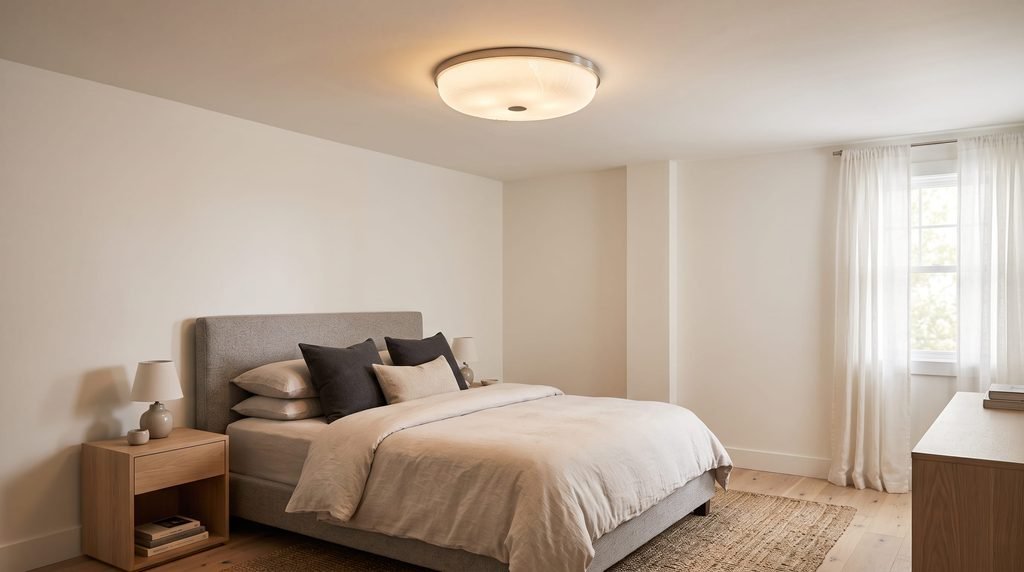
8. Use a Flush-Mount Ceiling Light for Low Ceilings
In a bedroom with standard eight-foot ceilings, a chandelier or hanging pendant can feel disproportionate or even become a hazard someone bumps into. A flush-mount or semi-flush fixture sits close to the ceiling, providing the same ambient light without eating into the room’s headroom.
Modern flush mounts have moved well past the plain glass dome most people picture — options with fabric drum shades, sculptural metal frames, or frosted glass in interesting shapes all deliver the low-profile benefit while still adding real style to the ceiling.
For light output, a rough guideline for general ambient lighting is aiming for about 20 lumens per square foot of room area, though a dimmer switch matters more than hitting an exact number, since it lets you scale a bright fixture down for evening use rather than being stuck with one brightness level.
This is a straightforward swap for an existing ceiling fixture in most cases, though it’s still worth having an electrician confirm the wiring and box are rated for the new fixture’s weight if it’s noticeably heavier than what was there before.
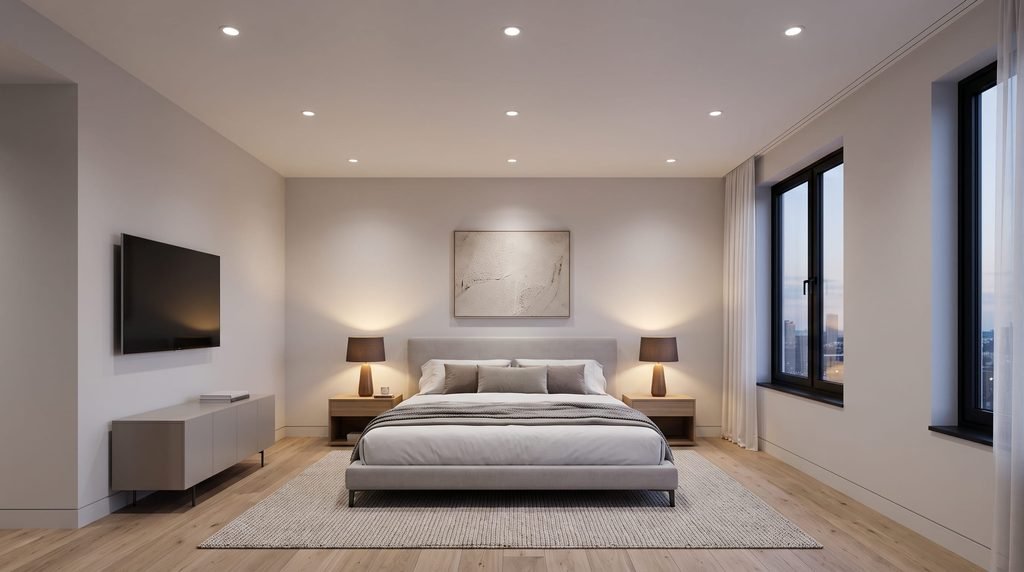
9. Add Recessed Lighting for a Modern Look
Recessed lights, set flush into the ceiling, give a bedroom a clean, uncluttered look with no visible fixture at all — a strong fit for a more modern or minimalist aesthetic where even a small flush-mount fixture would feel like too much visual noise. They also free up the ceiling entirely for anyone who prefers an unbroken sightline.
This is one of the more involved projects on this list, since it typically requires cutting into the ceiling and running new wiring, which makes it a job for a licensed electrician rather than a weekend project — and it’s much easier to plan during a renovation or new build than to retrofit into a finished ceiling. Placement is worth thinking through carefully before installation: recessed lights spaced too far apart leave dark gaps, while too many can flatten the room’s sense of depth, working against the layered-lighting approach this whole list is built around. Pairing recessed ambient lighting with a couple of warmer accent sources — a lamp, a sconce — keeps the room from feeling clinical despite the clean ceiling.
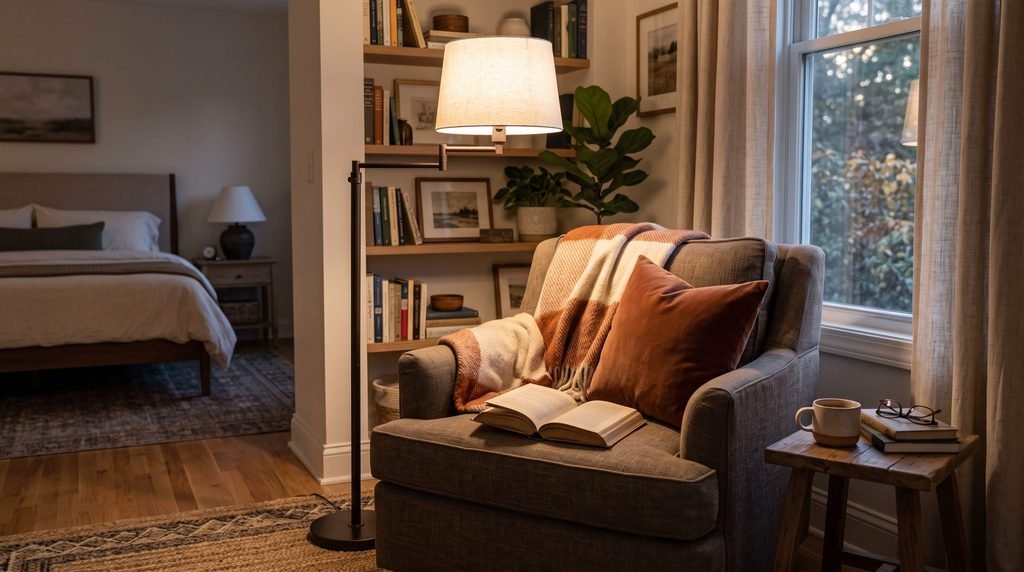
10. Set Up a Floor Lamp in a Reading Corner
A floor lamp positioned beside a chair or in an underused corner turns dead space into a genuine reading nook, and it adds a light source at a different height than the bedside lamps and ceiling fixture, which helps the room’s overall lighting feel layered rather than flat.
An adjustable arm or swing-arm floor lamp gives you more control over exactly where the light lands, which matters if the lamp needs to do real work for reading rather than just sit there decoratively. For actual reading use, position the lamp slightly behind and to the side of the shoulder rather than directly overhead, since overhead light casts a shadow from your own head onto the page. A dimmable floor lamp, or one on the same smart-bulb system as the rest of the room, lets this corner shift between a bright reading spot and a softer ambient source depending on the time of day.
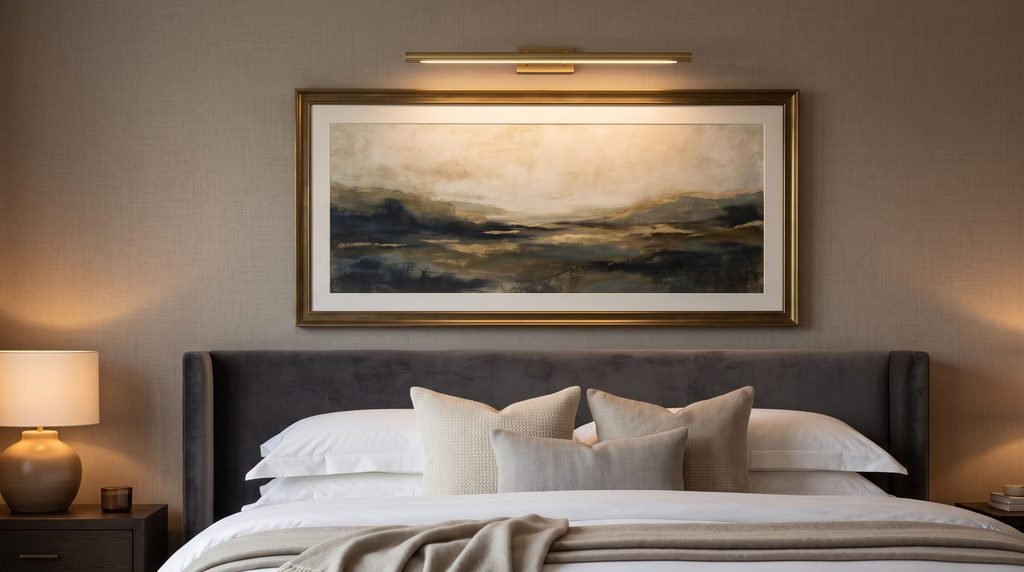
11. Add Picture Lights Over Artwork
A small picture light mounted above a piece of art does two things at once: it highlights the artwork properly, and it adds a soft, focused accent light source that contributes to the room’s overall layering without competing with the ambient or task lighting elsewhere.
Battery-powered, wireless picture lights have gotten quite good in the last few years and remove the need for any wiring or even a nearby outlet, which makes this one of the easier accent-lighting additions on the list for a renter. Position the light so it washes evenly across the piece rather than creating a single bright hotspot — for most standard picture lights, that means mounting it roughly six to twelve inches above the top of the frame, adjusted based on the light’s specific beam angle. This works particularly well above a headboard in place of, or alongside, LED strip lighting, giving the wall behind the bed a genuine focal point.
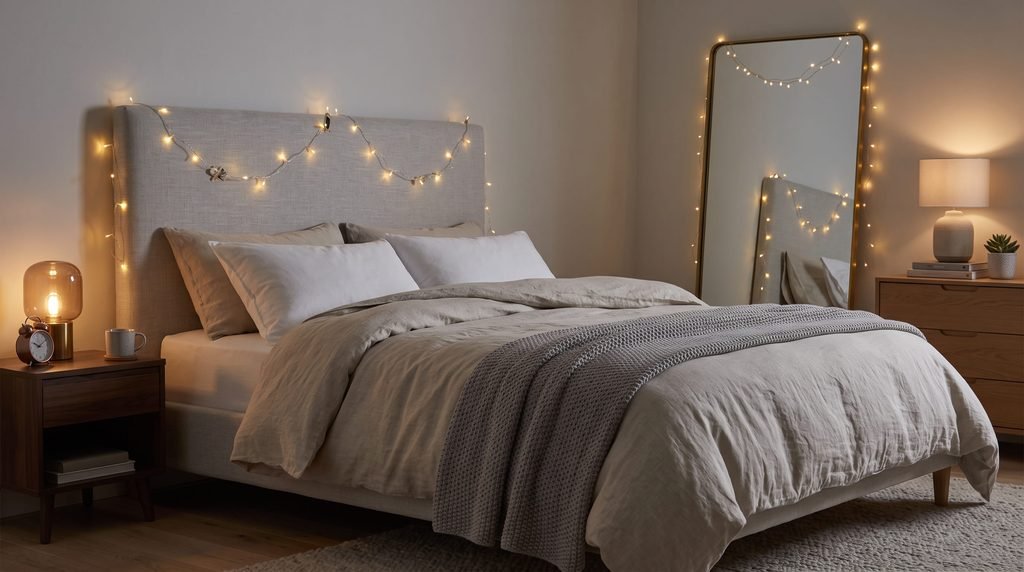
12. String Fairy Lights for a Cozy Touch
Fairy lights are the lowest-cost, lowest-commitment way to add a soft, whimsical accent to a bedroom, and they work in almost any style of room from minimalist to maximalist, since the effect scales with however many strands you use and how you arrange them. Draped along a headboard, wound around a mirror frame, or hung in a corner, they add a gentle point of light without any real installation.
Battery-powered strands with a built-in timer are worth the small extra cost, since they turn off automatically after a set number of hours rather than needing to be switched off manually every night, which also extends battery life. Warm-white LED strands generally suit a bedroom’s mood better than the cooler white or multicolor options aimed more at kids’ rooms or holiday decorating. This is a fully temporary, renter-safe addition — no wiring, no drilling, and easy to take down entirely if the look doesn’t end up working for the room.
13. Make Your Lighting Dimmable
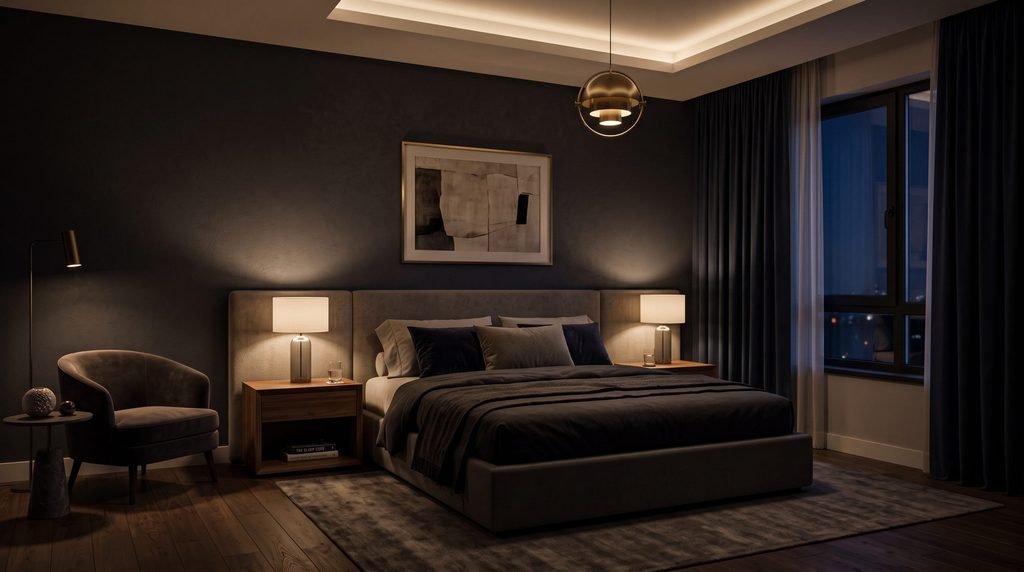
Dimming capability might be the single highest-impact change on this entire list relative to its cost, because it turns every other fixture in the room into two or three different light sources depending on the setting. A bright ceiling light for cleaning or getting dressed becomes a soft ambient glow for winding down, all from the same fixture.
Retrofitting a dimmer switch into an existing non-dimmable circuit is usually straightforward for an electrician, though it’s worth confirming the bulbs themselves are dimmable first — many LED bulbs need to be specifically rated for dimming, and using standard LEDs on a dimmer switch can cause flickering or an unpleasant buzzing sound. Smart plugs are a dimmer-free workaround for lamps specifically, letting you adjust brightness through an app or voice control without any electrical work at all, which is a solid renter-friendly alternative to a hardwired dimmer switch.
14. Add Smart Bulbs and Smart Lighting
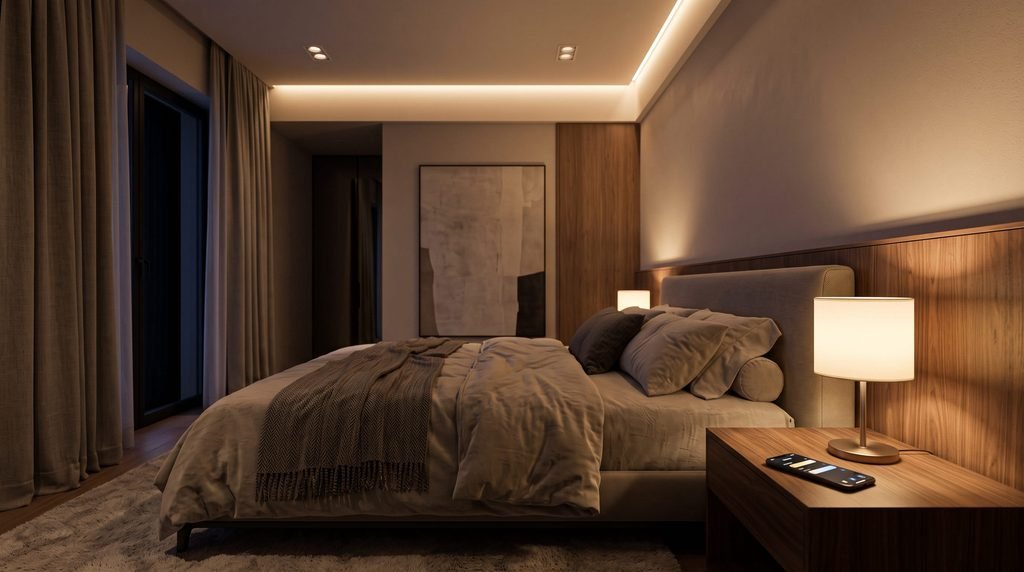
Smart bulbs let you adjust brightness and, often, color temperature from a phone app or voice assistant, which means a single bulb can shift from bright white light for getting ready in the morning to warm, dim light for winding down at night — all without buying multiple fixtures or bulbs for different moods.
Scheduling is the feature worth actually using here, not just the novelty of voice control: setting lights to automatically warm and dim in the hour before your usual bedtime can make winding down noticeably easier, since bright, cool light in the evening tends to work against your body’s natural signal to feel sleepy. Most smart bulbs screw into any standard fixture without needing new wiring, which makes this one of the easier upgrades on the list to add incrementally, one lamp or fixture at a time, rather than committing to a whole-room overhaul at once.
15. Try Cove or Indirect Ceiling Lighting
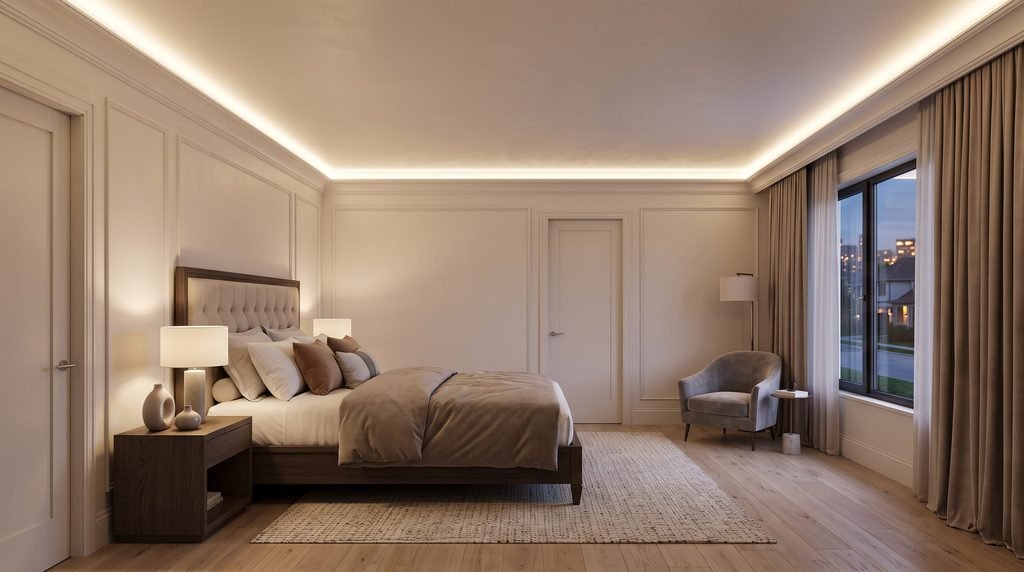
Cove lighting — LED strips hidden in a ceiling recess or along crown molding, aimed upward so the light bounces off the ceiling rather than shining directly into the room — creates one of the softest, most diffused ambient lighting effects available, without a single visible fixture anywhere in the room.
This is one of the more architecturally involved ideas here, generally requiring either built-in coving during a renovation or a mounted ledge added to an existing ceiling, so it’s best planned alongside other structural or electrical work rather than as a standalone weekend project. Warm-white LED strips work better than cool white for this application, since the light is meant to feel like a gentle glow rather than a bright, clinical wash. For anyone not ready for a full renovation, a simpler version of the same effect comes from uplighting with a floor lamp aimed at the ceiling in a corner — not as seamless, but a similar soft, indirect result for a fraction of the effort.
16. Light Your Vanity Properly
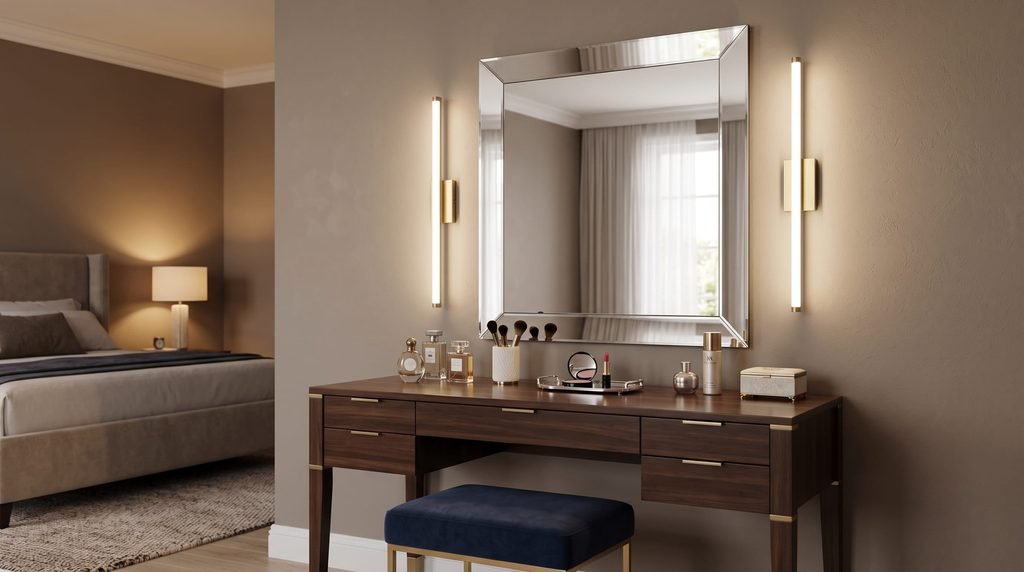
A bedroom vanity or dressing area needs distinctly different lighting than the rest of the room — bright, even, and ideally free of harsh shadows, since this is where you’re actually doing detail work like makeup or grooming rather than relaxing. A single overhead bulb creates shadows under the eyes and chin that make this task harder, not easier.
The classic fix is lighting positioned at face height on either side of the mirror, rather than only above it — vertical sconces flanking the mirror, or a lighted mirror with an even ring of bulbs around the frame, both avoid the downward shadow problem that overhead-only lighting creates. Brighter, closer-to-daylight bulbs — something in the 4000K to 5000K range rather than the warm 2700K used elsewhere in the bedroom — actually work better here, since this is one of the few spots in the room where accurate color rendering matters more than a cozy mood. It’s worth treating vanity lighting as its own small project separate from the rest of the room’s warm, layered scheme.

17. Add Closet Lighting
A closet with no dedicated lighting relies entirely on whatever light spills in from the bedroom, which usually isn’t enough to actually see clothing colors accurately or find something specific, especially in a walk-in or reach-in closet without a window. Dedicated closet lighting fixes a real daily annoyance, not just an aesthetic one.
Battery-powered, motion-sensor LED lights are the easiest fix for a closet with no existing wiring — they stick to the interior ceiling or wall, turn on automatically when the door opens, and need no electrician at all. For a closet with existing wiring or during a renovation, a small flush-mount fixture or a run of LED strip lighting along the shelving gives more even, reliable coverage than a single battery puck light can. Brighter, more neutral-white light — closer to what you’d use in the vanity area than the warm bedroom lighting elsewhere — makes it easier to actually judge clothing colors accurately when getting dressed.
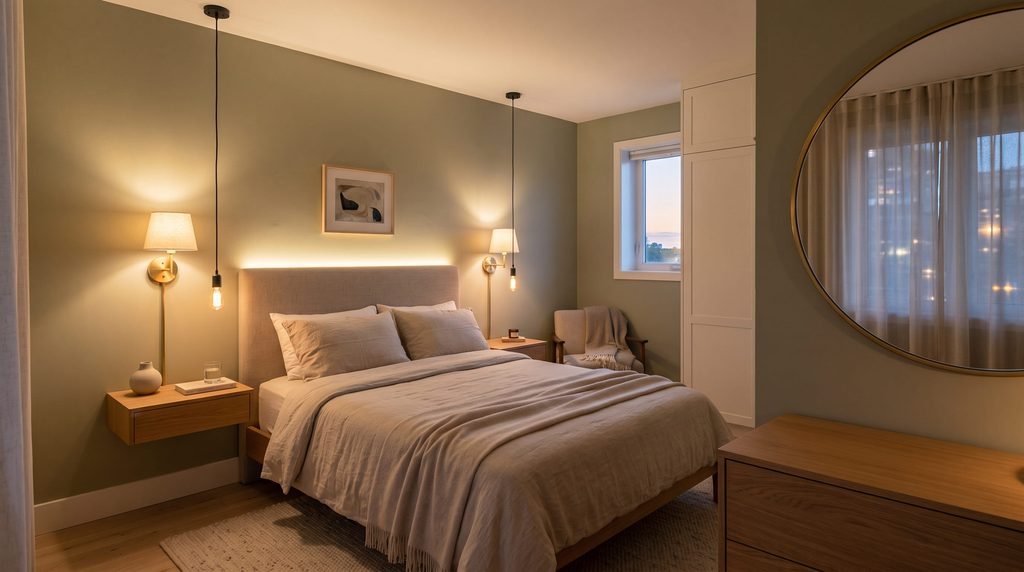
18. Choose the Right Lighting for a Small Bedroom
A small bedroom has less wall and surface space to spare for lighting, which makes the choice between fixtures more consequential than in a larger room — a bulky floor lamp or oversized table lamp eats into space that’s already tight. Wall-mounted sconces and pendant lights, both of which free up the nightstand or floor entirely, tend to work better here than anything sitting on a surface.
Multiple smaller light sources generally suit a small bedroom better than one large statement fixture, since a big chandelier or oversized pendant can visually dominate a compact room the same way an oversized piece of furniture would. Mirrors placed near a light source can also help a small bedroom feel brighter by bouncing light around the room rather than letting it stop at the first surface it hits. If floor space truly can’t spare a lamp at all, LED strip lighting along a shelf or behind a headboard adds a layer of accent light without claiming any surface or floor space whatsoever.
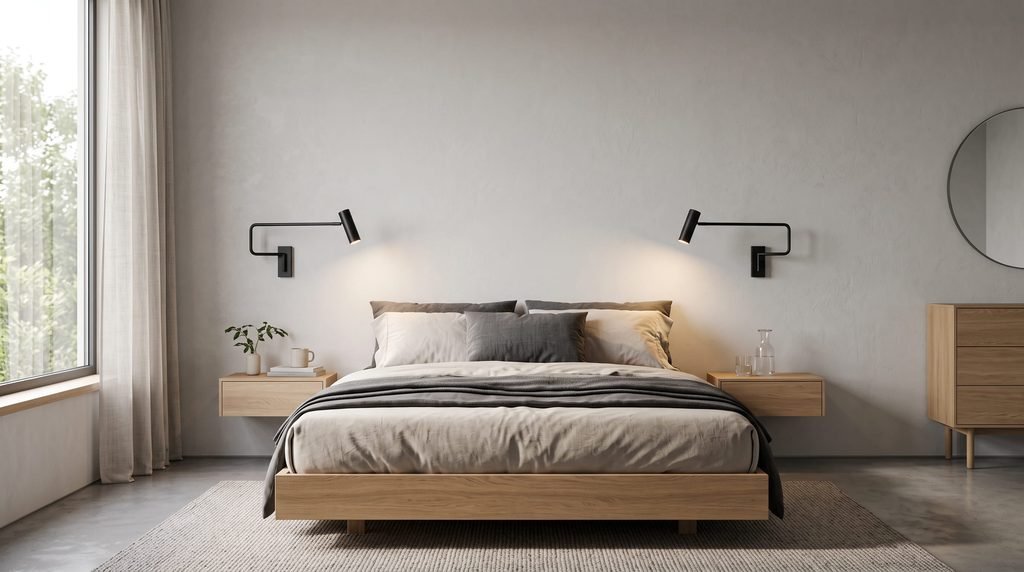
19. Add Minimalist Wall-Mounted Lights
For a pared-back, minimalist bedroom, a simple wall-mounted fixture — a slim metal sconce, a plain glass globe, an unadorned LED puck light — provides ambient or accent lighting without adding visual clutter the way a more decorative fixture might in a room built around restraint.
The trick with minimalist lighting is that the fixture’s simplicity puts more pressure on its proportions and finish quality, since there’s no ornate detail to distract from a slightly awkward shape or a cheap-looking finish. A matte black, brushed brass, or unlacquered metal finish tends to read as more considered than a shiny chrome option in a minimalist scheme, and consistency matters more here than in a more eclectic room — matching the finish across two or three wall-mounted fixtures ties the room together in a way that mismatched finishes would undercut.
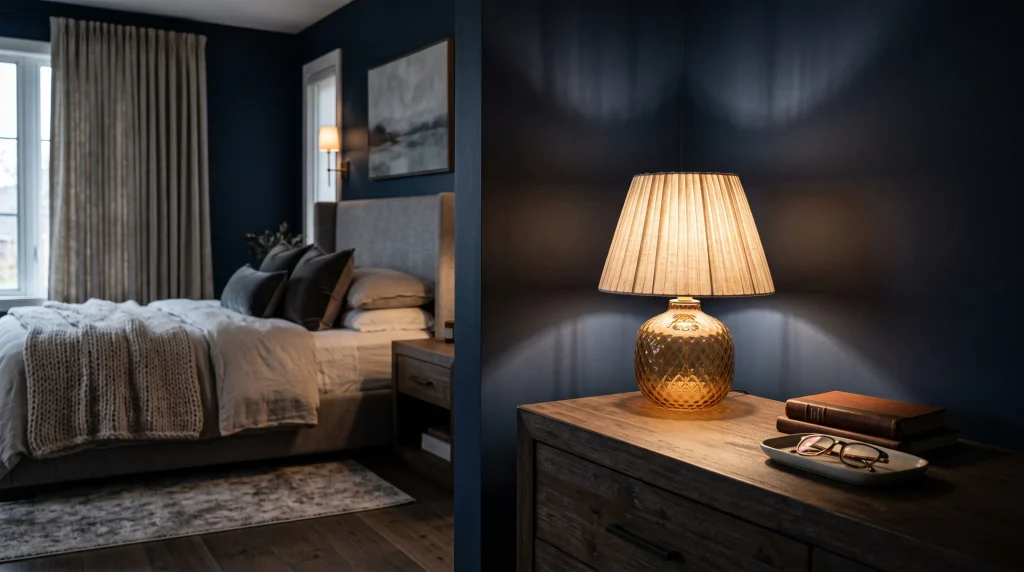
20. Add a Cozy Corner Accent Lamp
A small accent lamp — placed on a low shelf, a dresser corner, or the floor of an otherwise empty nook — adds one more layer of warm, low-level light to round out the room’s overall lighting scheme, and it’s often the detail that pushes a well-lit bedroom from merely functional to genuinely inviting.
This is a good spot for a lamp with some personality — colored or textured glass, an interesting base material, a shade that casts patterned light onto the wall or ceiling — since it’s playing a purely accent role rather than needing to handle serious task lighting like reading. Keep the bulb warm and relatively low-wattage here; this lamp’s job is a soft glow in an otherwise dim corner, not another bright light competing with the room’s main sources. It’s a small, inexpensive addition, but it’s frequently the finishing touch that makes the rest of the layered lighting actually feel complete.
How to Layer Lighting in a Bedroom
Layering starts with identifying what each light source in the room is actually for, rather than buying fixtures first and figuring out their purpose later. Ambient lighting — the ceiling fixture, cove lighting, or recessed lights — sets the room’s baseline brightness. Task lighting — bedside lamps, sconces, a reading floor lamp, vanity lighting — handles specific activities that need real, focused brightness. Accent lighting — LED strips, picture lights, fairy lights, a small corner lamp — adds mood and visual interest without needing to be bright enough to do anything functional on its own.
A well-layered bedroom usually has at least one source from each category, ideally on separate switches or dimmers so they can be controlled independently rather than all coming on or off together. In the evening, that means the ability to turn off the bright ambient light entirely and rely on just the warmer task and accent sources — bedside lamps and maybe an LED strip — which does more for a room’s mood at night than any single fixture, however nice, ever could on its own.
Choosing the Right Color Temperature for Bedroom Lighting
Color temperature, measured in Kelvin, describes how warm or cool a bulb’s light appears — lower numbers read as warmer and more amber, higher numbers read as cooler and more blue-white. For most bedroom lighting — bedside lamps, ambient ceiling fixtures, accent lighting — warm-white bulbs in the 2700K to 3000K range tend to feel more relaxing and suit the room’s purpose better than cooler options.
Task-specific areas are the exception worth knowing about: vanity and closet lighting generally benefit from a cooler, more neutral range, closer to 4000K to 5000K, since accurate color rendering matters more there than mood. If you’re not sure where to start, a warm-white bulb everywhere except the vanity and closet is a reasonable default that covers most of what a bedroom actually needs, and dimmable warm-white bulbs give you the flexibility to go brighter when you need real light without switching to a cooler, harsher tone to get it.
Bedroom Lighting Mistakes to Avoid
The most common mistake is relying on a single overhead fixture and calling the lighting finished. One ceiling light, however nice, can’t create the depth and mood that even two or three additional smaller sources provide, and it’s usually the single biggest reason a bedroom feels flat despite being otherwise well-decorated.
Cool-white bulbs in a room meant to feel relaxing are another frequent issue — a bedroom lit entirely in 5000K daylight-mimicking bulbs tends to feel more like an office than somewhere to unwind, even if every other design choice in the room is right. Sconces or pendants mounted at the wrong height — too high to actually help with reading, or low enough to be an obstacle — undercut fixtures that would otherwise work well. And skipping dimmers on the main ambient light is a mistake worth avoiding wherever the budget allows, since a bright, non-dimmable ceiling fixture forces an all-or-nothing choice between full brightness and switching it off entirely, with no comfortable middle ground for evenings.
Frequently Asked Questions
How should I light my bedroom?
Combine ambient, task, and accent lighting rather than relying on a single fixture — a ceiling light for general brightness, bedside lamps or sconces for reading, and one accent source like LED strips or a small lamp for mood, ideally with a dimmer on at least the main light.
What is the best color temperature for bedroom lighting?
Warm-white bulbs in the 2700K to 3000K range generally suit most of a bedroom best, with a cooler, more neutral range reserved for task-specific spots like a vanity or closet where accurate color and brightness matter more than mood.
How do you layer lighting in a bedroom?
Identify what each fixture is for — general brightness, focused task light, or decorative accent — and aim for at least one source from each category, ideally on separate switches or dimmers so you can adjust them independently depending on the time of day.
Where should bedside lights be placed?
Wall sconces generally sit around 24 to 28 inches above the mattress, roughly eye level for someone sitting up in bed, while table lamps should have their shade positioned to direct light downward and outward for effective reading light.
What is the best lighting for a small bedroom?
Wall-mounted sconces, pendant lights, and LED strip lighting all provide light without claiming surface or floor space, which tends to matter more in a small bedroom than in a larger room with space to spare for floor lamps.
How can I light a bedroom without a ceiling light?
A combination of floor lamps, wall sconces, and table lamps can provide enough ambient and task light to replace a ceiling fixture entirely, particularly if at least one source is bright enough to serve as the room’s main light when needed.
How can I make bedroom lighting look more expensive?
Layering multiple warm light sources at different heights, choosing fixtures with a consistent metal finish throughout the room, and adding dimmers so the lighting can shift between bright and moody usually does more for a polished look than any single statement fixture on its own.
Final Thoughts
Good bedroom lighting is rarely about one perfect fixture — it’s about having enough different light sources, at the right warmth, that the room can shift from bright and functional during the day to soft and relaxing at night. Start with the cheapest, easiest change if the room currently relies on one overhead light: add a warm bedside lamp, then build outward from there with dimmers, accent lighting, and task-specific fixtures as budget and time allow. The rooms that feel genuinely cozy are almost always the ones with several smaller, well-placed lights working together, not the ones with a single impressive fixture doing all the work alone.




One Comment