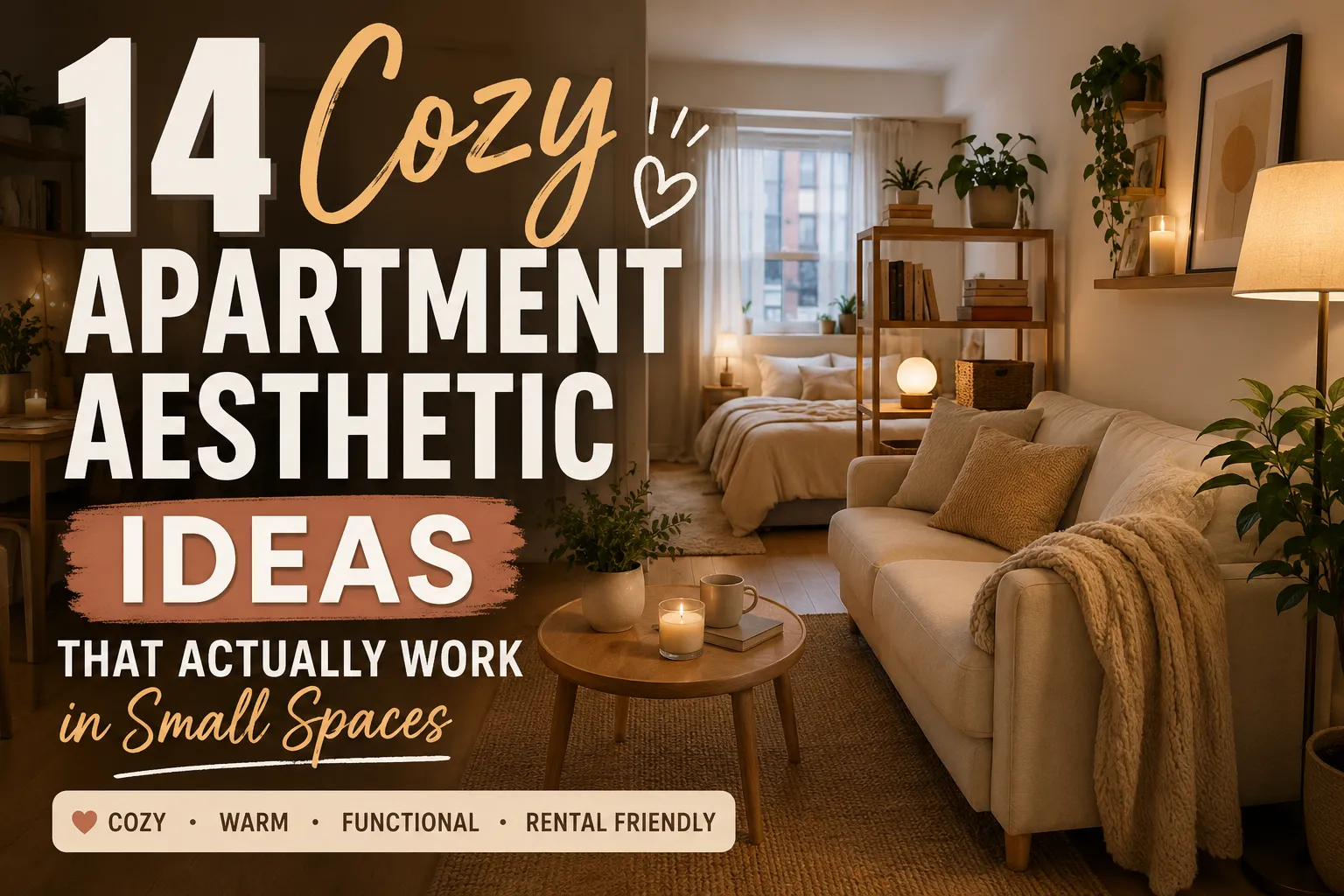
14 small apartment aesthetic cozy ideas
Small apartment aesthetic cozy ideas can turn a limited floor plan into a warm, stylish space that feels genuinely like home.
When I first moved into my small apartment, I honestly thought I’d have to choose between “organized” and “cute.” Spoiler: you don’t. Turns out, nailing that cozy apartment aesthetic in a tiny space is less about square footage and more about smart storage that doesn’t look like storage. I’ve spent way too many weekends testing what actually works for small cozy apartment decor—stuff that’s renter-friendly (no drilling holes you can’t patch), doesn’t cost a fortune, and still gives major warm apartment decor vibes.
If you’re tired of your studio apartment decor looking like a Pinterest board that gave up halfway through, these 12 storage hacks are for you. They’re simple, they’re custom-looking without the custom price tag, and honestly? Your small space is about to feel like an actual sanctuary instead of a place you’re just… surviving in.
1. Build Light in Layers, Not from One Source
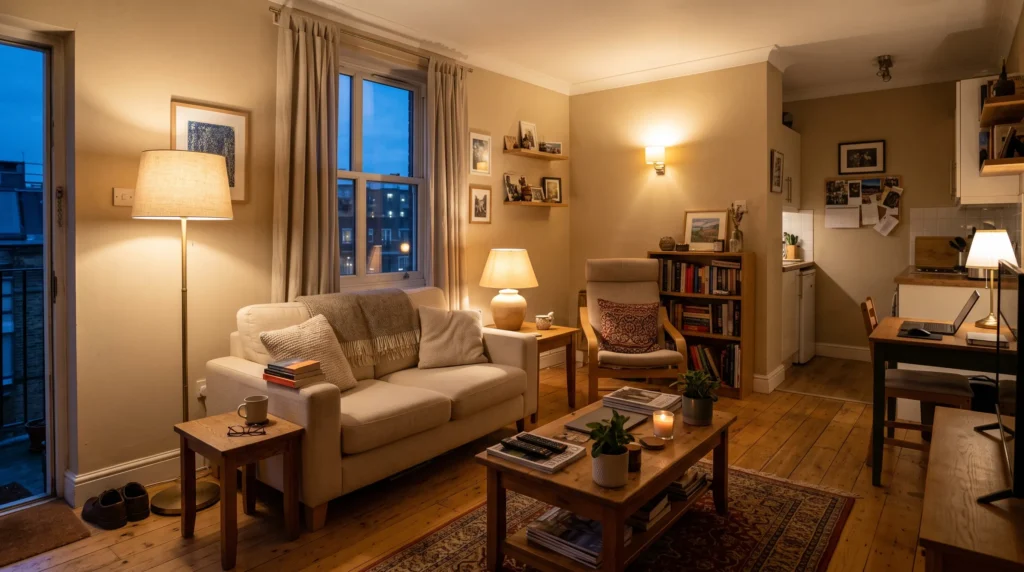
Most small apartments come with a single ceiling fixture, and it’s almost always too bright, too flat, and too far above eye level to feel warm. Turning that one light off — or at least turning it down — and replacing it with two or three smaller sources is the single change that made the biggest difference in my own place. A floor lamp next to the couch, a small lamp on a side table, and one warm sconce near a reading chair do more for the mood of a room than any paint color ever could.
The trick most people get wrong is bulb temperature. A 5000K “daylight” bulb from the hardware store will undo everything, no matter how nice the lamp is. Look for bulbs around 2700K, sometimes labeled “soft white” or “warm white” — that’s the range that makes skin, wood, and neutral walls look inviting instead of clinical. If your building allows it, dimmable smart bulbs are worth the extra ten dollars because they let you shift the mood from “getting ready for work” to “unwinding” without buying a second set of lamps.
Lighting also does quiet work in open-plan or studio apartment decor layouts, where there’s no wall to separate the bed from the couch from the kitchen table. A lamp positioned at each “zone” — one by the sofa, one by the bed, one near the dining spot — creates a visual boundary that a rug alone can’t. Your eye reads three pools of light as three distinct areas, even if there’s nothing physically dividing them.
Keep the shades themselves simple. Linen, cream, or frosted glass all diffuse light evenly and blend into almost any color scheme, so you’re not locked into replacing them if your decor changes later. Add a candle or two on a shelf for evenings — not for the scent, just for the flicker, which does something a bulb can’t replicate. None of this requires touching the wiring or the landlord’s fixture. It’s simply rearranging what light you already have access to.
2. Stack Soft Textures Without Turning the Room Into a Catalog
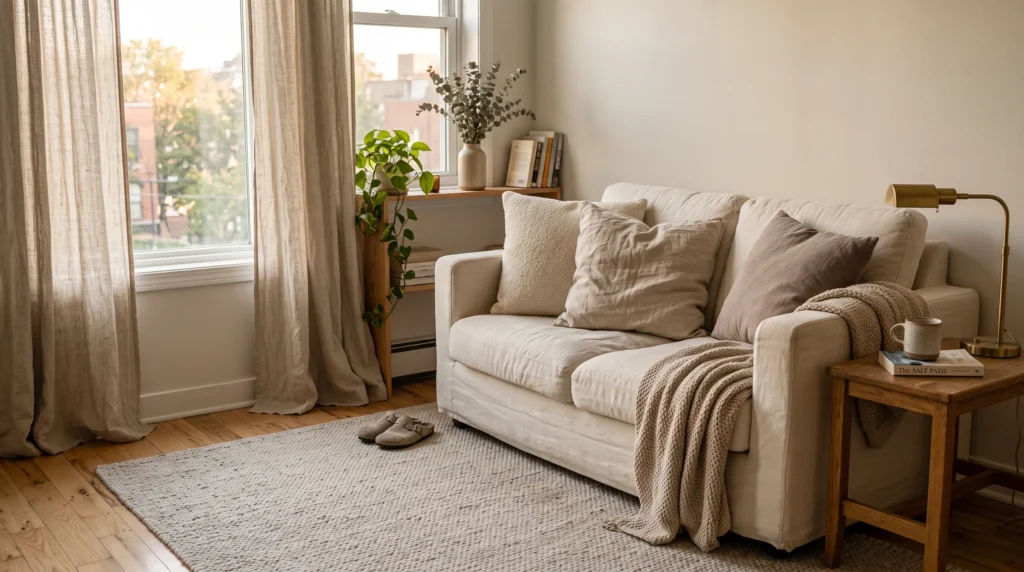
Texture is the fastest way to make a small living room feel comfortable, and it’s also the easiest one to overdo. Start with one washable area rug — this matters more than people expect, since a bare floor in a small room reads as cold no matter how warm the walls are. From there, add a throw blanket that actually gets used (not one that sits folded for photos) and two or three cushions in different weaves: linen next to boucle, cotton next to something slightly nubby.
The mistake I made early on was buying cushions in different patterns instead of different textures. Patterns compete with each other in a small room; textures don’t. If you keep the color palette tight — cream, oatmeal, taupe, warm beige — and vary the material instead of the print, the room reads as intentional rather than mismatched. This is one of those small apartment aesthetic details that photographs well by accident, because it was never styled for a photo in the first place.
A textured curtain adds a layer most people skip. Even a simple linen panel over a plain window changes how the light falls into the room in the evening, and it costs less than most throw pillows. If your apartment has hard flooring throughout, this kind of layering matters even more — a single rug plus one textured curtain can soften an entire room that would otherwise sound and feel like an empty box.
Restraint is what separates “cozy” from “cluttered” here. Pick one rug to anchor the main seating area, one throw, two or three cushions, and stop. Every extra textile you add past that point starts working against you — more laundry, more visual noise, and a room that looks staged rather than lived in. The goal isn’t maximum softness; it’s just enough that the room stops feeling like a rental.
3. Let Wood Do the Work That Accessories Usually Do
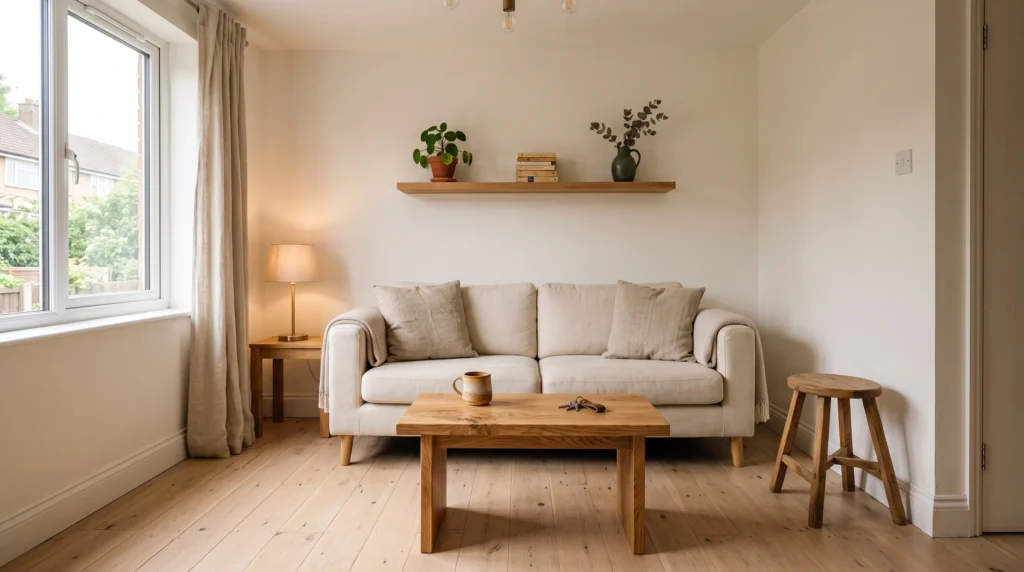
White walls and pale flooring are common in rental units, and they’re also the reason so many small apartments feel a little sterile no matter what you hang on the walls. Natural wood fixes this faster than almost anything else, because it introduces grain and warmth without adding visual clutter. A small oak coffee table, one floating shelf, or a simple wooden stool can shift the entire feel of a room.
What matters more than the piece itself is consistency. Mixing a dark walnut console with a light ash shelf and a honey-toned side table will fight itself no matter how nice each piece is individually. Pick one wood tone — or at least two that sit close together on the color wheel — and stick with it across the apartment. Lighter woods like oak, ash, and birch tend to work better in genuinely small rooms because they add warmth without making the space feel heavier or darker.
You don’t need to fill every surface. A narrow console behind the sofa, doubling as extra storage, is often enough on its own. If you have space for open shelving, resist the urge to fill every inch of it — three or four objects (a plant, a stack of books, one ceramic piece) styled with actual gaps between them will always look more considered than a shelf packed edge to edge.
Pair the wood with the soft neutrals and textiles from the earlier sections and you’ve already covered most of what a cozy apartment aesthetic needs, without buying a single “statement piece.” Wood is doing quiet, structural work here — it’s the material equivalent of a good foundation, not a decoration on top of one.
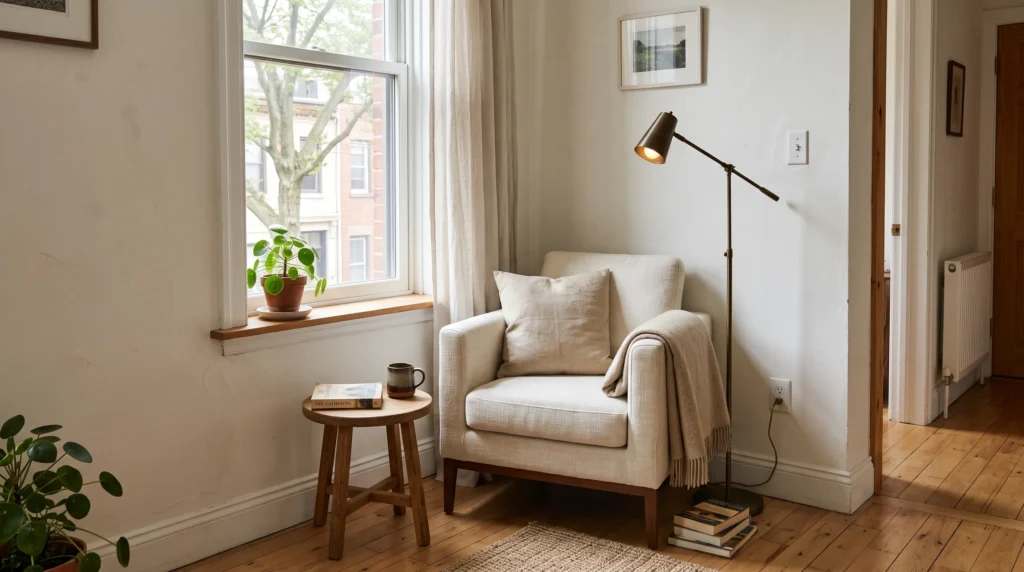
4. Carve Out a Reading Nook, Even If It’s Just a Chair and a Window
Not every small apartment has room for a dedicated reading corner, but almost every apartment has one underused patch of floor — next to a window, in an awkward corner near a bookshelf, or beside an unused wall — that can become one. All it takes is a compact armchair, a narrow side table, and a lamp that actually gives enough light to read by after dark.
Scale is the part people get wrong. A bulky recliner will swallow a small nook and make the surrounding room feel cramped. Look for a chair with slim, visible legs and narrow arms — furniture you can see through, in a sense, reads as lighter even when it takes up the same floor space as something bulkier. A round side table barely bigger than a dinner plate is usually enough for a mug and a book; it doesn’t need to double as storage.
If the corner doesn’t get much daylight, prioritize the lamp over the chair. A warm, adjustable-head floor lamp solves more problems than an expensive chair in a dim corner ever will. Add one cushion and a folded throw, and resist adding anything else — a nook works precisely because it’s small and slightly separate from the rest of the room’s activity.
This is one of those small living room styling moves that costs very little but changes daily behavior more than almost anything else on this list. A chair by a window with good light is somewhere you’ll actually sit for ten minutes with coffee, which is worth more than a coffee table book nobody opens.
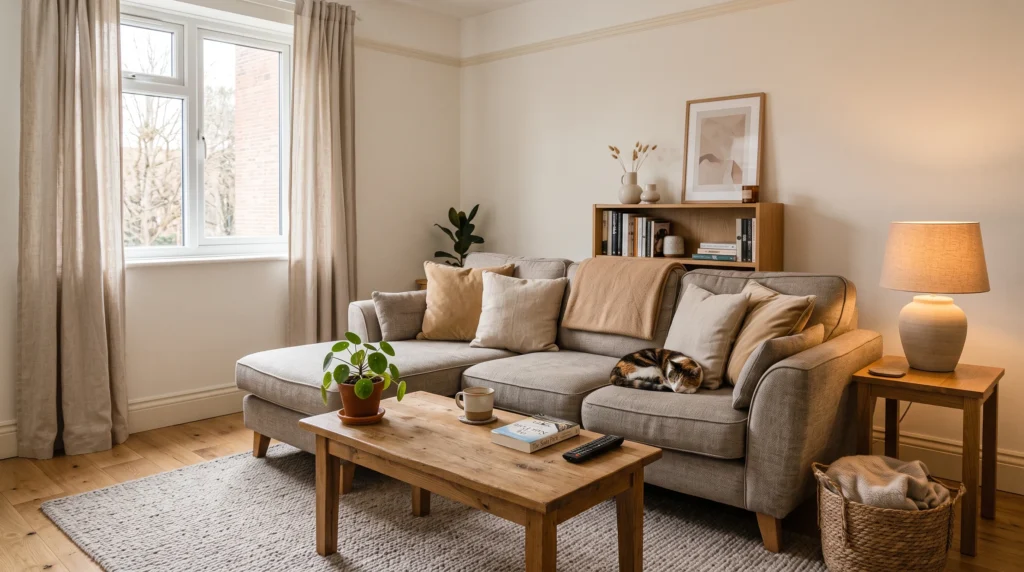
5. Choose a Neutral Palette With Warm Undertones, Not Just “Neutral”
Neutral doesn’t automatically mean cozy. A lot of “neutral” paint and furniture actually leans cool — grays with blue undertones, whites that read stark rather than soft — and in a small room with limited daylight, that coolness gets amplified. The fix isn’t complicated: swap stark white for warm white, cool gray for greige, and bright white trim for cream.
Test this before committing to anything expensive. Paint swatches and fabric samples look different under your apartment’s actual lighting than they do in a store or online photo, and warm undertones especially can shift depending on what’s next to them. If your apartment doesn’t get much direct sun, lean toward the warmer end of every neutral — oatmeal instead of gray, honey beige instead of taupe.
You don’t need to match every surface exactly. In fact, slightly varying the tone across walls, rugs, and upholstery — two or three shades within the same warm-neutral family — creates more depth than a single uniform color would. This is what makes a small cozy apartment decor scheme feel finished instead of flat: enough variation to hold visual interest, but nothing that clashes.
The real advantage of a warm neutral base is flexibility. Once the big-ticket items — walls, rug, sofa — sit in that same warm family, you can swap in seasonal accents (a darker cushion in fall, a lighter throw in summer) without redoing the whole room. It’s the closest thing to a permanent decision that still leaves room to change your mind.
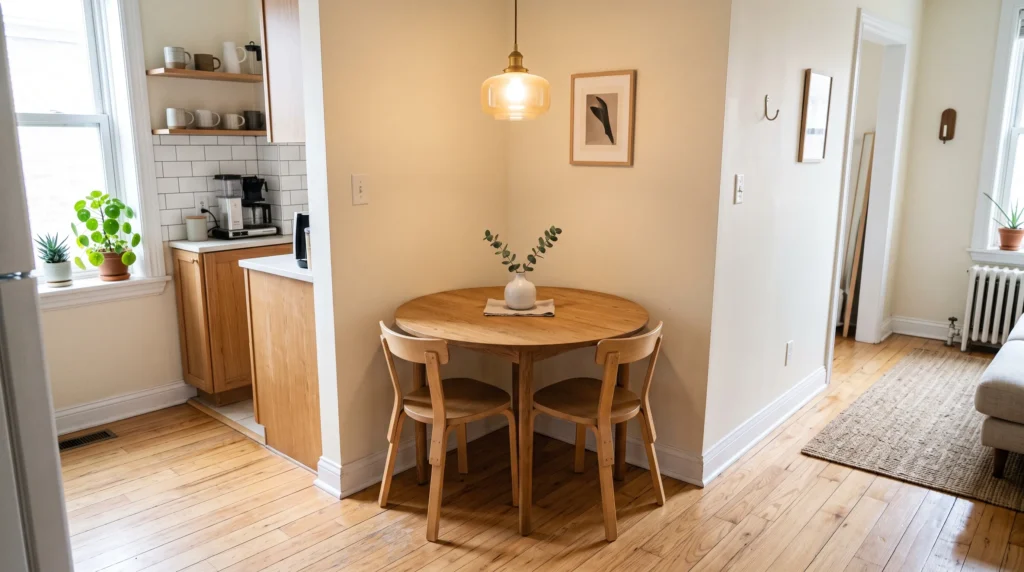
6. Set Up a Dining Space That Doesn’t Block the Room
A dining table in a small apartment has to earn its floor space, and a full-size four-top rarely does. A round or square table sized for two, pushed against a wall or tucked near the kitchen, usually works better — and a drop-leaf table is worth the slightly higher price if you occasionally host, since it can expand for guests and fold back down the rest of the time.
Chairs matter more than people expect here. Bulky upholstered dining chairs eat floor space even when nobody’s sitting in them; slim wood or metal chairs that can slide fully under the table when not in use free up several square feet of walking room. If you’re tight on space, stackable chairs are worth considering even if they’re slightly less comfortable — you can store two of them in a closet and only bring them out when needed.
One pendant light hung above the table does more to define a “dining zone” in an open-plan apartment than the table itself. It signals to your eye that this spot has a specific purpose, separate from the rest of the room, without needing a wall or a room divider.
Keep the tabletop styling minimal day-to-day — a small vase or a linen runner is plenty. A table that also functions as a desk or a prep surface needs to be cleared and reset constantly, and it does that job better with less permanently sitting on it. This is a case where a slightly smaller, more flexible table beats a larger “proper” dining set almost every time in a compact apartment.
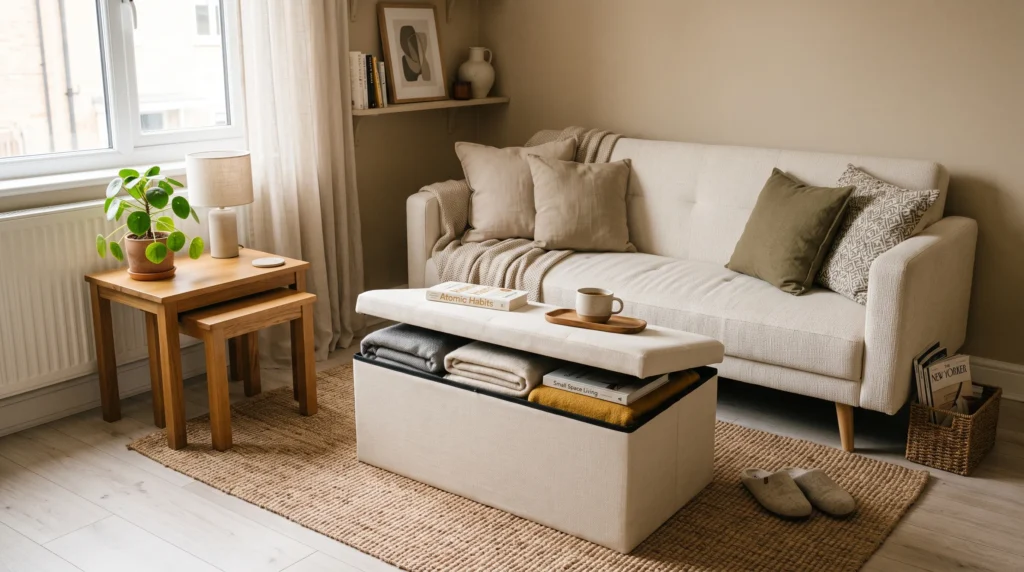
7. Buy Furniture That Solves Two Problems at Once
Every extra piece of furniture in a small apartment costs you floor space, so the furniture that earns its place is the kind that does more than one job. A storage ottoman is the clearest example — footrest, occasional coffee table, and hidden storage for blankets or remotes, all in one object that takes up less room than a coffee table and a chest would separately.
A sofa bed is the bigger version of the same idea, and it’s worth considering even if you don’t host guests often, simply because it removes the need for a guest room you don’t have. Nesting tables are a smaller-scale version — separate them when you need extra surface area, stack them back down when you don’t, and they take up a fraction of the footprint of two fixed side tables.
The trap to avoid is buying something “multifunctional” that’s actually just large. A storage bed frame that’s six inches wider than a standard frame isn’t saving you space; it’s costing you space in exchange for storage you could have gotten from an under-bed bin instead. Before buying anything marketed as multifunctional, measure it against what you’re replacing — the win only counts if the total footprint goes down.
The best pieces in this category tend to be the ones that hide their second function. A console table with a fold-out leaf, a bench with a lift-up seat, an ottoman that unzips into extra seating — these solve real problems without looking like “space-saving furniture,” which is exactly what keeps a small apartment from looking like it’s constantly compensating for its size.
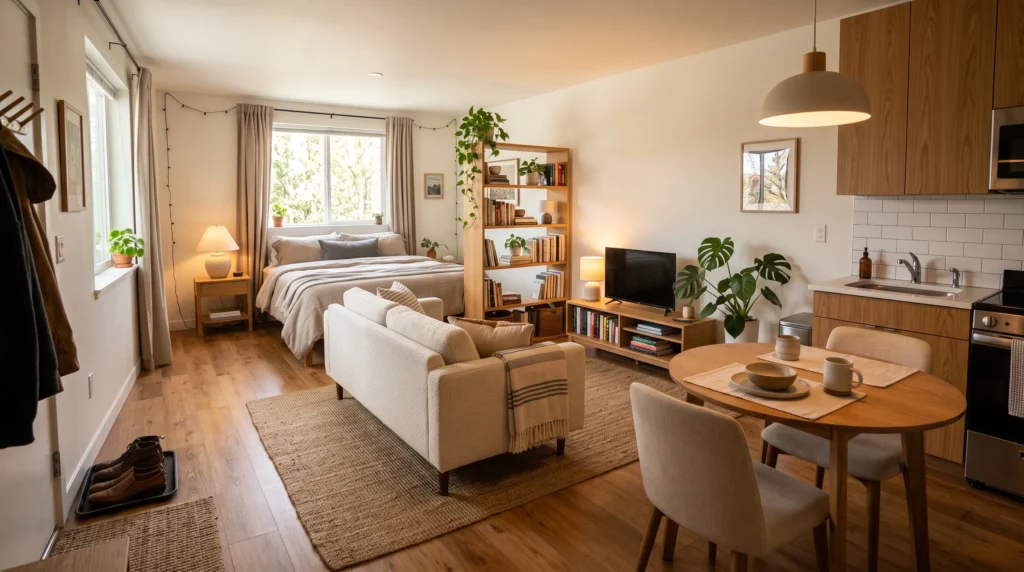
8. Give an Open-Plan Layout Invisible Walls
Studios and open-plan apartments have one recurring problem: without walls, every activity bleeds into every other one, and the whole apartment can start to feel like one undifferentiated room. You don’t need construction to fix this — a rug under the sofa, a bookcase angled to partially block the sightline to the bed, or a curtain panel near the sleeping area can all function as walls without actually being walls.
Furniture placement does more of this work than most people realize. A sofa with its back to the “bedroom” side of a studio creates a soft boundary just by existing there — you don’t need to add anything else. The same goes for a narrow bookcase placed perpendicular to a wall instead of flush against it; it reads as a partial divider rather than just storage.
Repetition across zones matters as much as separation. If the “living room” side of an open studio has warm wood tones and the “bedroom” side has completely different materials, the apartment can start to feel disjointed rather than zoned. Keep the same wood tone, the same two or three neutral colors, and the same general lighting warmth on both sides, and the zones will feel connected even while staying visually distinct.
Leave clear walking paths between each area — this is the part that’s easy to sacrifice when you’re trying to fit a lot of “zones” into one room, and it’s the part that makes the difference between a studio that feels open and one that feels like an obstacle course. A smaller number of well-placed dividers almost always beats a larger number of half-measures.
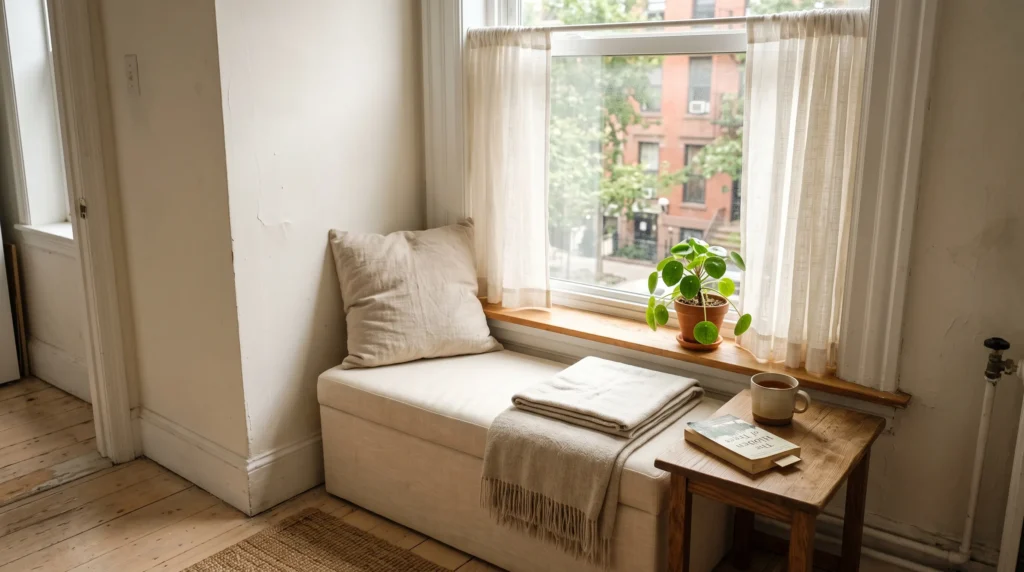
9. Make the Window the Best Seat in the Apartment
If your apartment has one good window, it’s probably being underused. A slim bench, a single compact chair, or even a wide, cushioned windowsill can turn that spot into the most-used corner in the place, and it barely requires any floor space to do it.
Sheer linen curtains are worth the small investment here — they cut glare without blocking the light that makes small rooms feel bigger, which blackout curtains or heavy drapes would undo. Keep the curtain rod mounted wide of the window frame (not directly on it) if your lease allows a renter-friendly bracket, since it lets more light in even when the curtains are closed partway.
Watch the depth of whatever furniture you put here. A window corner is usually narrow, and a chair or bench that’s too deep will block the radiator, the window’s swing, or the natural walking path past it. Shallow, slim-profile pieces work better than anything overstuffed. A storage bench is a smart choice if you can find one shallow enough — it adds seating and hides blankets or off-season items at the same time.
Add one cushion, one small plant that can tolerate direct sun, and stop there. This corner works precisely because it’s small and a little separate from the rest of the apartment’s activity — it doesn’t need styling, it needs a reason to sit down, and good light plus a comfortable seat is usually enough.
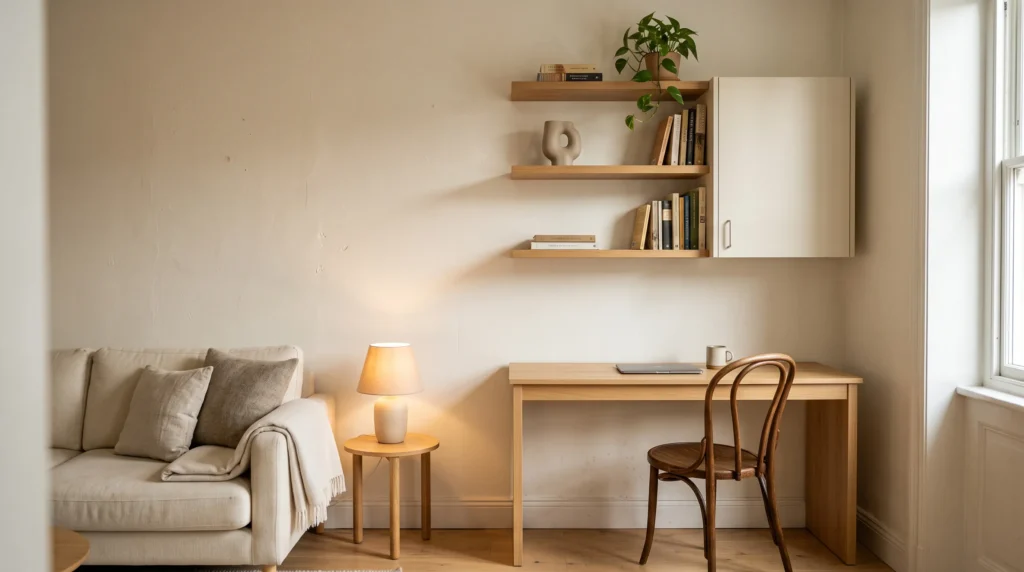
10. Use the Walls You’re Not Using
Vertical space is the most underused resource in almost any small apartment, and wall-mounted storage is the most direct way to claim it back without touching the floor plan. Floating shelves above a desk, a slim cabinet near the entry, or a wall-mounted media console under the TV all free up floor space that would otherwise go to a bookcase or a media stand.
The failure mode here is filling every wall just because you can. One or two genuinely useful installations — a shelf where you actually need extra storage, a cabinet that solves a real clutter problem — will do more for the apartment than five scattered shelves that end up half-empty or over-decorated. Pick the wall that’s solving an actual problem first.
Open shelving works best with restraint: a few books, one or two ceramic pieces, a plant, with visible gaps between them. Anything with a “closed” option — a cabinet door, a drawer — is the better home for things you use daily but don’t want on display: chargers, mail, cleaning supplies, the stuff that makes a room look messy within an hour of being tidied.
Command-style adhesive hooks and strips have gotten strong enough to hang lightweight shelves without drilling, which matters if you’re renting and want this to be reversible. Always check your lease first — some buildings are fine with adhesive products and others aren’t — but in most cases, wall storage is one of the few upgrades here that adds real functional square footage without any construction at all.
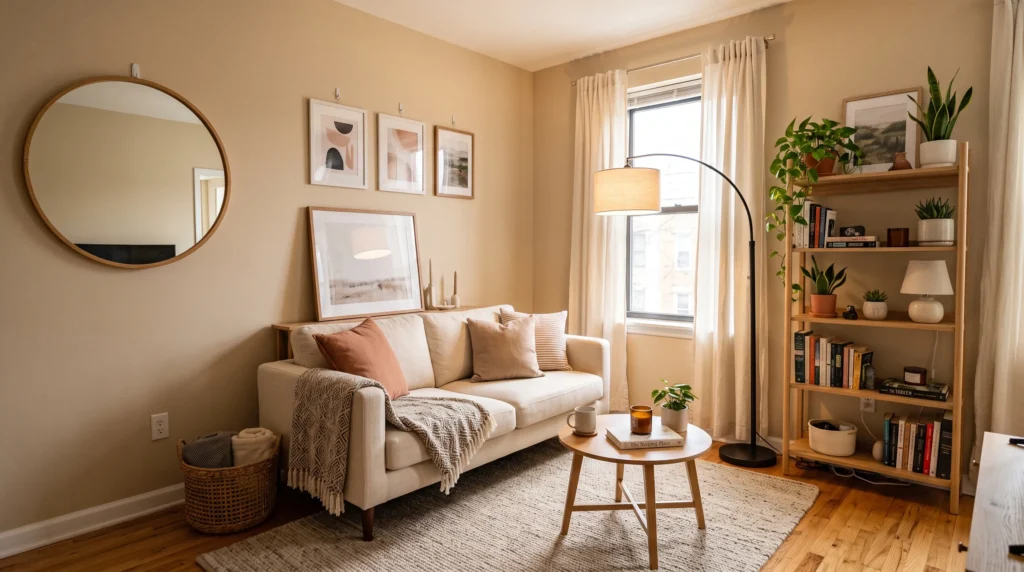
11. Decorate Like You Might Move (Because You Might)
Renting shouldn’t mean living with someone else’s beige walls and standard fixtures for years. The upgrades that move with you — rugs, curtains, lamps, artwork, mirrors, freestanding shelves — do almost all of the same work that a renovation would, without needing a landlord’s approval or a security deposit risk.
A large rug is probably the single highest-impact renter-friendly purchase you can make. It visually anchors a room in a way that paint usually would, and it goes with you to the next place. A floor lamp does the same job that recessed lighting or a fixture swap would, minus the electrician and minus the need to restore the original fixture before you move out.
If you want color or pattern beyond what neutral walls give you, removable wallpaper panels or framed prints do that job without commitment — you can change them as often as you’d repaint, at a fraction of the cost and effort. Command hooks and tension rods cover most of what nails and drilled anchors used to be needed for, including curtain rods, art, and light shelving.
Always check the lease before using adhesive products, even “removable” ones — some finishes don’t take kindly to any adhesive, and it’s cheaper to ask than to lose part of a deposit. Working with the apartment’s existing bones — its layout, its light, its fixed points — instead of fighting them tends to get better results anyway. A rental with the right rug, the right lighting, and a few reversible changes can look more finished than an owned space that was never fully styled.
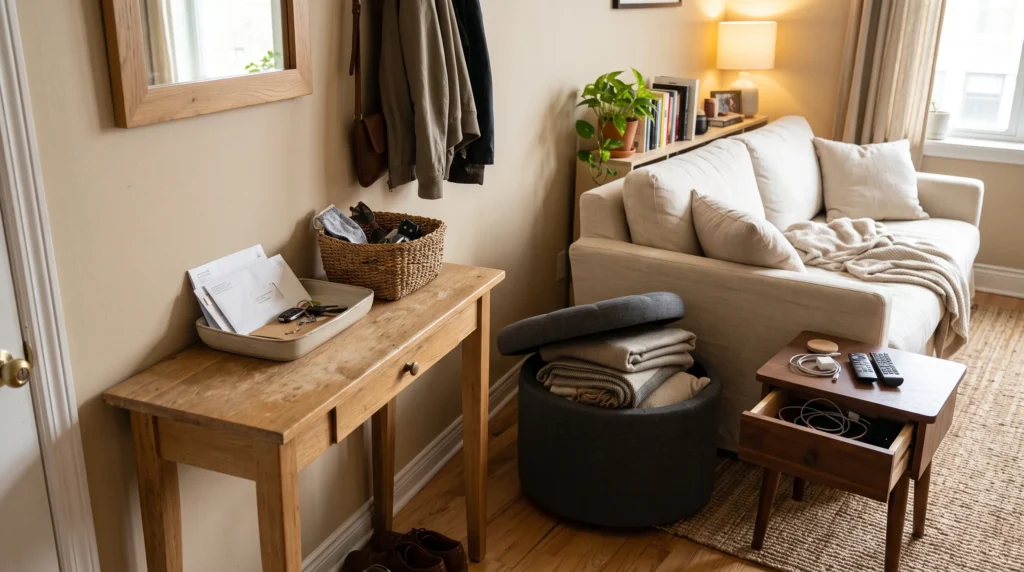
12. Give Everyday Clutter Somewhere Specific to Go
A cozy apartment can turn cramped fast if every surface stays covered in daily-use items — mail, chargers, remotes, whatever you set down when you walk in. The fix isn’t owning less; it’s giving each category of clutter one specific, close-by home so putting things away takes seconds instead of thought.
Start with what actually accumulates in your apartment, not a generic list. If mail piles up near the door, a small tray or shallow basket right there solves it. If chargers end up tangled on the coffee table, one drawer near the outlet you actually use fixes it faster than any organizer bought without that specific problem in mind. A storage ottoman is good for blankets specifically because blankets are bulky and used often enough that a closet is too far away.
The mistake to avoid is buying storage before deciding what it needs to hold. A large basket bought “for stuff” tends to become a catch-all that’s just as disorganized as the clutter it replaced, just contained. Smaller, purpose-specific storage — one drawer, one tray, one basket, each assigned to one category — works because it removes the decision-making step every time you need to put something away.
A short reset before bed, putting the handful of things back where they belong, keeps this system working. It only takes a few minutes if everything already has a place; it takes much longer if you’re deciding where things go each time. The goal was never a completely empty apartment — it’s one where the clutter that does exist has an obvious, close, specific home.
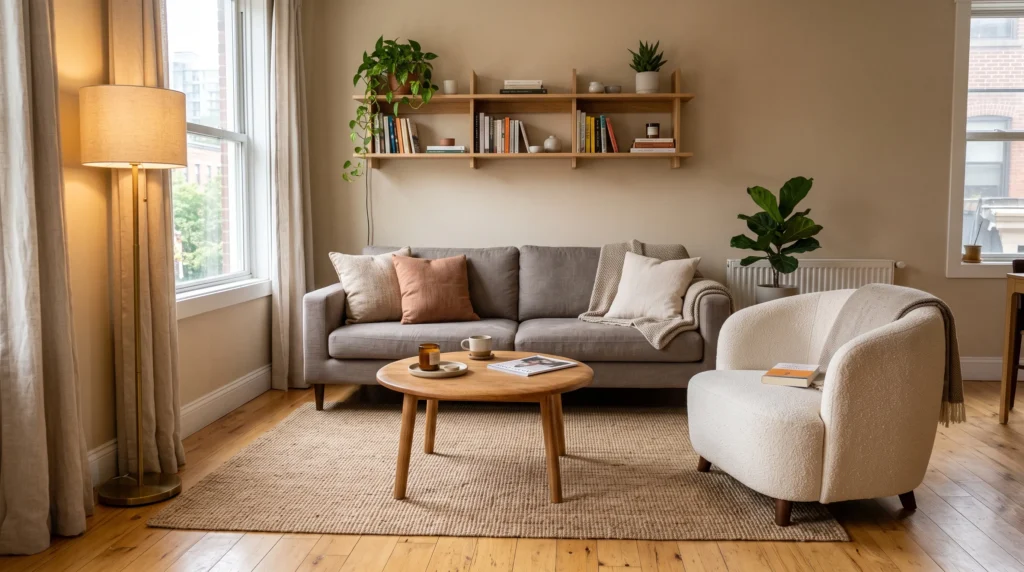
13. Soften the Room With a Few Curved Pieces
Most small apartments are full of straight lines by default — rectangular sofas, square coffee tables, boxy shelving — and one or two curved pieces can break that up without needing a full redesign. A rounded coffee table, a gently curved armchair, or even a round mirror introduces variation that a room otherwise dominated by right angles doesn’t get on its own.
Curves also help walking paths feel less rigid in tight layouts. A rectangular coffee table’s sharp corner is both a visual stopping point and, in a small room, an actual obstacle you have to navigate around. A round or oval version of the same table softens both problems at once, which matters more in compact apartments than the aesthetic benefit alone would suggest.
Don’t assume curved automatically means smaller, though — some rounded furniture actually has a larger footprint than its rectangular equivalent, since the shape needs more clearance on all sides to look intentional rather than cramped. Measure before buying, the same way you would for any other piece, and account for the clearance a round shape needs around it.
One well-chosen curved piece is usually enough. Pair it with the soft textiles, warm wood, and neutral palette already covered here, and it reads as a natural design choice rather than a theme. Overdo it — curved everything — and the room starts to feel more like a showroom than an apartment someone actually lives in.
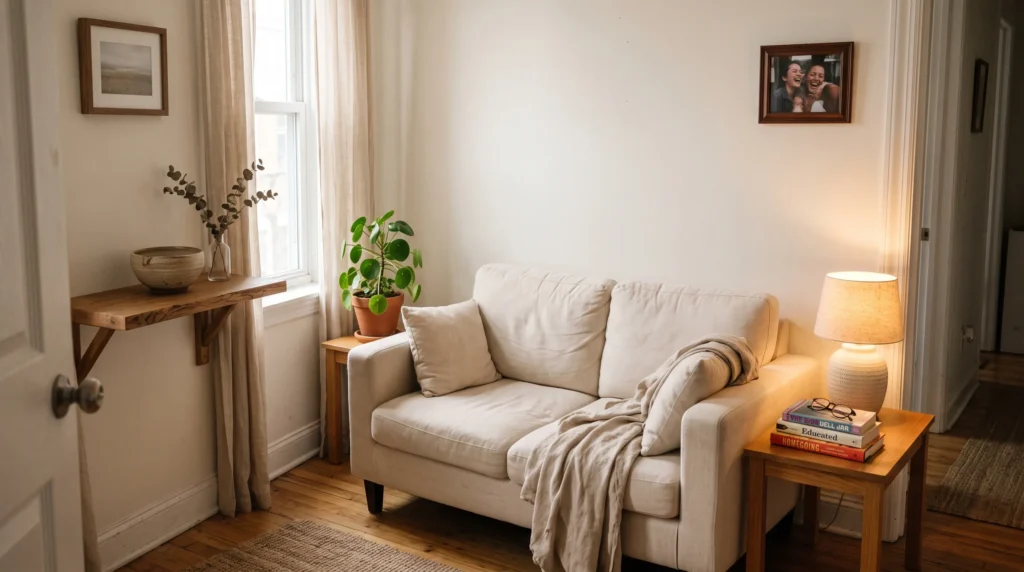
14. Let a Few Personal Objects Do the Final Work
Everything on this list up to now is about structure — light, texture, layout, storage. The last piece is the one that actually makes an apartment feel like yours instead of a well-decorated stranger’s: the handful of objects you keep around because they mean something, not because they match.
This can be as simple as a small stack of books you’re actually reading on the nightstand, one framed photo near the entry, or a piece of pottery a friend made that doesn’t match anything else in the room and doesn’t need to. These details carry more warmth than a coordinated accessory set ever will, precisely because they weren’t chosen to fill a gap in a color scheme.
Keep the collection edited rather than growing indefinitely. One meaningful print hung with intention above the sofa does more for a room than a gallery wall assembled mostly to cover empty space. If you find yourself adding things just because a shelf looks bare, that’s usually a sign to stop rather than a sign to keep going — bare space reads as calm, not unfinished.
Rotating a few seasonal pieces — a different textile in winter, a different plant in summer — keeps the apartment feeling current without constant new purchases. The apartments that feel most lived-in usually aren’t the most decorated ones; they’re the ones with just enough personality showing through a calm, uncluttered base to feel unmistakably like someone’s actual home.
Frequently Asked Questions
How do you make a small apartment feel cozy? Focus on layered lighting instead of one overhead fixture, add a couple of soft textiles (a rug and a throw are usually enough to start), and keep the color palette to two or three warm neutrals. These three changes alone do more than most single “statement” purchases.
What are good cozy apartment aesthetic ideas for small spaces? Warm lighting, natural wood accents, a defined reading corner, and multifunctional furniture like a storage ottoman all work well together because none of them require extra floor space — they layer onto what’s already there instead of adding to it.
What warm lighting ideas work best for small apartments? Skip the single ceiling fixture where possible and use two or three smaller sources — a floor lamp, a table lamp, a wall sconce — with bulbs around 2700K. Dimmable bulbs let you adjust the mood without buying more fixtures.
How do you decorate a studio apartment to feel cozy? Use rugs, furniture placement, and lighting to create separate “zones” for sleeping, living, and dining without adding walls. Keeping the same wood tones and color palette across all the zones keeps the studio feeling connected rather than chopped up.
Final Thought
None of this requires a renovation, a big budget, or permission from a landlord. Start with one change — swap a harsh overhead bulb for a warm lamp, or add one rug to a bare floor — and build from there once you see how much difference a small adjustment makes. A cozy apartment aesthetic isn’t a finished look you buy all at once; it’s a handful of small, reversible decisions that add up to a space that actually feels like yours.



One Comment