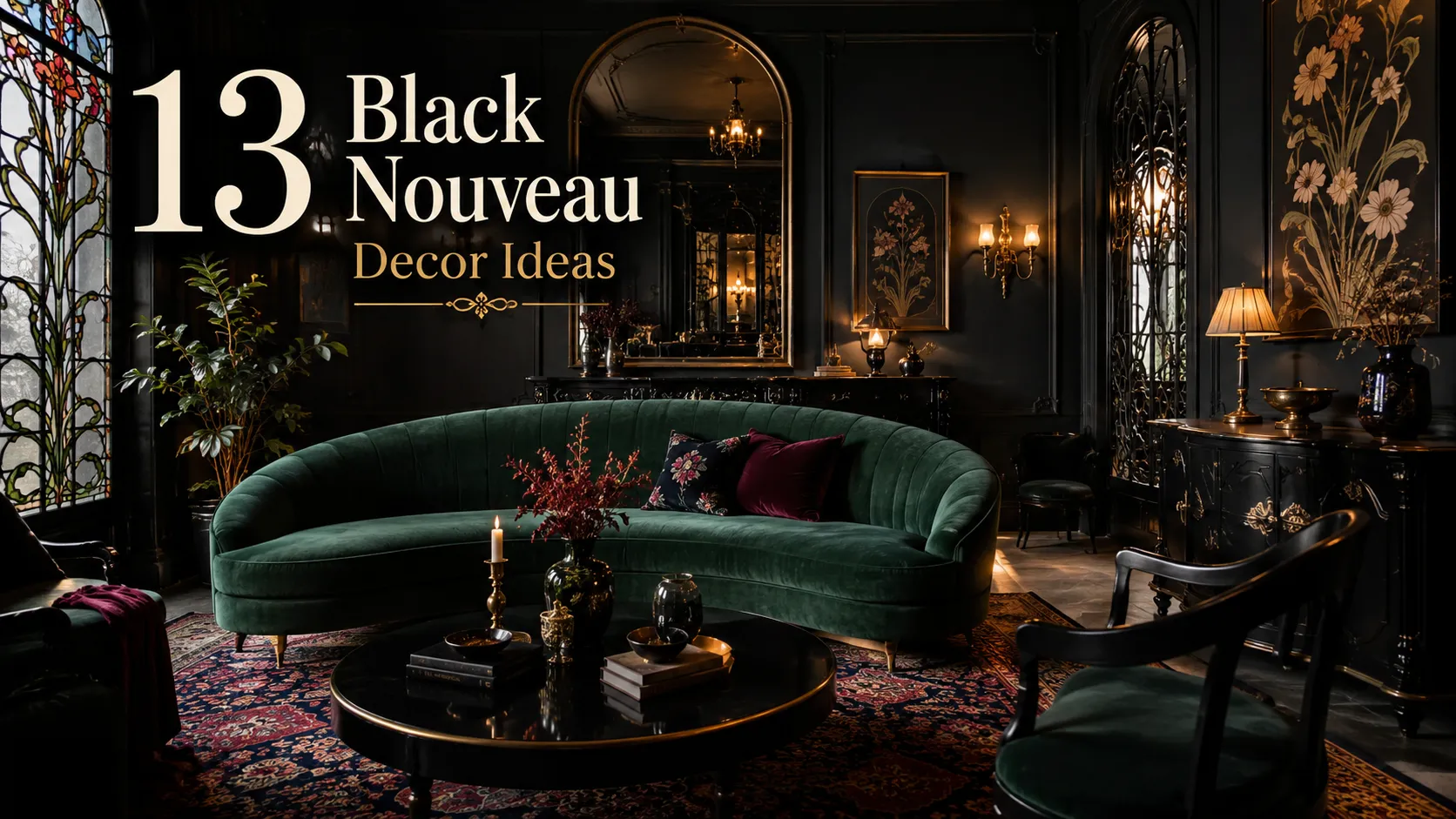
13 Black Nouveau Decor Ideas for a Moody, Elegant Home
Black Nouveau Decor brings together deep black and charcoal tones with Art Nouveau-inspired curves, botanical details, rich textiles, warm brass, and jewel-toned accents. Unlike Black Nouveau is best understood as a dark, decorative style that pairs black and charcoal tones with Art Nouveau-inspired curves, botanical and organic motifs, rich textiles, warm metals, and vintage detailing. It isn’t the same thing as plain “dark luxury” decor — the curved lines, decorative metalwork, and nature-influenced patterns are what give it a distinct identity, and they’re what separate a genuinely Nouveau room from a room that’s simply painted black.
If your space feels flat, half-finished, or too safe, you don’t need a full renovation to bring this look in. A handful of deliberate changes — a curved silhouette here, a botanical detail there, a warm brass fixture in the right spot — can shift the entire mood of a room without turning it into a cave. Below is a short guide to what actually defines the style, followed by 13 ways to bring it into your own home.
What Actually Makes a Room “Black Nouveau”
Before getting into individual ideas, it helps to know what separates this style from other dark interior trends.
Color palette: deep black and charcoal as a base, layered with jewel tones — emerald, burgundy, sapphire, amber — rather than staying strictly monochrome. Cream and warm ivory soften the palette so it doesn’t read as gothic or purely industrial.
Shapes: flowing, organic curves borrowed from Art Nouveau design — arched doorways, curved furniture backs, sweeping lines in metalwork — instead of the hard geometry associated with Art Deco or the minimalism of modern black interiors.
Materials: black lacquer, aged brass, wrought iron, dark wood, and stone, often finished with a slight sheen rather than a completely matte or completely glossy surface.
Motifs: botanical and nature-inspired patterns — vines, florals, peacock or bird motifs — appear on wallpaper, textiles, and decorative accents, giving the style a more artistic, less austere feel than gothic or dark academia interiors.
Lighting: warm, decorative, and sculptural — think stained glass, wrought-iron fixtures, and brass sconces rather than plain recessed lighting.
Once you know these markers, it becomes much easier to tell the difference between “a room painted black” and a room that genuinely earns the Black Nouveau name. The ideas below build on these principles.
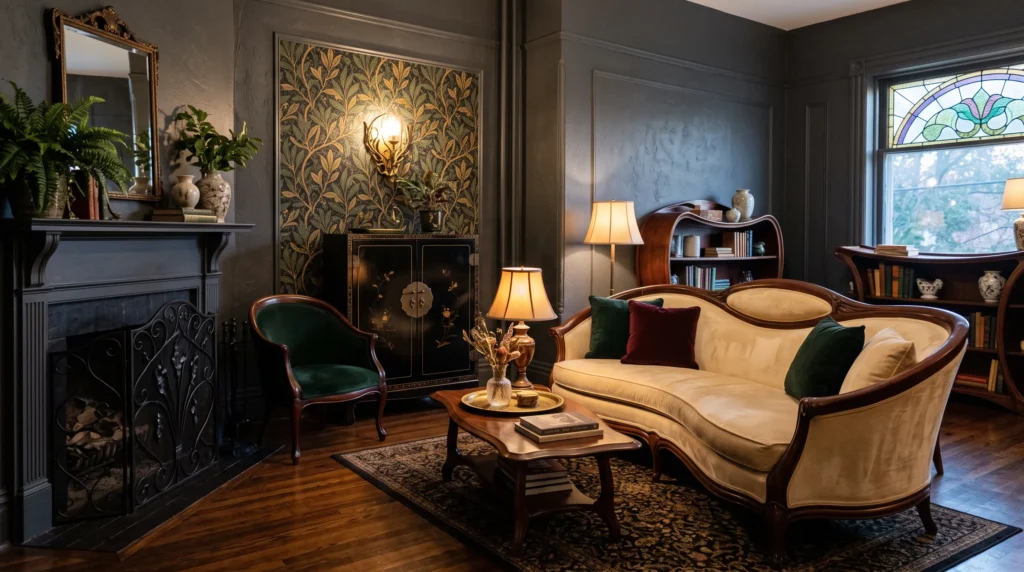
1. Matte Black Accent Wall
A single dark wall does more for a room’s atmosphere than almost any other change, and it’s a natural starting point for this style because it gives every other Nouveau element — curved furniture, brass fixtures, botanical art — a backdrop to stand out against. A soft matte or low-sheen black on one focal wall, with the surrounding walls kept in warm ivory or muted beige, creates depth without covering every surface.
This works especially well behind a bed or a media console, since it gives the eye a clear anchor point. Choose a genuinely matte paint; satin or eggshell finishes tend to bounce light unevenly and can make black paint look patchy instead of rich.
Pair the wall with pieces that carry the style’s signature curves — an arched mirror, a rounded console, a botanical print — rather than boxy, straight-edged furniture, which will read as generic dark decor instead of Nouveau. Warm-toned bulbs around 2700K matter more here than most people expect; cool white lighting flattens matte black and can make it look muddy rather than deep. If natural light is limited, mix a floor lamp with a smaller accent light so the wall keeps its dimension after dark.
Best for: bedrooms and media walls. Skip it if: the room already has low ceilings and little natural light on every side.
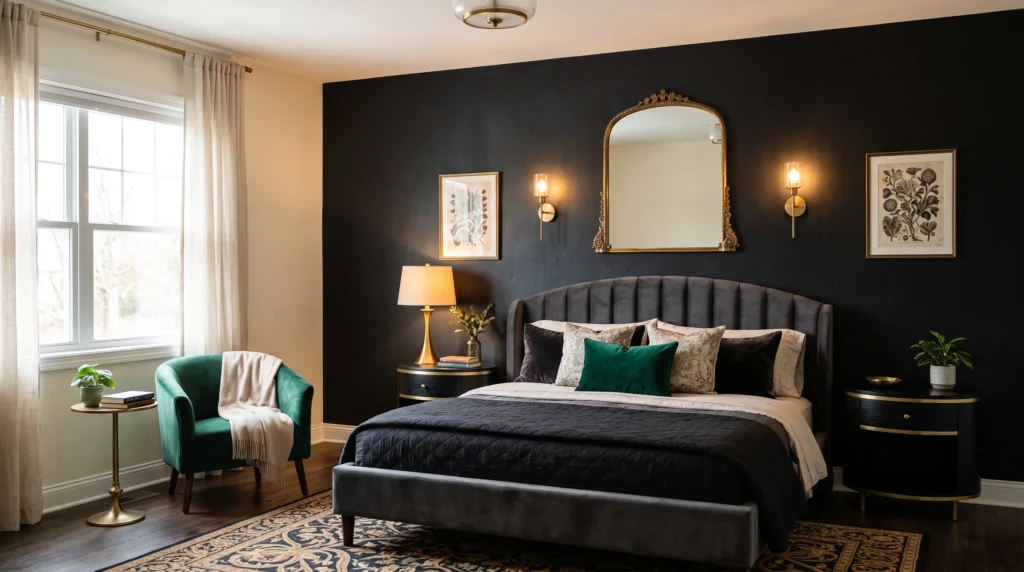
2. Art Nouveau-Inspired Wall Art
This is one of the easiest ways to add real “Nouveau DNA” to a room without a major purchase. Look for prints, panels, or framed pieces featuring flowing botanical lines, peacock or bird motifs, or the sweeping organic curves associated with classic Art Nouveau illustration and stained-glass design. These read very differently from generic black-framed photography, and they’re what actually tie a room back to the style’s namesake.
Group two or three pieces rather than a large uniform gallery wall — Black Nouveau tends to favor a few striking, artistic statements over a densely packed arrangement. Keep the palette within black, gold, emerald, and cream so the pieces feel connected even if their subjects differ.
Frame choice matters here. A black frame with a slightly decorative or curved edge suits the aesthetic better than a plain flat-black frame, which can drift toward generic modern decor. If you can find botanical wallpaper panels or a single patterned accent panel instead of framed art, that’s an even stronger nod to the style’s roots.
Balance the artwork with furniture that has softer, rounder shapes underneath it, and add one aged-brass picture light or small frame nearby for warmth. The goal is a wall that feels artistic and specific to this style, not interchangeable with any other moody living room.
Best for: living rooms and entryways. Budget move: a single botanical panel instead of a full gallery.
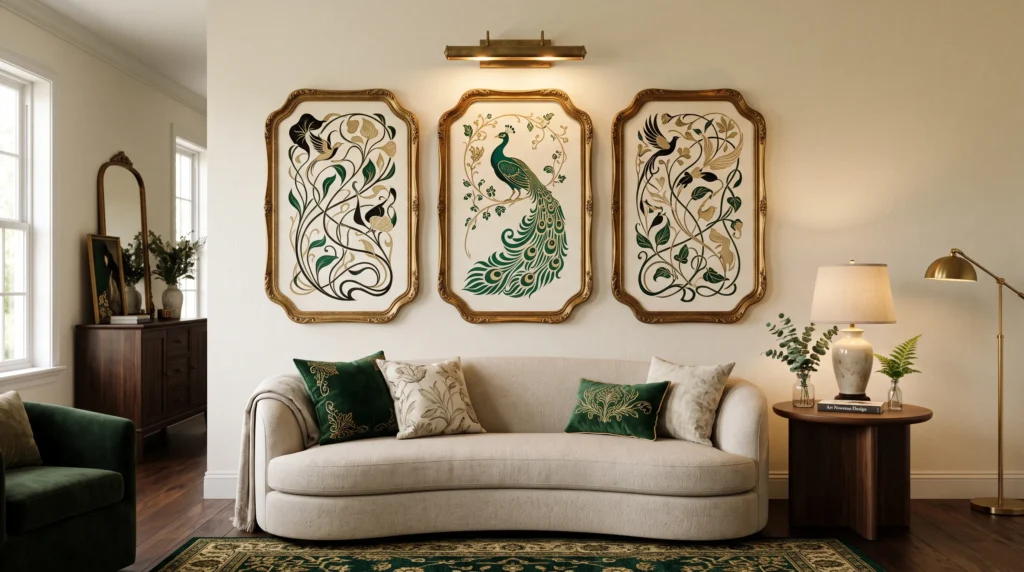
3. Sculptural, Curved Furniture
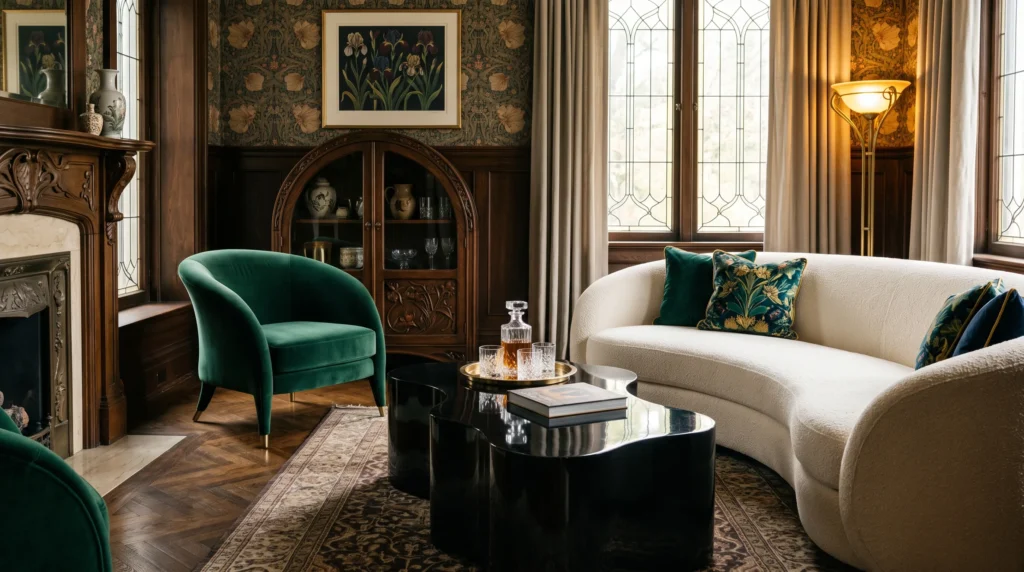
Furniture with genuine curves — arched headboards, rounded armchairs, pedestal tables, sweeping cabinet fronts — is where Art Nouveau influence shows up most clearly in a room. These forms carry visual weight on their own and connect directly back to the style’s origins in organic, flowing design, unlike the straight lines common in Art Deco or minimalist black interiors.
Black-stained wood, black lacquer, or deep espresso finishes suit this look better than high-gloss black, since a lower sheen keeps the wood grain and texture visible instead of turning the piece into a flat block. Lacquered black furniture with a slight sheen is a particularly good fit — it has just enough shine to feel decorative without going fully glossy.
One statement piece can anchor an entire room. In a bedroom, a curved dark bed frame paired with simple nightstands and soft sconces does more than a room full of matching dark pieces. In a living room, a single rounded coffee table next to a neutral sofa and a jewel-toned cushion hits the same note. Give each piece room to be seen — the curve of the silhouette is doing most of the work here, before any accessories get added.
4. Aged Brass and Wrought-Iron Details
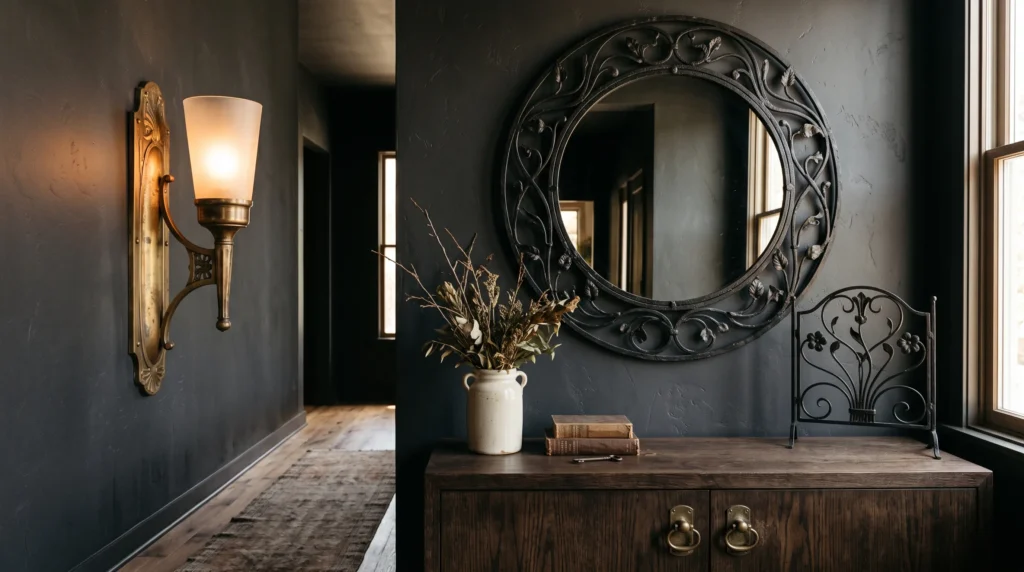
Warm, decorative metalwork is central to this style, and it covers more ground than brass alone. Aged brass on lamps, cabinet pulls, and mirror frames brings a soft glow, while wrought-iron details — a curved stair rail, a decorative screen, an iron-framed mirror or light fixture — add the sculptural, slightly ornate quality that separates Black Nouveau from plainer dark interiors.
Aged finishes are genuinely practical, too: fingerprints and small scratches blend into the existing texture instead of standing out, which matters on things like door handles that get touched constantly.
Repeat the metallic tone at a few different heights around the room — a wall sconce, a low tray, a framed mirror — rather than clustering it in one spot. Mixing brass with the occasional wrought-iron piece, especially anything with a curved or botanical silhouette, reinforces the style’s decorative roots more than brass alone would. If your home already has silver or chrome hardware, introduce brass and iron gradually through lamps and small accents rather than replacing everything at once; the mix often looks more collected than a perfectly matched set.
5. Jewel-Toned Vintage Rug
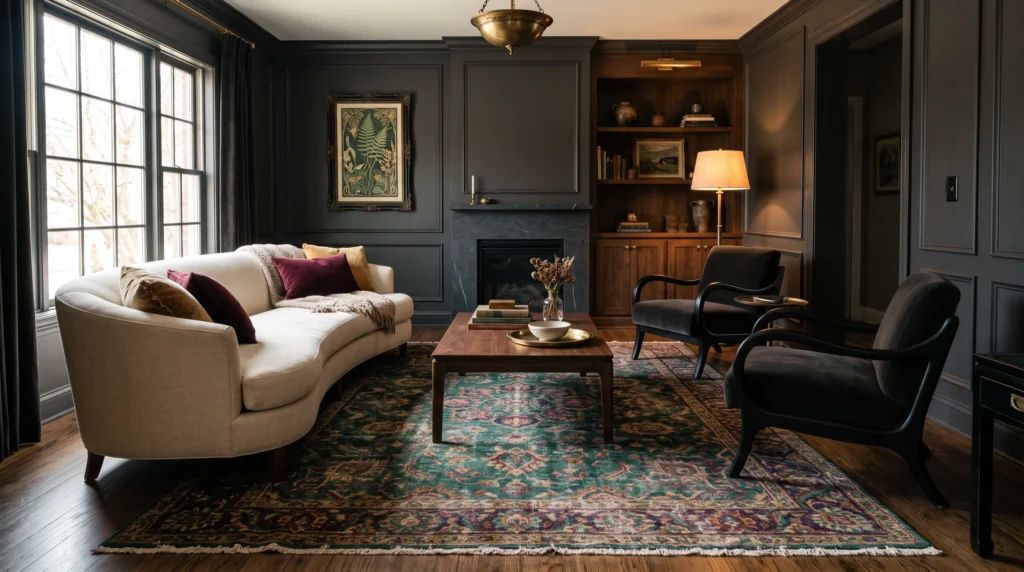
A textured, low-pile rug in a jewel tone — deep emerald, burgundy, or sapphire, often with a faded or Persian-inspired pattern — grounds a room while introducing the color layer that separates Black Nouveau from a purely black-and-neutral palette. The pattern also breaks up large blocks of dark furniture, which matters especially in living rooms where several black or lacquered pieces sit close together.
Wool or wool-blend rugs are the most practical choice, since they hold up to daily use and have a natural texture that plain synthetic rugs can’t replicate. A slightly irregular, vintage-inspired pattern also hides everyday wear better than a solid-color rug would.
Placement matters as much as the rug itself. In a living room, the front legs of the sofa and chairs should sit on the rug so the seating area feels grounded rather than floating in the middle of the floor. In a bedroom, choose a size that extends far enough beyond the bed to create a soft landing spot on both sides. Keep the surrounding flooring and furniture simple when the rug has a detailed pattern, so the room stays legible instead of busy.
6. Arched Mirror With Stained-Glass or Brass Detailing
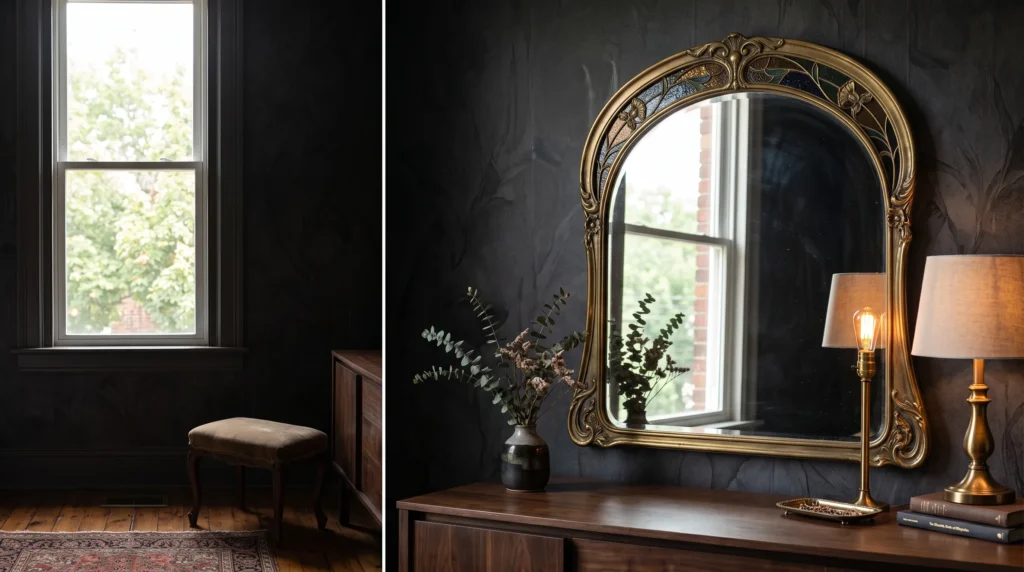
A large arched mirror does double duty in this style: it makes a dark room feel taller and brighter by reflecting existing light, and its shape — arched, scalloped, or softly rounded — is itself a nod to Art Nouveau architecture. A black or aged-brass frame with a decorative edge suits the aesthetic better than a plain flat frame.
For an even stronger connection to the style, look for a mirror or nearby light fixture with a stained-glass border or panel. Even a small stained-glass accent piece nearby — a lamp base, a hanging panel — adds color and texture that a plain mirror alone can’t provide.
Position the mirror opposite or beside a window so it bounces natural daylight further into the room, and avoid hanging it where it reflects clutter or a television screen. One oversized mirror generally does more for a room than several small decorative objects scattered across the same wall. Keep the styling around it minimal — a single lamp, a ceramic vessel, maybe a small botanical branch — so the reflection stays the focal point.
7. Dramatic Ceiling Detail
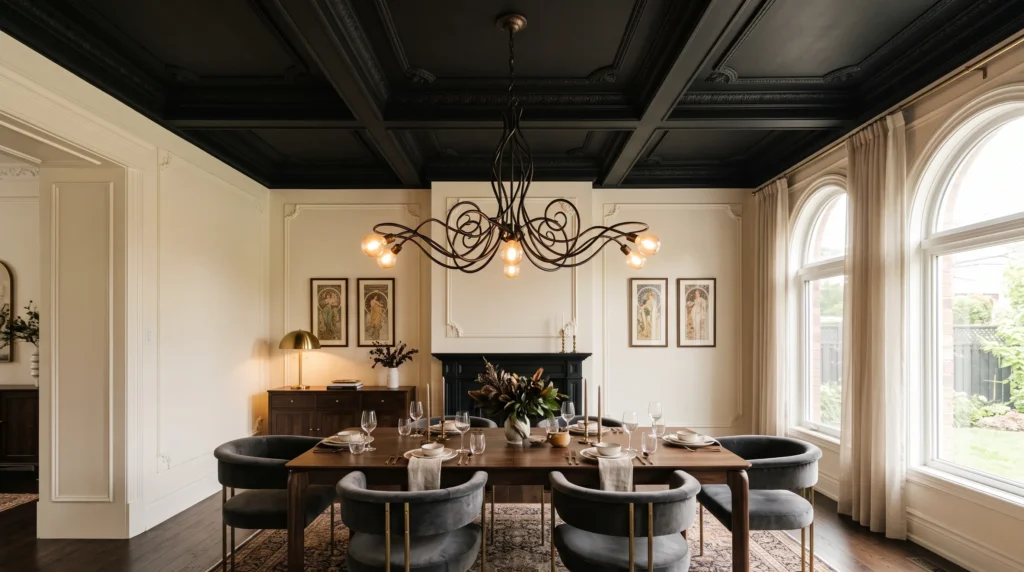
The ceiling is the most overlooked surface in most rooms, and it’s an effective place to add drama without touching the walls. A matte black ceiling creates an intimate, architectural feeling overhead while the walls stay lighter, which works particularly well in dining rooms and bedrooms with a bit of extra height.
Before painting, consider how much natural light the room gets and whether existing architectural details — beams, molding, coffered panels — would be highlighted by a dark finish. A flat ceiling can carry a simple matte black just fine, but a ceiling with visible structure reads even richer once painted, since the paint catches shadow differently across raised and recessed sections.
Warm white bulbs soften the contrast in the evening; cool or overly bright lighting tends to flatten the black finish. If painting an entire ceiling feels like too big a step, start with a smaller room or a recessed section instead. A wrought-iron or brass pendant with a curved silhouette underneath a dark ceiling reinforces the style further than a plain fixture would.
8. Curved Velvet Seating
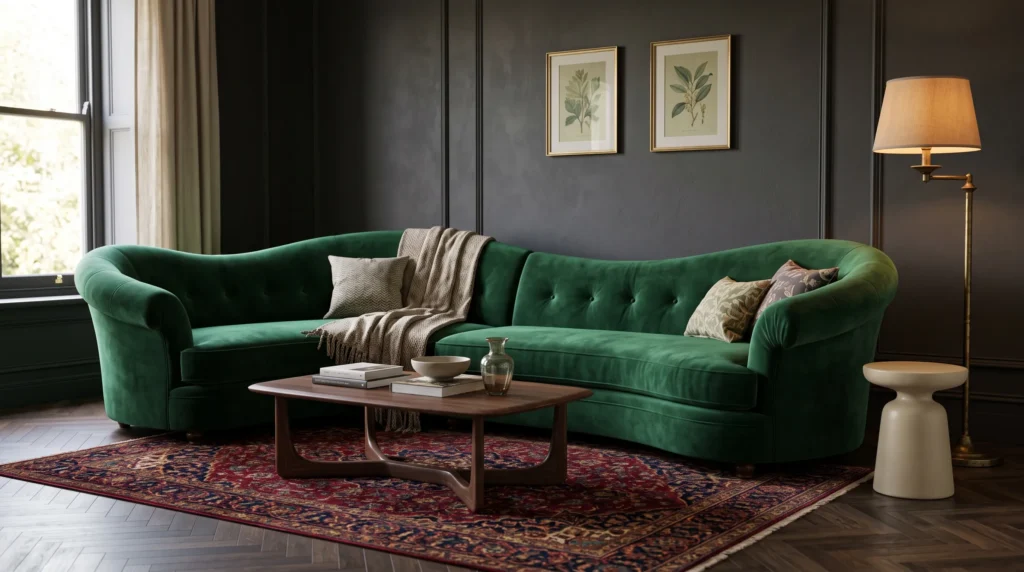
Few single pieces change a room’s feel as much as a well-shaped upholstered seat, and the curved silhouette is one of the clearest links back to Art Nouveau’s flowing lines. A curved velvet sofa or accent chair in deep charcoal, black, burgundy, or emerald softens the room while adding a sense of quiet luxury that flat, angular furniture doesn’t offer.
Velvet also shifts subtly in tone depending on the angle of light hitting it throughout the day — a quality flat cottons and linens don’t have, and one that suits this style’s slightly theatrical warmth. One substantial curved piece typically makes a stronger impression than two or three smaller accent chairs.
Keep the materials around the seating quieter: a natural wood coffee table, a jewel-toned cushion, or a plain ceramic side table. Leave enough space around a curved sofa that its silhouette is visible from across the room. For smaller rooms, a single rounded accent chair delivers the same softness at a fraction of the footprint.
9. Ornate Black Door With Decorative Glass
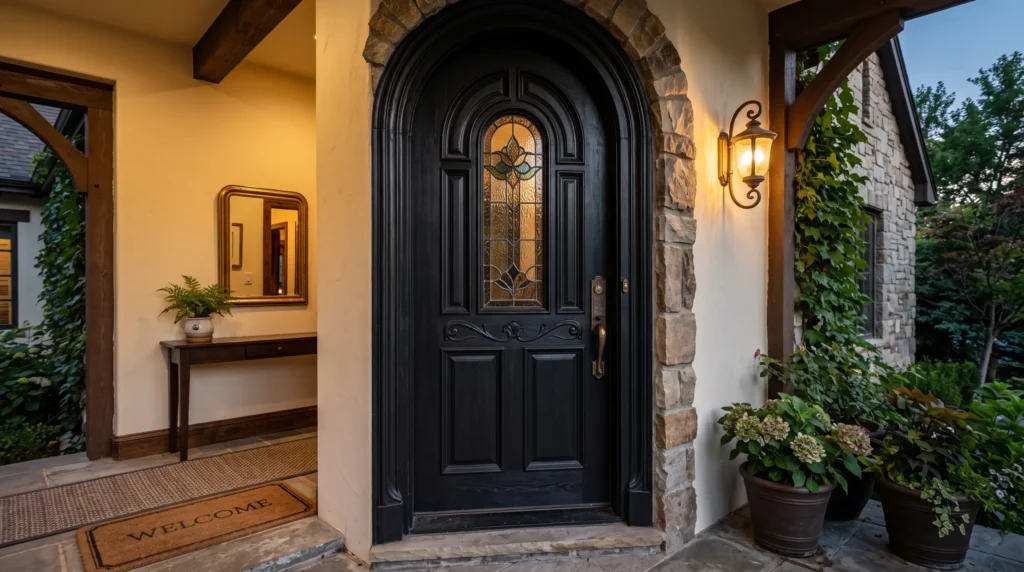
A detailed black door sets the tone for a home before anyone steps through it. Raised-panel, arched, or fluted door styles finished in matte or satin black look more intentional than a flat slab door painted the same color — the detail is what reads as designed rather than simply dark. For an especially strong Nouveau touch, a door or transom panel with a small stained-glass or leaded-glass insert connects directly to the style’s architectural roots.
Hardware carries a lot of the character here. Aged brass, antique bronze, or wrought-iron hardware with a curved profile reinforces the vintage, decorative feel; shiny chrome or polished nickel tends to clash with the softer tone this style is going for. If replacing the whole door isn’t practical, new hardware alone can shift its personality noticeably.
Keep the entryway around the door relatively calm so it stays the focal point — a narrow wood console, a vintage-style mirror, and a textured runner add function without crowding the space. Repeating one detail from the door, such as the black finish or a brass accent, somewhere else nearby helps the entry feel connected.
10. Layered Lighting With Sculptural or Stained-Glass Fixtures
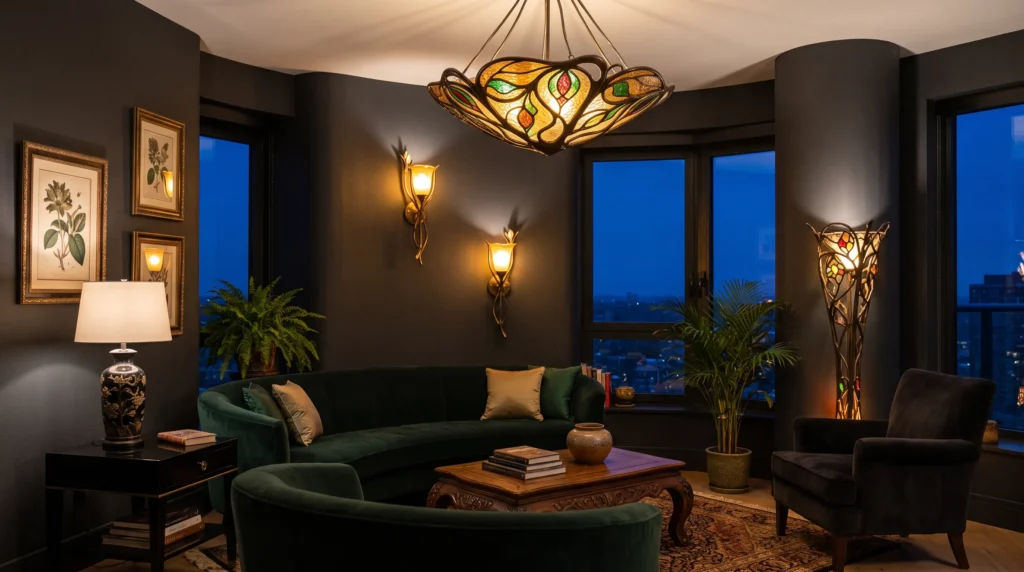
Relying on a single ceiling fixture flattens a dark room fast. Combine a pendant, wall sconces, and a floor lamp at different heights, and lean toward fixtures with a curved, botanical, or stained-glass element rather than plain geometric shapes — this is one of the more visible places to signal the style, since lighting fixtures are naturally decorative objects in their own right.
Bulb temperature matters: warm bulbs around 2700K create a comfortable glow against black, brass, and jewel-toned surfaces, while cooler bulbs tend to make the same room feel sterile even with identical fixtures. Think through what each light needs to do — a pendant usually handles general lighting, sconces highlight artwork or architectural detail, and a floor lamp anchors a reading corner.
Dimmers matter more here than in most styles, since the ability to adjust brightness shifts the room from functional in daylight to intimate in the evening. The fixtures don’t need to match perfectly; mixing a curved pendant with more angular sconces often reads as collected rather than mismatched.
11. Black Lacquer Furniture and Paneling
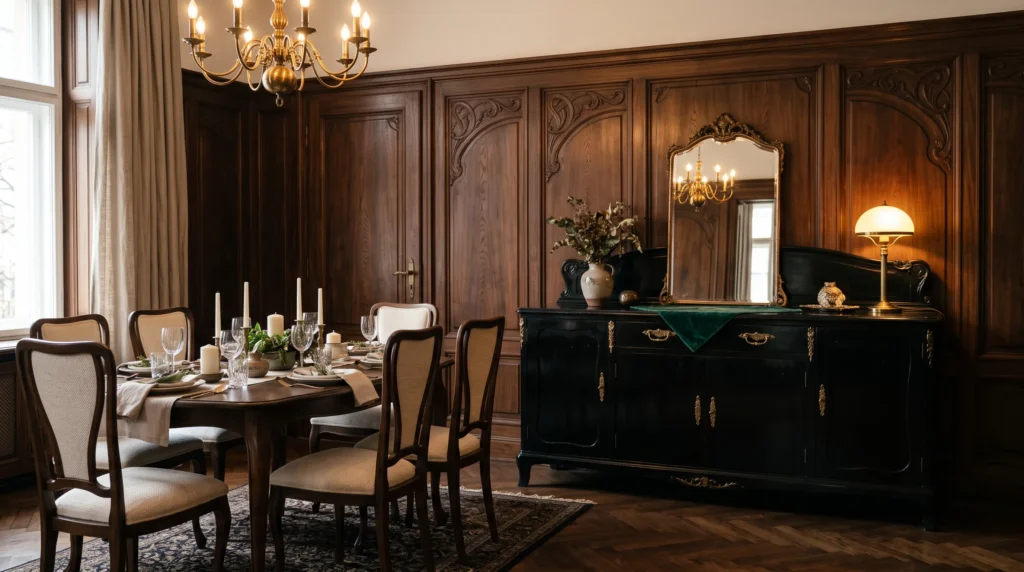
Lacquered black surfaces bring a decorative sheen that flat matte paint can’t replicate, and the finish has a strong historical association with Art Nouveau and chinoiserie-influenced interiors. A lacquered black cabinet, sideboard, or set of panels adds richness to a dining room, study, or bedroom without needing much additional decoration.
If a fully lacquered piece feels like too much commitment, wood paneling in walnut, smoked oak, or espresso on a single wall — or below a chair rail — delivers similar texture at a smaller scale. Vertical boards draw the eye upward, while traditional framed panels lean more classic.
Keep the furniture around a lacquered or paneled surface relatively simple so the finish itself stays visible. Lighting positioned to wash across the surface, rather than pointed straight at it, brings out subtle sheen and grain after dark that direct lighting tends to flatten.
12. Black Marble Accents
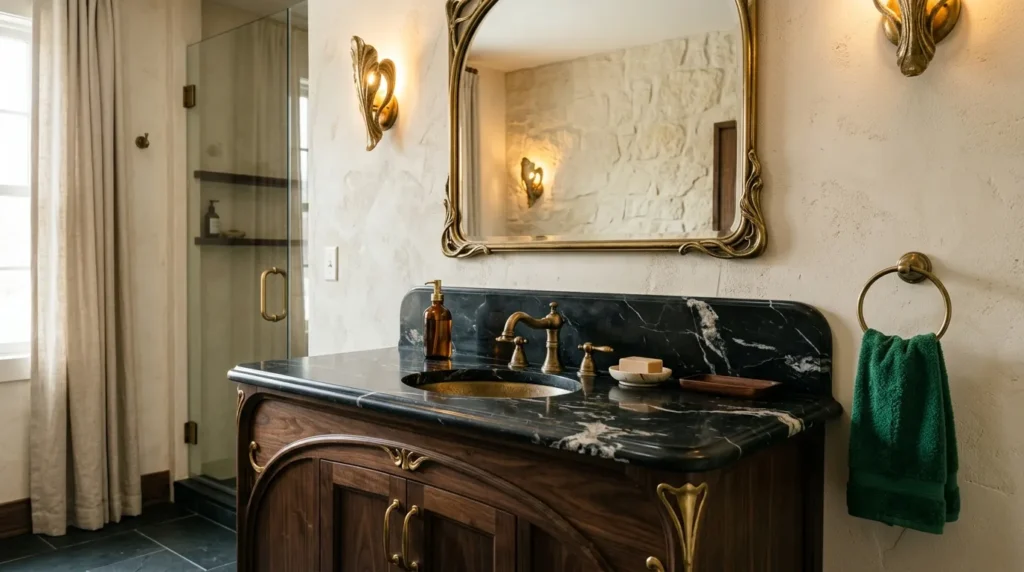
Black marble introduces drama through its natural veining rather than a single flat color block. Used selectively — on a vanity top, fireplace surround, or small console — it tends to have more impact than covering an entire room, since the eye is drawn to a defined feature instead of an overwhelming surface. Look for stone with soft white, gray, or warm veining that connects with jewel-toned or brass accents nearby.
Because marble already draws attention, keep the surrounding finishes quiet. A simple black vanity with a marble top, paired with a rounded mirror and warm brass fittings, can carry a bathroom on its own. In a living room, a marble-topped coffee table works well against neutral upholstery and a dark, curved sofa. If genuine marble isn’t in the budget, quality porcelain or a stone-look surface delivers a similar effect for considerably less, though it’s worth weighing maintenance before choosing natural stone for heavily used surfaces.
13. Statement Fireplace With Botanical or Iron Detailing
A fireplace with real presence anchors a room and gives it a sense of permanence that furniture alone can’t. A matte black or dark stone surround, balanced against curved furniture and jewel-toned textiles nearby, keeps the fireplace powerful without tipping the room into feeling closed off. For a stronger Nouveau connection, look for a surround or fire screen with wrought-iron scrollwork or a botanical motif rather than a plain rectangular mantel.
Keep the mantel styling simple — a large arched mirror, one botanical print, or a single sculptural ceramic object — so the fireplace remains the focal point instead of competing with clutter on top of it.
If the fireplace is functional, decorative materials need to stay a safe distance from any heat source, following manufacturer clearance guidelines. For a non-working fireplace, candles or a stack of decorative logs add texture without pretending to be a live fire. Warm lamps nearby emphasize the dark surround once the sun goes down.
Frequently Asked Questions
What’s the difference between Black Nouveau and gothic decor? Gothic interiors lean on heavier, more severe details — pointed arches, dark religious or medieval motifs, minimal warmth. Black Nouveau uses the same dark palette but softens it with curved furniture, botanical patterns, and warm brass, giving it a more decorative, romantic feel than gothic style.
Is Black Nouveau too dark for a small room? Not necessarily. Use black on one surface — a single wall or the ceiling — rather than throughout the room, and balance it with a lighter floor, jewel-toned accents, and warm lighting so the space doesn’t feel closed in.
What paint finish works best for a black accent wall? A matte or low-sheen finish. Glossier finishes reflect light unevenly and can make black paint look patchy instead of deep and even.
Does Black Nouveau Decor work in rental homes? Yes, largely through furniture, rugs, lighting, mirrors, and art. Renters can also swap hardware or use removable wallpaper with a botanical pattern on one wall for a similar effect without repainting.
Conclusion
Black Nouveau isn’t just dark decor with a stylish name attached — it’s the combination of black and jewel tones, Art Nouveau-inspired curves, and botanical or decorative metalwork that gives it a real identity. Pick one idea that fits your space, lean into the curves and details rather than flat black surfaces alone, and let the room build from there.