
12 Coastal Bedroom Decor Ideas That Feel Like a Calm Retreat
Coastal decor has a reputation problem: mention it and a lot of people picture navy stripes, a rope-wrapped mirror, and a bowl of seashells on the dresser. That version of coastal peaked a while ago. What actually feels coastal now is quieter than that — soft, sandy neutrals, natural materials like linen and rattan, plenty of light, and just enough restraint that the room feels calm rather than themed.
The twelve ideas below build that version of a coastal bedroom: one that brings a sense of the beach indoors through texture, color, and natural light rather than literal beach props. Work through the ones that fit your room’s actual light and layout, and by the end you’ll have a bedroom that feels like a genuine retreat rather than a gift shop display.
12 Coastal Bedroom Decor Ideas
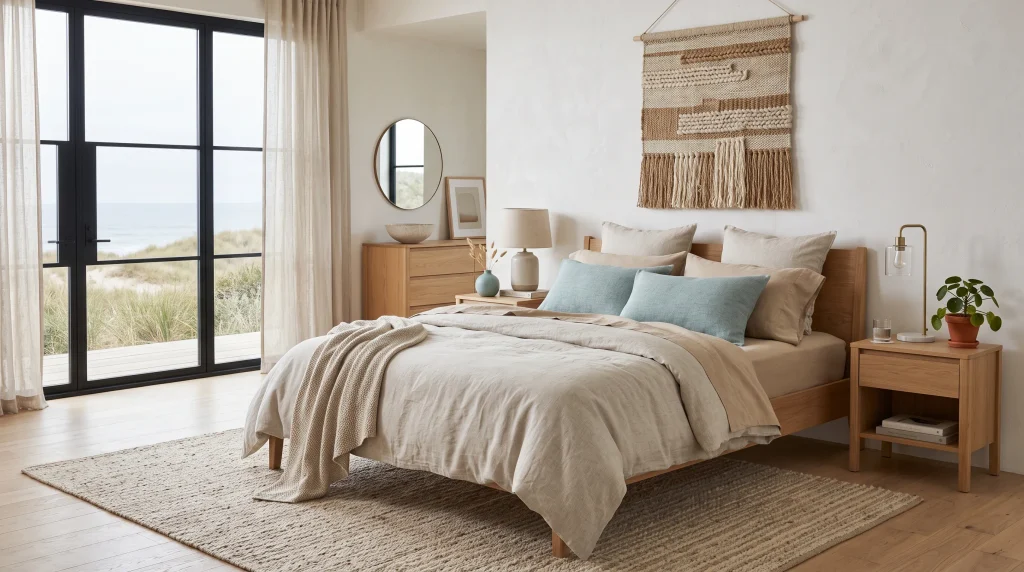
1. Start With a Soft Coastal Color Palette
The color palette is where a coastal bedroom either succeeds or tips into cliché, and the current direction is softer than most people expect: warm white, sandy beige, oatmeal, and pale stone as the base, with muted blue or blue-green appearing only as an accent rather than the room’s dominant color. This palette feels coastal because it echoes sand, driftwood, and hazy sky rather than a literal ocean-blue paint chip.
Keep the palette to two or three tones total, and let the warm neutral carry most of the room — walls, larger furniture, bedding — while the blue or green shows up in smaller doses through a pillow, a piece of art, or a throw. A bedroom painted entirely in saturated ocean blue tends to feel more like a themed room than a calm retreat; the restraint in how much blue you actually use is what separates modern coastal from the more literal version of the style.
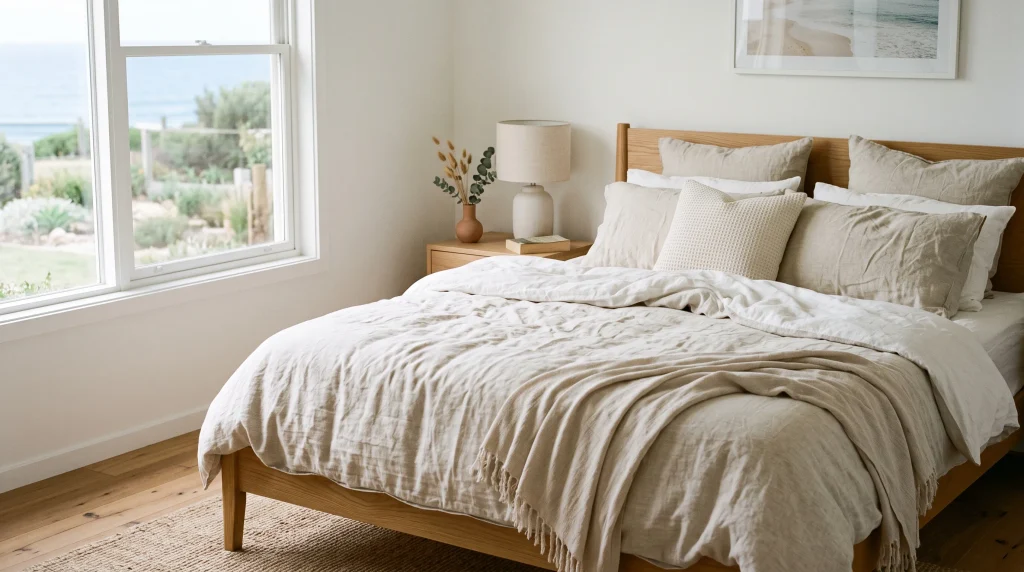
2. Layer Linen Bedding for a Breezy Look
Linen is doing more work in a coastal bedroom than almost any other single material, because its relaxed, slightly rumpled texture is what makes a bed look breezy and lived-in rather than stiff and overly formal. A crisp, tightly pressed duvet works against the calm, unfussy feeling coastal decor is going for.
Layer a linen duvet in warm white or oatmeal with a few textured pillows and a lightweight throw, keeping the pattern minimal — a subtle stripe or a solid texture rather than anything busy. Current coastal bedding leans toward texture over pattern, so if you want visual interest on the bed, get it from mixing linen with a cotton or waffle-weave pillow rather than introducing bold prints. Linen also breathes better than heavier cotton blends, which suits the airy, uncluttered feeling the rest of the room is aiming for.
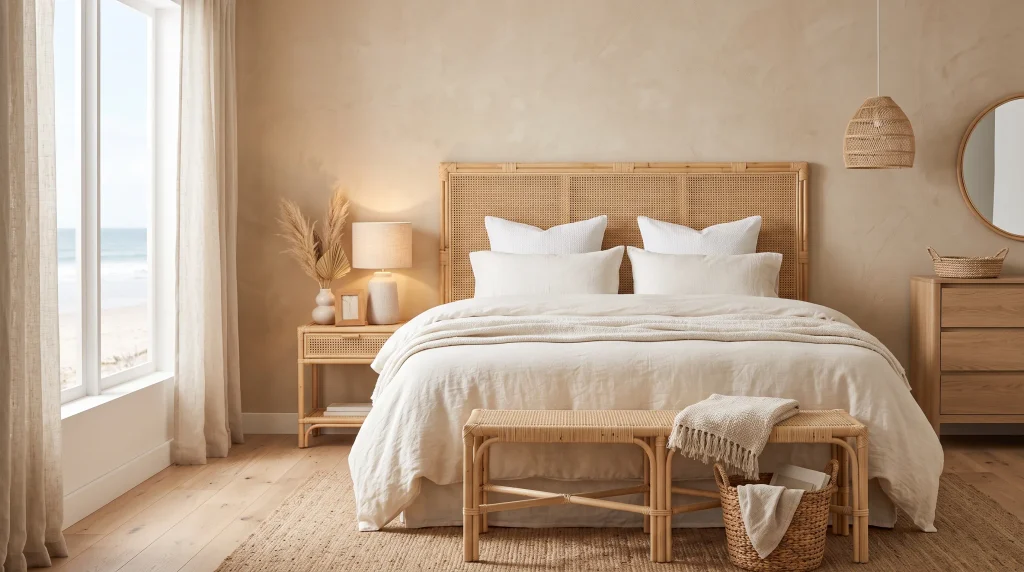
3. Add Rattan or Woven Furniture
Rattan and other woven materials are one of the strongest and most consistent markers of coastal style right now, showing up in bed frames, nightstands, pendant lights, and even wall decor. The open, natural weave brings texture into the room without adding visual weight, which keeps a coastal bedroom feeling light even with real furniture in it.
A rattan headboard or a woven bench at the foot of the bed introduces this texture at a scale that actually matters in the room, while smaller pieces — a rattan nightstand, a woven mirror frame — reinforce the same material language in the details. If you’re mixing rattan with other furniture materials, pair it with light or weathered wood rather than dark, heavily finished pieces; the combination of dark polished wood and pale rattan tends to clash rather than blend into the relaxed coastal look.
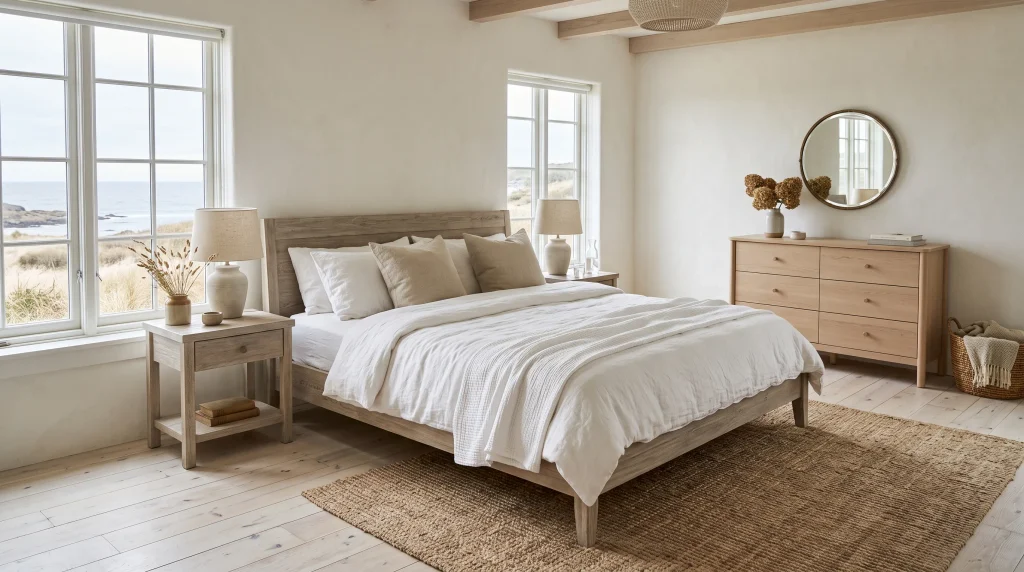
4. Bring in Weathered or Light Wood
Light, weathered, or whitewashed wood suits a coastal bedroom far better than dark, heavily stained furniture, which can pull the room toward a more traditional or formal feel than the relaxed coastal look is going for. Pale oak, driftwood-toned pieces, and whitewashed frames all look sun-bleached and beach-worn rather than polished and formal.
This applies to flooring too, if you have any say in it — a light or whitewashed wood floor does more for a coastal bedroom’s overall feel than almost any other single material choice, since it sets the tone for the whole room from the ground up. If replacing flooring isn’t realistic, a large jute or light-toned rug over existing flooring gets a similar visual effect at a fraction of the cost and effort, which matters if you’re renting or working with a smaller budget.
5. Let Natural Light Do the Decorating
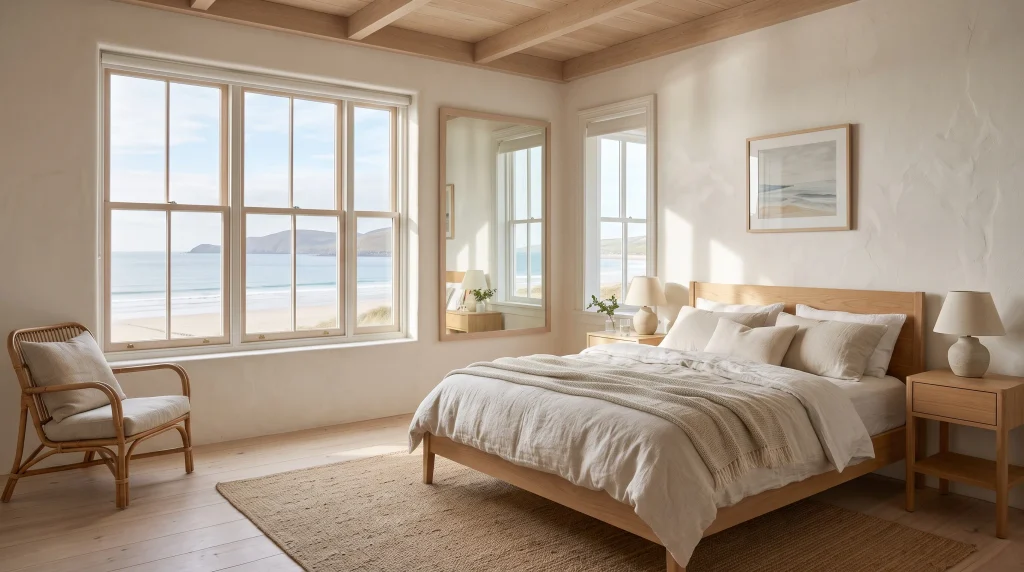
Light is arguably the single most important element in a coastal bedroom, more than any specific color or material — a dim room with all the right rattan and linen still won’t feel coastal, while a bright, airy room with a simpler palette often will. If your bedroom gets decent natural light, the goal is maximizing it rather than blocking it with heavy furniture or dark window treatments.
Keep furniture, especially anything tall, away from windows so light can actually travel across the room, and choose lighter wall colors that bounce daylight rather than absorbing it. A large mirror positioned to reflect a window can meaningfully brighten a room that doesn’t get quite enough natural light on its own. For a bedroom with truly limited daylight, layered warm artificial lighting becomes more important to compensate for what the windows can’t provide.
6. Frame the Windows With Sheer Linen Curtains
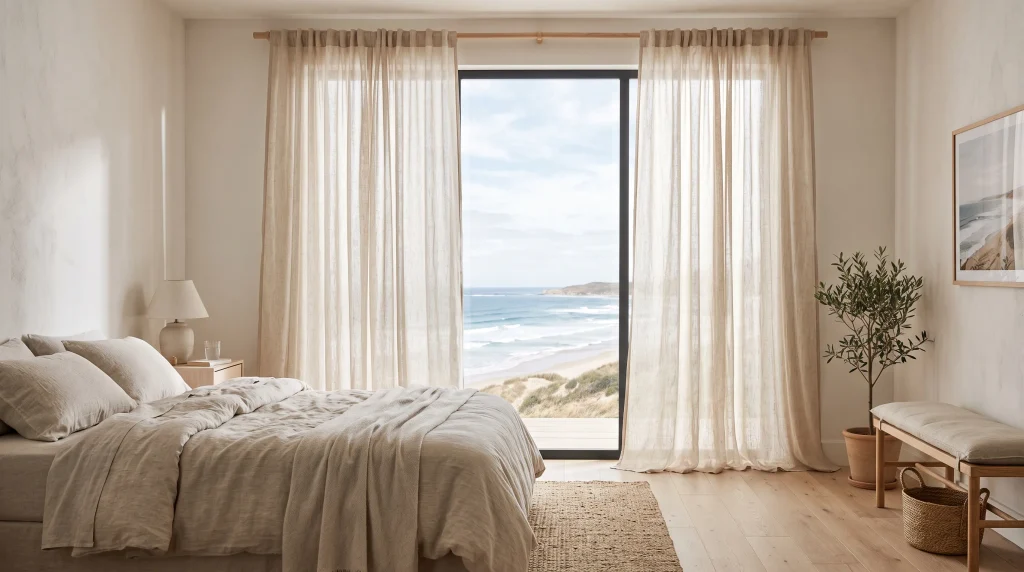
Heavy, opaque curtains work against a coastal bedroom’s whole point, blocking the natural light that does so much of the room’s decorating for it. Sheer linen or lightweight cotton curtains let daylight filter softly through during the day while still giving the window some visual softness and a sense of privacy.
If you need real darkness for sleeping, pair the sheer layer with a separate blackout curtain or shade that stays open during the day and only closes at night — that way you’re not stuck choosing between daytime brightness and nighttime darkness. Hanging the curtain rod higher than the window frame, and letting the curtains run close to the floor, adds height and an airier feel to the whole window, which matters even more in a style built around openness and light.
7. Ground the Room With a Natural-Fiber Rug
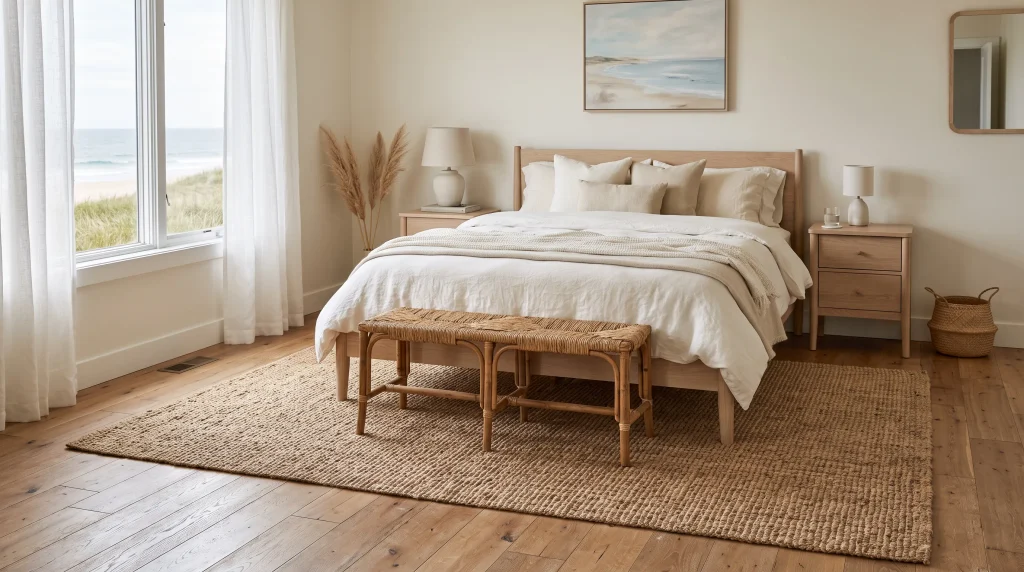
A jute, seagrass, or other natural-fiber rug grounds a coastal bedroom the same way any rug grounds a room, but the material itself also reinforces the natural, textural theme running through the rest of the space. It’s a more fitting choice here than a smooth synthetic rug, which can feel out of step with the linen, rattan, and wood elsewhere in the room.
Size the rug so it extends under at least the front legs of the bed and any nearby furniture, since a too-small rug makes the room feel less grounded rather than more finished. Natural-fiber rugs do have a rougher, more textured feel underfoot than a plush synthetic option, which is worth knowing before buying — a smaller, softer accent rug layered on top near the bed can add comfort back in without giving up the material’s natural look across the room.
8. Use Soft Blue or Sea-Glass Accents
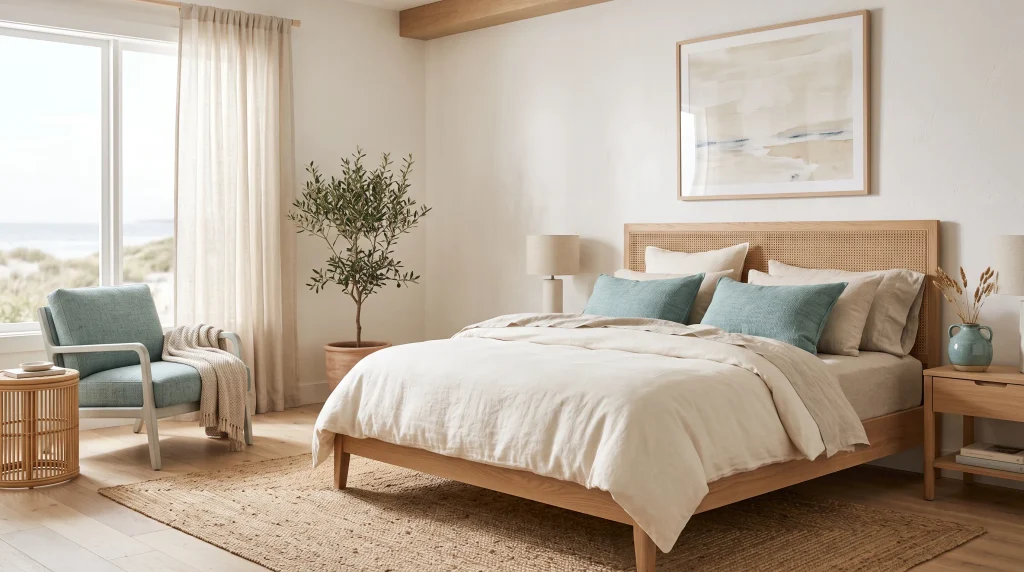
Blue and blue-green are still core coastal colors, but the current, more modern direction uses them as an accent rather than the room’s dominant color — a muted, sea-glass-toned blue-green rather than a bright, saturated navy or turquoise. Used this way, the color feels like a quiet nod to the ocean rather than a literal theme.
Bring the color in through a couple of pillows, a piece of ceramic decor, or a single accent chair rather than painting an entire wall in a bold blue, unless the rest of the room is otherwise very neutral and can support that much color. Repeating the same muted blue-green in two or three spots around the room looks more intentional than scattering several different shades of blue across different items, which can start to look accidental rather than deliberate.
9. Add Subtle Coastal-Inspired Wall Art
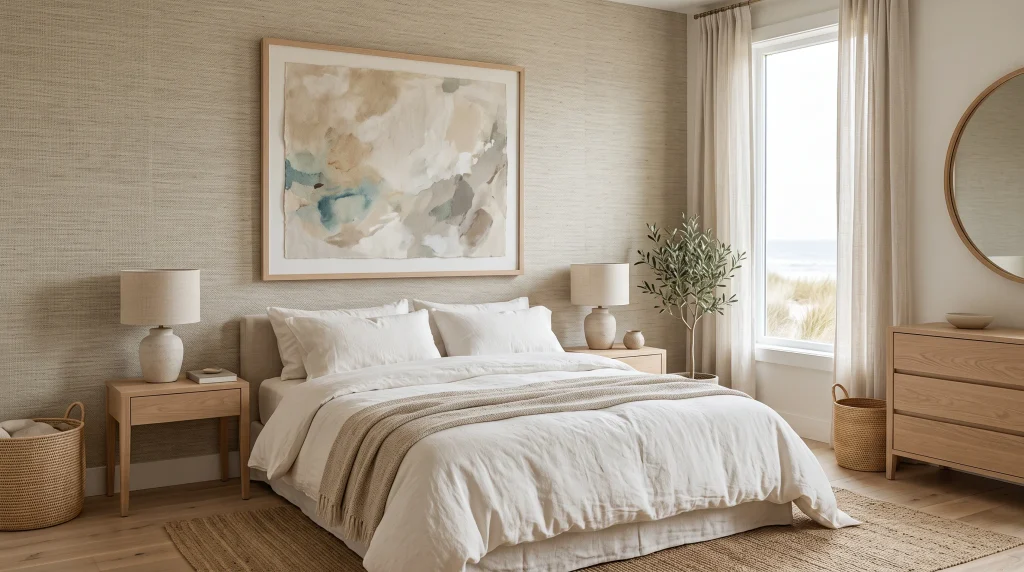
Wall art is a place where a coastal bedroom can lean into its theme more directly than it should almost anywhere else in the room, but the current direction still favors abstraction and subtlety over anything literal — an abstract piece in sandy or blue-green tones, a simple landscape, or a botanical print, rather than a large painted sailboat or a “Life’s a Beach” sign.
One or two well-chosen, larger pieces generally look more considered than a wall covered in many small coastal-themed prints, which can tip the room from calm and coastal into visually busy and overtly themed. Woven wall hangings work well here too, adding texture in place of a traditional framed piece, and they tie back into the same rattan and natural-fiber materials used elsewhere in the room.
10. Choose Soft, Layered Lighting
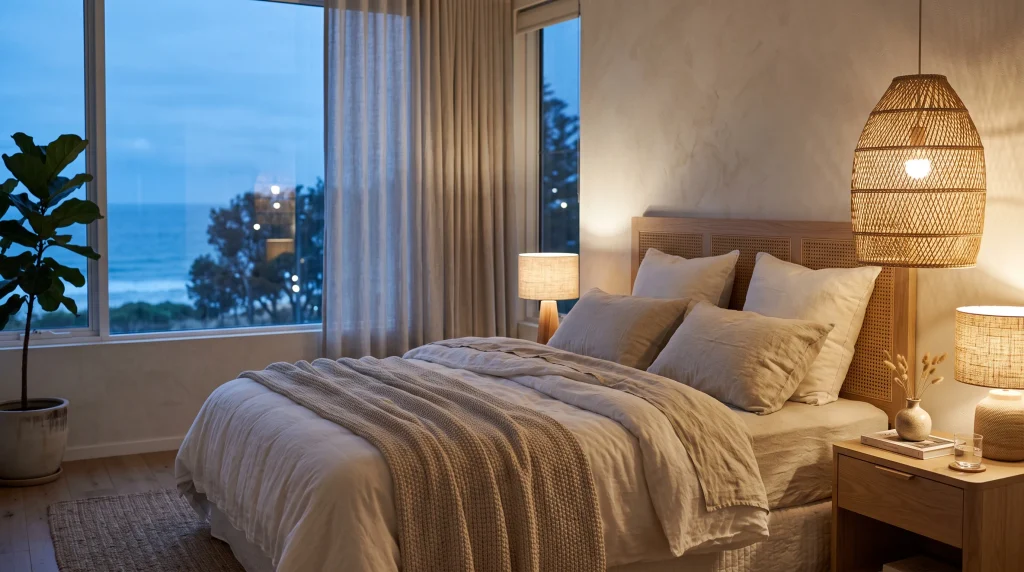
A coastal bedroom’s lighting should feel as soft and natural as everything else in the room, which means warm-white bulbs and multiple smaller light sources rather than one bright overhead fixture. A rattan or woven pendant light doubles as both a fixture and a texture piece, tying the lighting directly into the room’s material palette.
Add a bedside lamp with a woven or linen shade for reading light, and consider a globe-style bulb or fixture, which has become a recurring detail in current coastal lighting because its soft, rounded shape suits the relaxed style better than anything sharp-edged or overly modern. Warm bulbs matter more than the fixture style itself — a beautiful rattan pendant fitted with a harsh, cool-white bulb still works against the calm, warm mood the rest of the room is built around.
11. Mix in Personal and Vintage Pieces
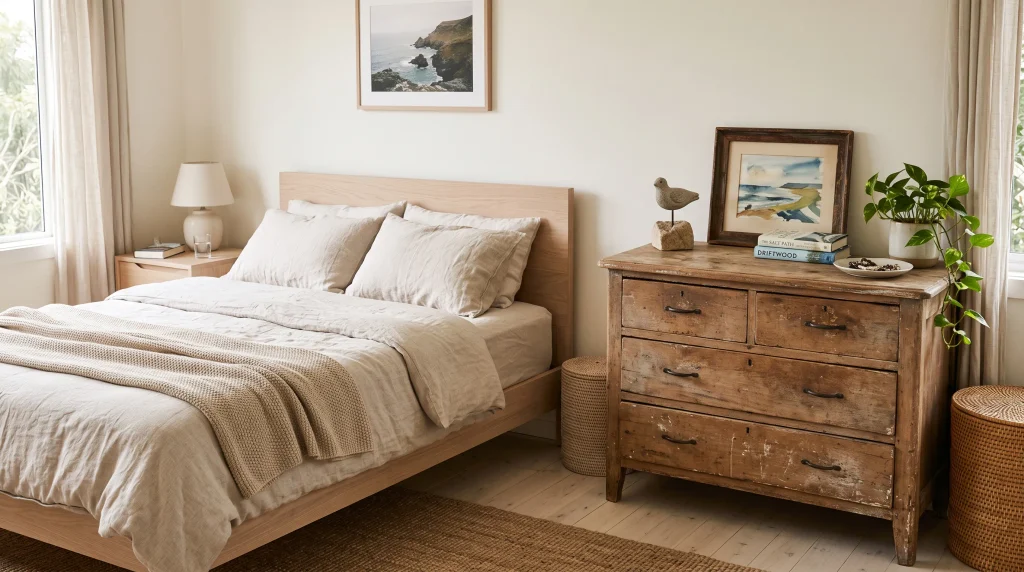
A coastal bedroom that’s entirely new, matching furniture can start to feel more like a hotel room than an actual home, which is where personal and vintage pieces earn their place — a weathered secondhand dresser, a piece of art from an actual trip, an object with real history rather than something bought purely to complete a look.
This is also where the room stops looking like a copy of a Pinterest board and starts looking like yours specifically. A single vintage piece, mixed among newer coastal furniture, does more for the room’s character than an entire matched collection would, since the contrast between old and new is part of what makes a space feel collected rather than staged. Keep these pieces loosely in the same warm, natural material family as the rest of the room so they blend rather than clash.
12. Keep the Room Coastal, Not Themed
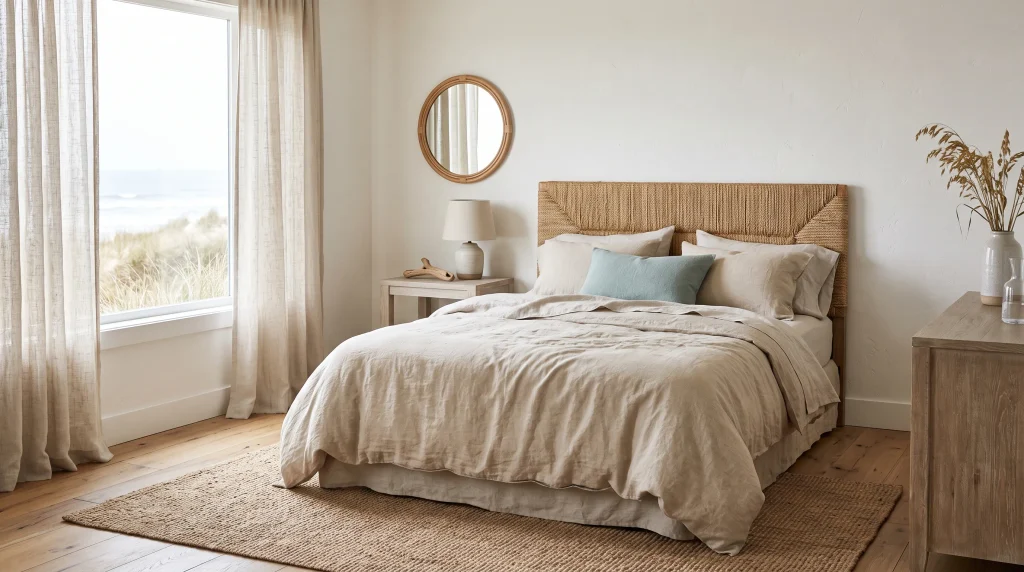
This might be the most important idea on the whole list, because it’s the difference between a bedroom that feels like a genuine coastal retreat and one that feels like a beach souvenir shop. Modern coastal decor leans on light, natural materials, soft color, and texture — it deliberately avoids seashells lined up on a shelf, anchor motifs, and heavy nautical stripes, which read as costume rather than atmosphere.
If you’re drawn to a literal coastal object — an actual shell you collected, a small piece of driftwood — one or two used sparingly can work fine as a personal touch, the same way a vintage piece would. The mistake is treating those objects as the entire decorating strategy rather than an occasional accent. A room built primarily from color, material, and light will read as coastal even with zero literal beach objects in it at all, which is exactly the more modern, understated direction current coastal design has moved toward.
How to Make a Bedroom Look Coastal
Making any bedroom look coastal comes down to combining a handful of consistent elements rather than adding beach-themed objects: a soft, warm-neutral color palette with a touch of muted blue, natural materials like linen, rattan, and light wood, plenty of natural light, and restraint in how much decor actually makes it into the room.
The through-line is texture and calm over literal theme — a coastal bedroom should feel like a quiet, breezy retreat rather than a beach-branded room. Start with whichever element is easiest to change in your current space, often bedding or curtains, and build outward from there with furniture and lighting as budget allows, rather than trying to overhaul the whole room in a single trip.
Modern Coastal Bedroom Ideas
Modern coastal takes the same natural materials and soft palette as traditional coastal style but pulls back further on ornamentation and literal beach references — cleaner-lined furniture, a more restrained color palette, and closer to zero nautical decor of any kind. It’s the direction most current coastal content is actively pushing toward.
Natural materials still carry the identity here — linen, rattan, light wood — but in simpler, more streamlined forms: a plain woven headboard rather than an ornately carved one, solid linen bedding instead of anything patterned. A more minimalist coastal bedroom leans on one or two natural-material statement pieces and keeps everything else quiet, letting light and texture do more of the work than color or decorative objects.
Coastal Bedroom Color Ideas
The coastal color story starts with warm neutrals — warm white, sandy beige, oatmeal, pale taupe, stone — which should make up most of the room’s palette, on walls, larger furniture, and bedding. This base is what gives the room its light, airy feeling before any accent color is even introduced.
Blue enters as an accent rather than a dominant color: muted, dusty, or sea-glass-toned blues and blue-greens work better here than bright, saturated ocean blue or navy, which can tip the room toward a more literal nautical look. For a coastal bedroom with a bit more warmth, sage green or a warm driftwood tone can stand in for or complement the traditional blue accent, giving the palette more range without straying from the overall calm, natural feeling.
Small Coastal Bedroom Ideas
A small coastal bedroom follows the same principles as a larger one — light, natural materials, restraint — with a bit more attention paid to keeping the floor and surfaces clear, since clutter feels visually heavier in a small room than a large one. Lighter wall colors and a pale wood or whitewashed floor both help a small coastal bedroom feel more open than its actual square footage.
Wall-mounted lighting and floating shelves keep the floor clear for walking space, while a single, well-chosen piece of woven or rattan furniture does more for the room’s character than several smaller decor items competing for the same limited space. A large mirror, ideally with a natural wood or rattan frame to stay on theme, helps bounce light around the room and makes a small coastal bedroom feel noticeably more spacious than it actually is.
Frequently Asked Questions
What colors are best for a coastal bedroom?
Warm neutrals like sandy beige, oatmeal, and warm white form the base, with muted blue or blue-green used as an accent rather than the room’s dominant color — bright, saturated ocean blue tends to read as more literal and themed than the current, softer coastal direction.
How do I make my bedroom look coastal?
Combine a soft neutral color palette, natural materials like linen and rattan, plenty of natural light, and restraint in how much decor you add — the effect comes from combining these elements consistently, not from adding beach-themed objects.
What is modern coastal bedroom decor?
Modern coastal pulls back on literal beach references like seashells and nautical stripes, leaning instead on natural materials, soft color, and light with cleaner-lined furniture and a more restrained overall palette than traditional coastal style.
What bedding works best for a coastal bedroom?
Linen bedding in warm white or oatmeal, layered with a few textured pillows and a lightweight throw, suits the relaxed, breezy feeling coastal decor is going for better than crisp, heavily patterned bedding.
How do you make a coastal bedroom cozy?
Layer in warm lighting, textured linen bedding, a natural-fiber rug, and a few personal or vintage pieces — the same natural materials that create the coastal look also add warmth, as long as the room isn’t left too sparse or overly minimal.
How can I make a coastal bedroom without seashells?
Build the room from color, natural materials, and light instead — linen bedding, rattan furniture, a soft neutral palette, and sheer curtains all read as coastal without a single literal beach object anywhere in the room.
What materials are used in coastal decor?
Linen, cotton, rattan, wicker, jute, seagrass, and light or weathered wood are the core materials, chosen because they feel natural, breathable, and sun-worn rather than polished or heavy.
Final Thoughts
A coastal bedroom works best when it brings in the feeling of the beach — light, calm, natural, unfussy — rather than the literal imagery of one. Start with the color palette and bedding if you’re beginning from scratch, layer in natural materials like rattan and light wood as you go, and keep the overall look restrained rather than themed. The bedrooms that feel most genuinely coastal are almost always the quieter ones, built from texture and light rather than a shelf full of beach souvenirs.