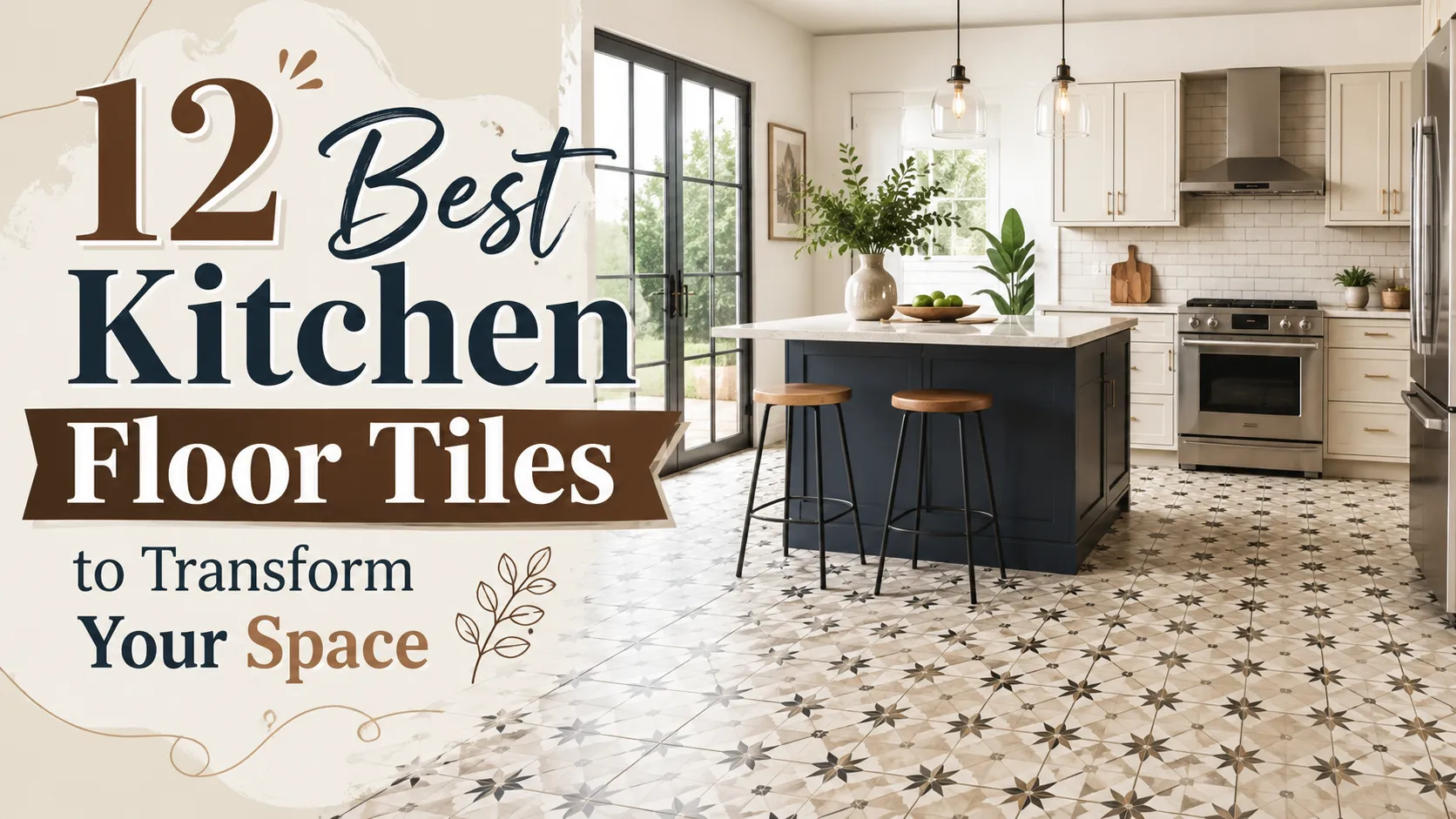
12 Best Kitchen Floor Tiles to Transform Your Space
Picking a kitchen floor tile always feels simple until you actually stand in a showroom staring at forty almost-identical shades of grey. It’s easy to fall for a tile because it looks good in a photo — but a kitchen floor doesn’t live in a photo. It lives under spilled tomato sauce, dropped cast iron pans, muddy paw prints on a rainy day, and a mop that comes out at least every other evening. Whatever you choose has to survive all of that and still look good enough to build the rest of the room around.
That’s really the whole challenge with kitchen flooring: style and practicality don’t always point in the same direction. A tile that looks stunning in a design magazine might be a nightmare to maintain, while the easiest floor to live with isn’t always the most exciting one to look at. Getting this decision right means thinking past colour and pattern, into things that rarely make it into the glossy photos — how water-resistant the tile actually is, how slippery it gets when wet, how much time the grout lines will demand from you every week, and what the tile costs to install versus what it costs to live with over the next decade.
Below, we’ve broken down 12 kitchen flooring ideas that consistently work in real homes — not just in showrooms — along with an honest look at where each one shines and where it asks a little more of you.
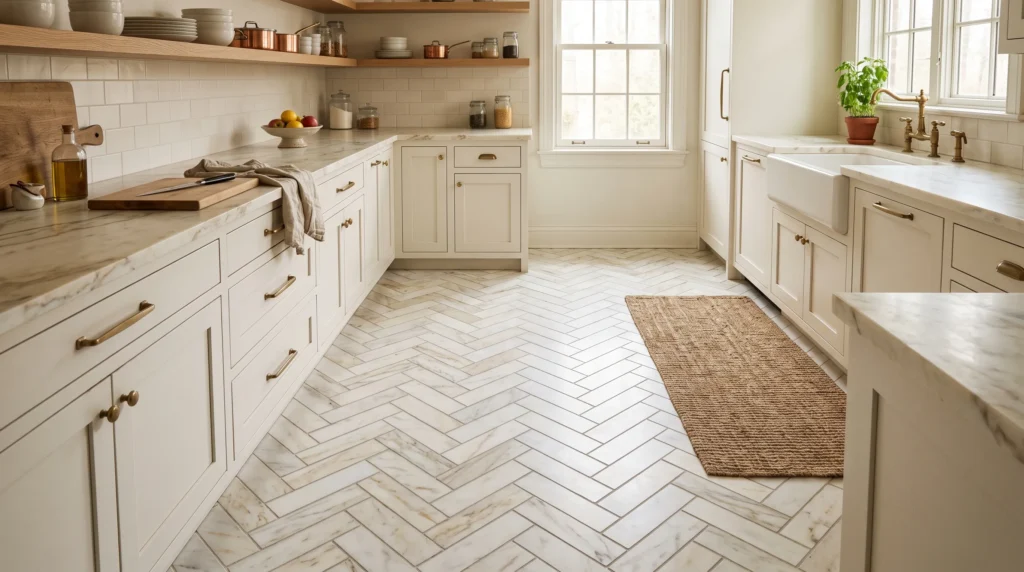
1. Herringbone Marble Tile
Herringbone earns its reputation the hard way — it’s genuinely one of the only tile layouts where the pattern itself does the design work. Lay the same marble in a straight grid and it reads as classic but static; angle it into herringbone and suddenly the floor has a direction, a rhythm, something that pulls your eye from the doorway to the far wall. That makes it especially effective in narrow galley kitchens, where the angled lines can create a stronger sense of direction and make the space feel longer than it is.
What makes natural marble specifically worth the extra cost here is the veining. Natural marble varies from piece to piece, so even tiles from the same stone can show differences in veining and tone. That variation gives a herringbone floor a quiet irregularity that printed tile doesn’t fully reproduce.
The trade-off is real, though: marble is a calcium-based stone, which means it’s genuinely vulnerable to anything acidic. A splash of lemon juice or red wine left to sit can etch a dull mark into the surface permanently, not just stain it. Marble usually needs sealing at installation and periodic resealing, with the exact schedule depending on the stone and the sealer used.
If that maintenance commitment sounds like more than you want to sign up for, marble-look porcelain has genuinely closed the gap in the last few years — high-definition digital printing can reproduce veining convincingly enough that most people can’t tell the difference from a few feet away, and porcelain doesn’t etch the way natural marble can.
Best for: period kitchens, statement floors, and smaller footprints where you want the layout itself to add visual length.
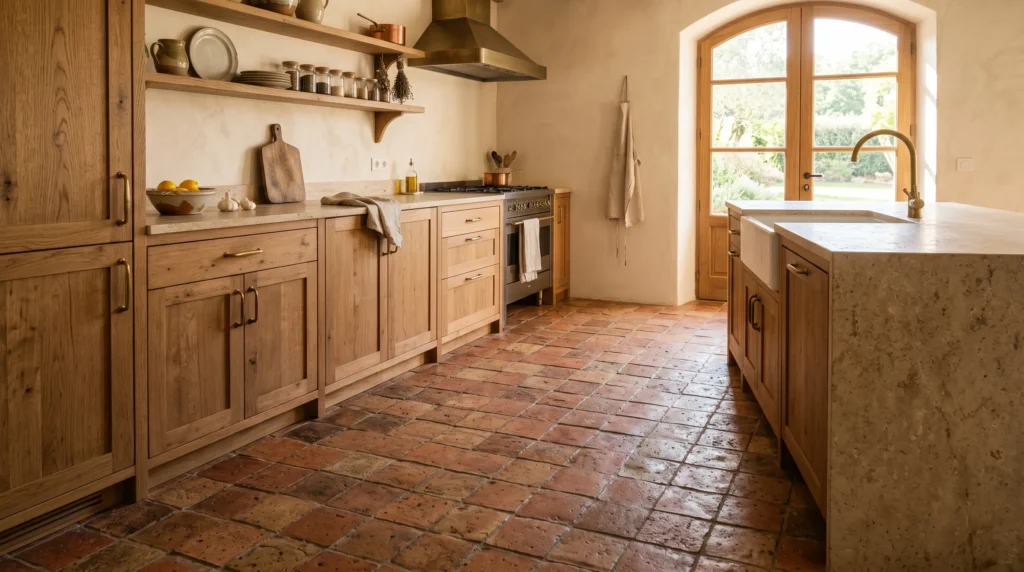
2. Terracotta Floor Tile
Terracotta went out of fashion for a while and it’s back, mostly because it solves a problem a lot of newer kitchens have — everything feels a little too cool and clinical. Warm-toned clay against cream cabinetry, oak shelving, and aged brass hardware softens a room in a way that white porcelain or grey concrete-look tile simply can’t. It’s also a practical colour choice day to day: flour dust, coffee rings, and crumbs don’t show up against terracotta’s natural variation the way they would on a pale, uniform floor.
The thing worth knowing before you commit is that traditional terracotta is unglazed and porous by nature — it’s basically fired clay, closer to a plant pot than a modern tile. That means it needs sealing before grouting and then resealing periodically, often every year or two depending on foot traffic and moisture exposure. Skip that step and it will absorb oil and stains permanently.
Terracotta-effect porcelain is often the easier alternative for this reason. Many options offer very low water absorption and don’t require the same sealing routine as traditional terracotta, while still giving you the warm clay tone and textured look.. For many busy kitchens, terracotta-effect porcelain is the easier low-maintenance alternative, with real terracotta reserved for smaller feature areas where the upkeep is more manageable.
Best for: rustic and Mediterranean-style kitchens, and warm neutral colour schemes that need softening.
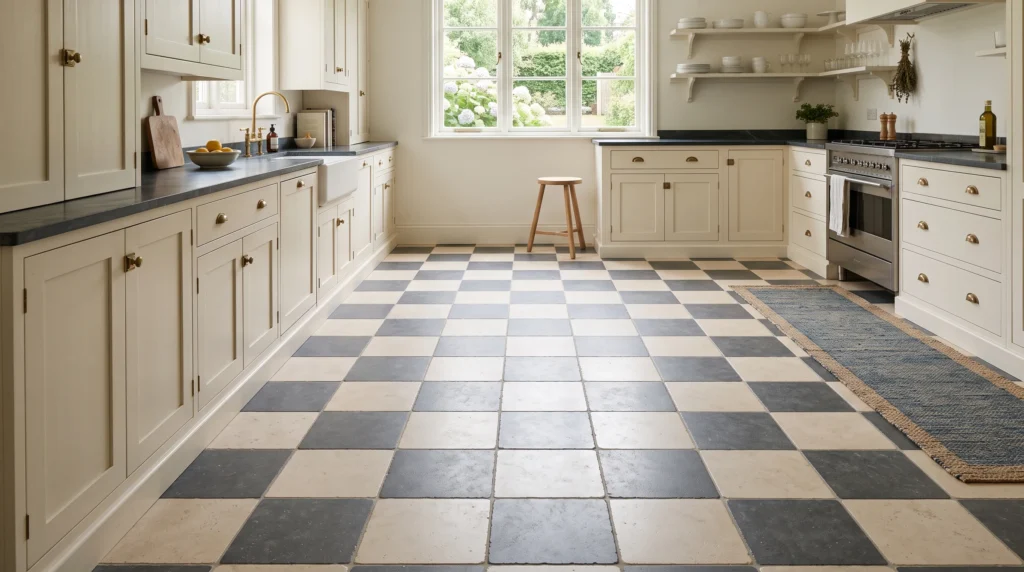
3. Checkerboard Tile Flooring
Checkerboard is one of the few kitchen trends that’s genuinely never fully gone away — it just keeps getting reinterpreted. Classic black-and-white has that diner-meets-heritage-home quality that reads as timeless rather than dated. Swap the palette to something softer, like cream and warm tan, or sage and bone, and the exact same layout suddenly feels contemporary and much less graphic.
Scale changes the mood more than colour does. Larger checks often feel more architectural, while smaller squares tend to give the floor a more traditional or vintage character. It’s worth taping out the actual tile size on your floor before ordering, since photos rarely give an accurate sense of scale in person.
Because checkerboard is inherently a high-contrast, attention-grabbing pattern, it tends to work best when it’s the loudest thing in the room — simple cabinetry, a restrained colour palette on the walls, and hardware that doesn’t compete for attention.
Best for: traditional and modern-classic kitchens that want one strong focal point without extra decor.
4. Wood-Look Porcelain Planks
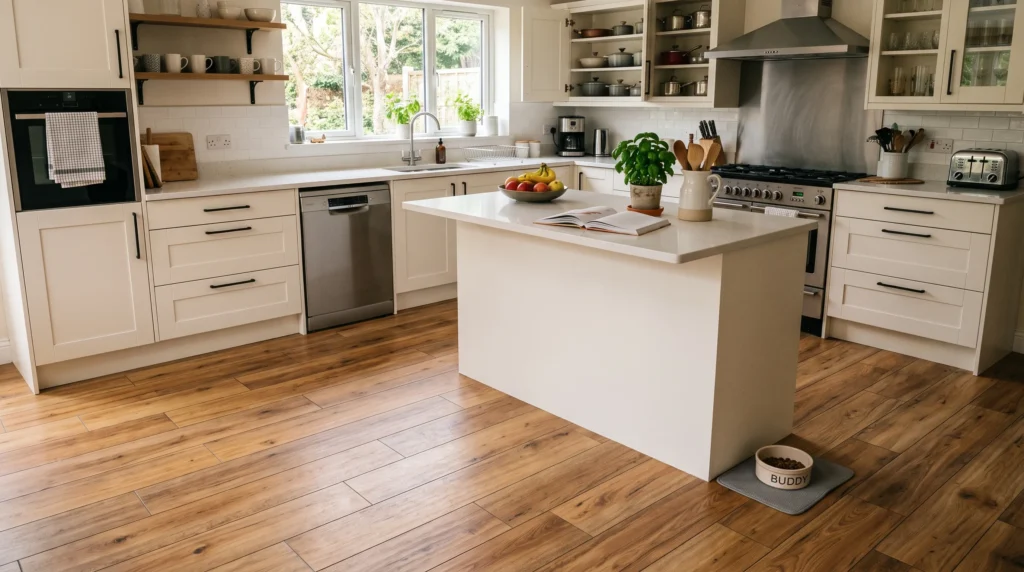
Wood-look porcelain remains a popular kitchen flooring choice because it combines the warmth of timber with the practical advantages of porcelain. Real hardwood and kitchens have always had an uneasy relationship: water near the sink, dishwasher, and fridge can eventually warp or stain timber, no matter how well it’s sealed. Porcelain planks give you the same warmth and grain while offering very low water absorption and greater resistance to everyday moisture than untreated or poorly maintained timber.
The printing technology behind this has improved a lot in recent years. High-definition digital printing can reproduce individual knots, grain variation, and even the slightly uneven colour you’d get from a real timber batch — plank to plank, no two tiles print identically, which is what stops it from looking like an obvious repeat pattern across a large floor.
One detail that trips people up is undertone. It’s tempting to default to grey wood-look planks because they photograph well, but under warm kitchen lighting — especially LED — cool grey can end up looking flat or almost sterile. Honey, oak, and mid-brown tones tend to hold their warmth better once the tile is actually down and lit.
Best for: busy households, pet owners, and open-plan homes that flow into a wood-floored living area.
5. Hexagon Tile Flooring
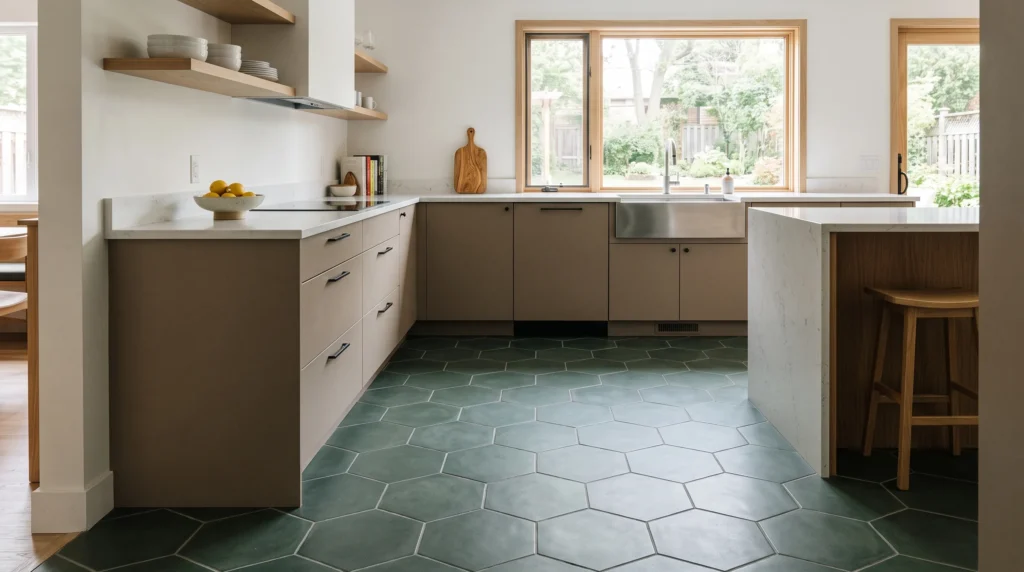
Hexagon tile occupies a nice middle ground — it brings real geometry into a kitchen without tipping into anything too formal or fussy. Keep the palette neutral and it stays calm and understated; go with a deep green, navy, or charcoal hex and the floor becomes a design feature entirely on its own, no other decor required.
The honest trade-off with hexagon — and any smaller-format tile, really — is grout. Because hexagons are inherently a smaller shape than a standard square or plank, you end up with significantly more grout lines per square foot of floor than you would with a large-format tile. More grout lines means more surface area that can trap dirt and eventually stain if you’re not using a stain-resistant or epoxy grout from the start. It’s a small decision at installation that saves a lot of cleaning later.
Larger hexagon formats cut down on grout lines substantially compared to small mosaic hex, while keeping the shape’s personality intact.
Best for: kitchens that already have a strong
6. Polished Concrete-Look Porcelain
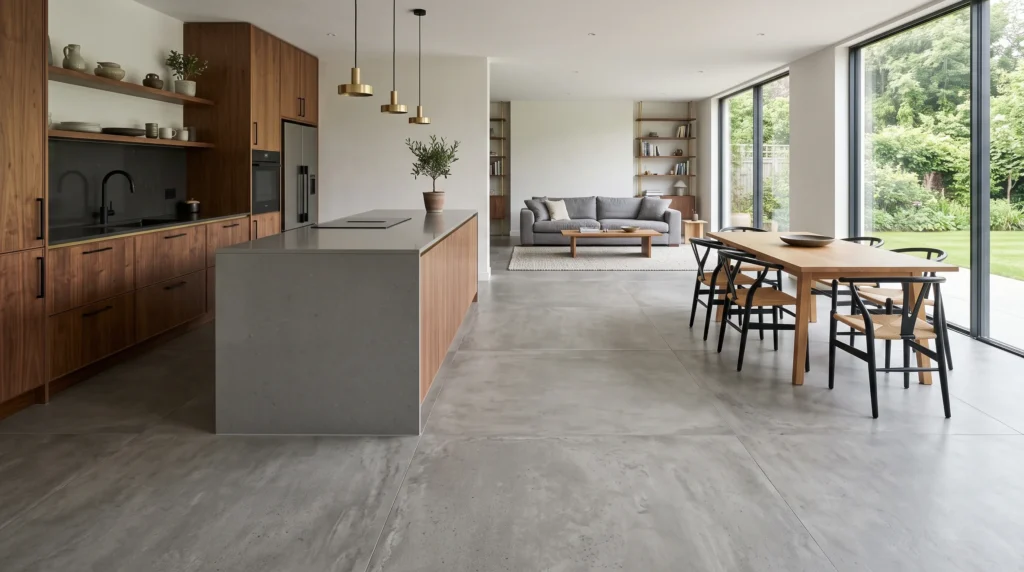
Large-format, concrete-look porcelain has become a go-to for kitchens that want a quieter, more architectural look — minimal grout lines, a matte industrial finish, and a floor that reads almost as one continuous surface rather than individual tiles. It tends to pair well with black fixtures, unlacquered brass, and warm wood cabinetry, giving the room a grounded, understated backdrop.
One thing worth knowing before you commit: large-format tile (24″x24″ and up) needs a properly level subfloor. Any unevenness in the base can show up as lippage — tile edges sitting slightly higher or lower than their neighbours — so installation quality matters more with this format than it does with smaller tiles.
Best for: minimalist and industrial-modern kitchens, and open-plan spaces that benefit from visual continuity.
7. Moroccan Pattern Tile
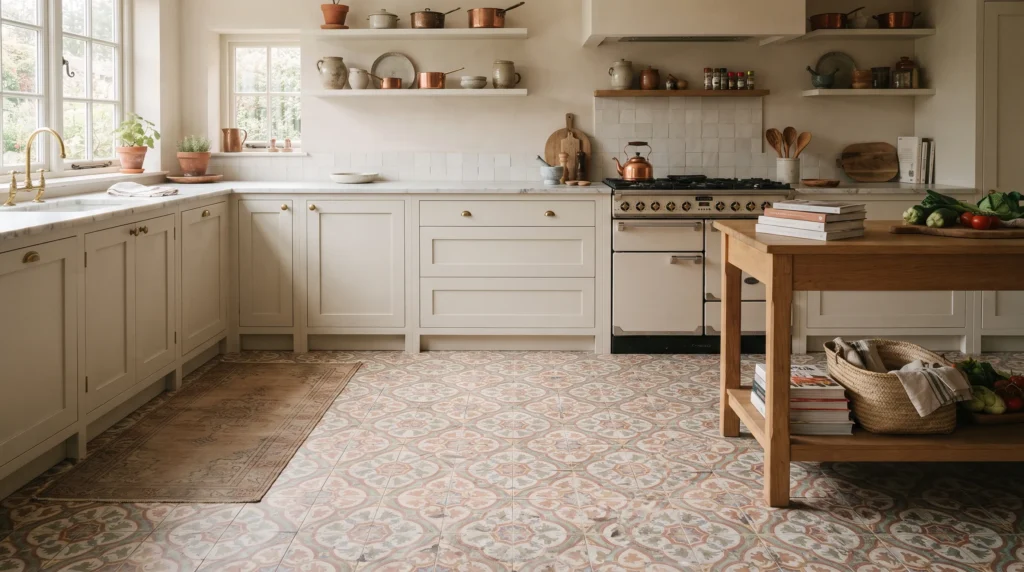
Patterned cement or Moroccan-style tile turns the floor into the room’s main design statement, so it usually works best when everything else — cabinet colour, hardware, wall paint — stays relatively restrained. A common approach is pulling one or two accent colours from the tile pattern for cushions, runners, or trim, rather than trying to match every shade in the design.
These tiles are typically cement-based rather than ceramic, which usually means they’re unglazed and need sealing both before and after grouting, plus periodic resealing over time — check the manufacturer’s specific care instructions, since this can vary by product. It’s also a fairly permanent design decision, so it’s worth living with sample tiles under your kitchen’s actual lighting before ordering a full floor.
Best for: eclectic and Mediterranean-inspired kitchens, or a plain room that needs personality without relying on wall decor.
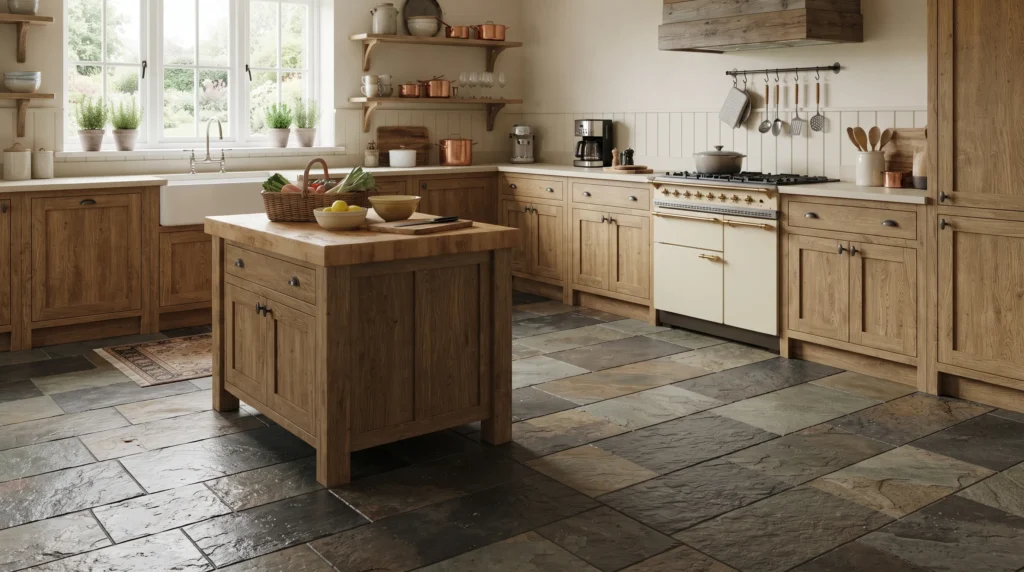
8. Natural Slate Tile
Slate stands out among natural stone options because its texture isn’t purely decorative — a textured, cleft surface can offer better grip underfoot when wet, which makes it a practical option near sinks and stovetops rather than just a stylistic one. Colour variation between individual tiles, ranging from charcoal to rust to green undertones, gives it a grounded, quarried look that manufactured tile finds hard to replicate exactly.
It does ask for some upkeep: slate typically needs sealing at installation and periodic resealing afterward, and the same cleft texture that helps with grip can also trap more debris than a smooth glazed tile, meaning slightly more effort to keep clean. A honed, smoother slate finish is available if you’d rather trade some of that texture for easier cleaning.
Best for: rustic, cottage, and farmhouse-style kitchens, and households that want a naturally textured, grippier floor.
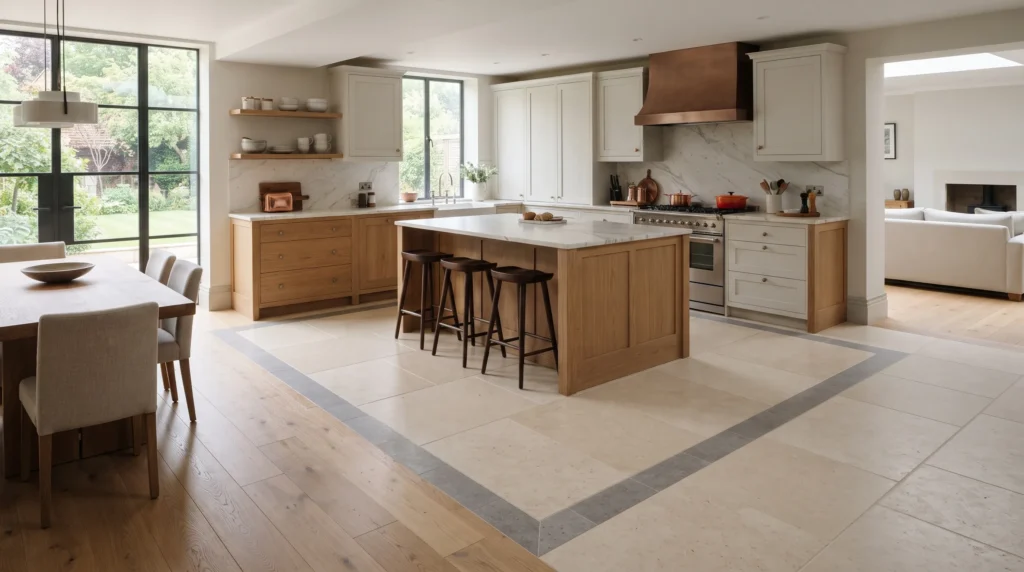
9. Two-Tone Border Tile
A contrasting border tile is a relatively simple way to add architectural intent to an open-plan kitchen without committing to a full pattern change. The field tile stays simple, while a narrow band in a contrasting colour or material frames the cooking zone or marks where the kitchen transitions into a dining or living area.
Keeping the two tones close in value — a warm white against a soft grey, for instance — gives a subtle, tailored effect, while a higher-contrast pairing makes the border read as a clear design line even from across the room.
Best for: open-plan layouts and traditional homes that want visual zoning without a physical threshold.
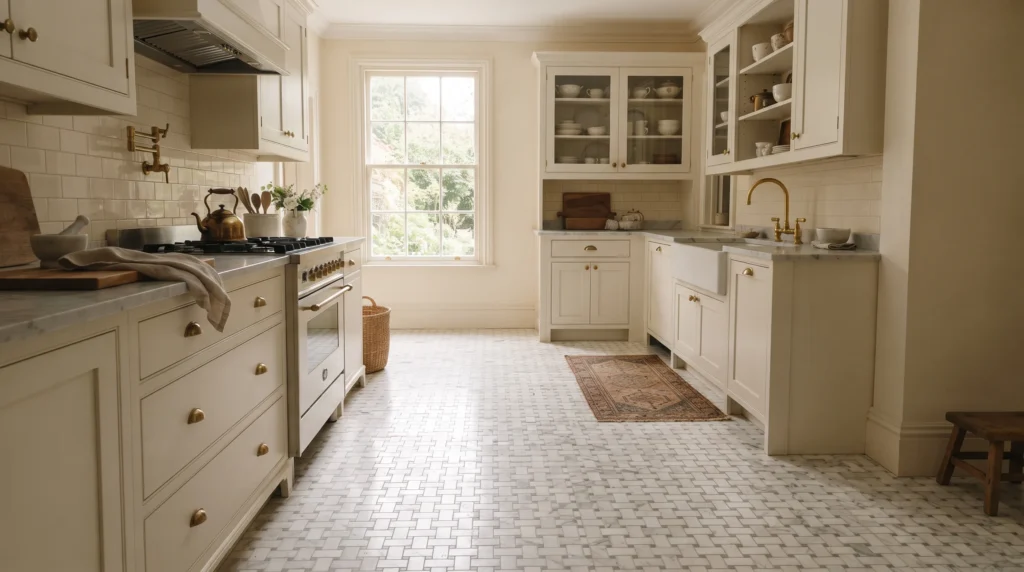
10. Marble Basketweave Tile
Basketweave is a mosaic pattern, usually made from small rectangular marble pieces arranged to look interlocked, and it adds detail and texture to a floor without relying on bold colour. It tends to work particularly well against white or cream cabinetry, where the subtle interlocking pattern reads as texture rather than visual noise.
As with other natural marble applications, it generally asks for more upkeep than porcelain — periodic sealing, and a bit more care around acidic spills that can etch the surface. Porcelain basketweave tile is a widely available alternative that keeps the visual texture with less ongoing maintenance.
Best for: period-style and classic kitchens that want detail underfoot without introducing a strong colour statement.
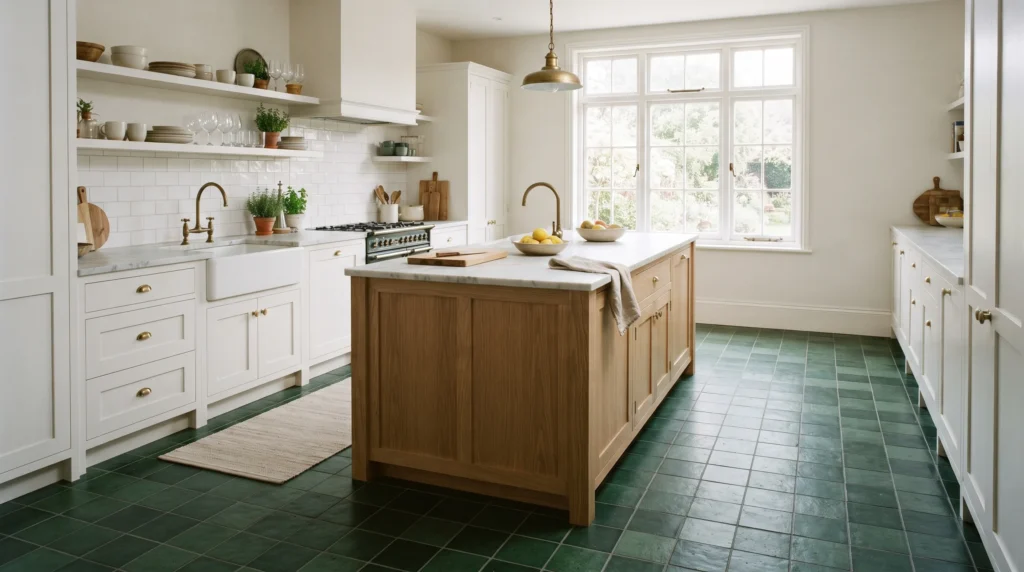
11. Bold Colour Tile Flooring
A saturated floor colour — deep green, cobalt, terracotta red, aubergine — can shift the mood of a kitchen significantly without a full renovation. Making a bold floor look intentional rather than accidental usually comes down to restraint everywhere else in the room: white or warm-neutral cabinetry, simple hardware, and minimal additional pattern.
Natural light is worth thinking through carefully before choosing this route. A dark, saturated tile can look rich in a bright, south-facing kitchen, but the same tile in a room with limited natural light may end up making the space feel heavier or smaller than intended.
Best for: small kitchens looking for personality, or a neutral renovation ready for one strong colour moment.
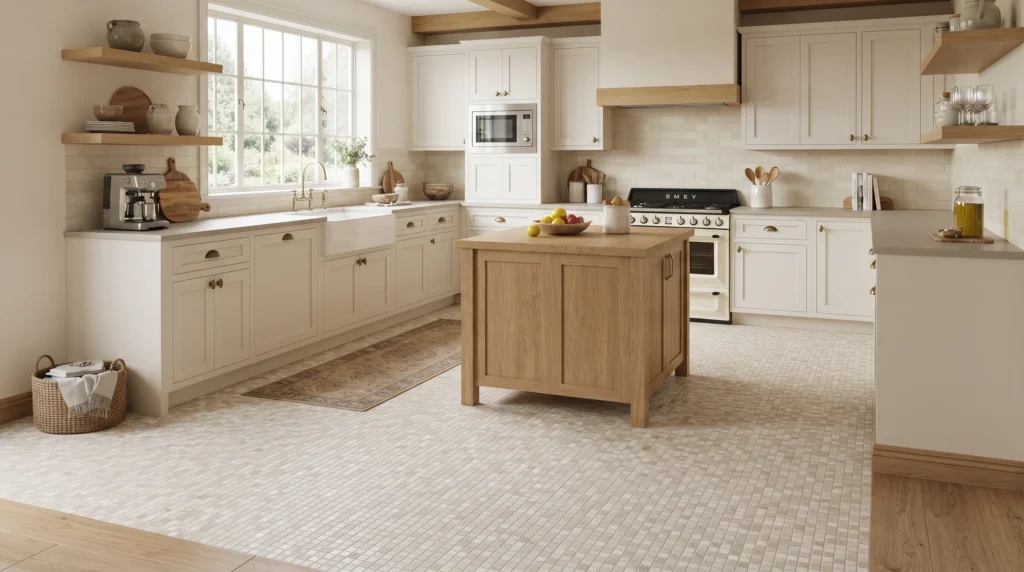
12. Subtle Neutral Mosaic Tile
Small-format neutral mosaic — beige, warm grey, greige, ivory — works a bit like a good foundation coat for a kitchen: it adds texture and depth without demanding attention, which makes it a flexible long-term choice for anyone who tends to update cabinetry or decor more often than flooring.
The trade-off, as with other small-format tile, is grout density. More individual tiles mean more grout lines, so it’s worth budgeting for a stain-resistant grout and a realistic cleaning routine from the start, rather than treating it as an afterthought.
Best for: family kitchens, resale-focused renovations, and flexible neutral schemes.?
Kitchen Floor Tiles – Quick Comparison Table
| Tile Style | Best For | Maintenance | Overall Feel |
|---|---|---|---|
| Herringbone marble | Classic statement floors | Medium–High | Elegant |
| Terracotta | Warm, rustic kitchens | Medium–High | Earthy |
| Checkerboard | Bold but timeless rooms | Low–Medium | Classic |
| Wood-look porcelain | Busy households | Low | Warm |
| Hexagon | Decorative modern spaces | Medium | Playful |
| Concrete-look porcelain | Minimal interiors | Low | Modern |
| Moroccan pattern | Character-rich kitchens | Medium–High | Artistic |
| Slate | Natural, rustic spaces | Medium | Textured |
| Two-tone border | Open-plan kitchens | Low–Medium | Tailored |
| Basketweave marble | Traditional interiors | Medium–High | Refined |
| Bold colour | Personality-led kitchens | Low–Medium | Vibrant |
| Neutral mosaic | Flexible, timeless spaces | Medium | Calm |
How to Choose Based on Your Lifestyle
The most photogenic tile isn’t always the most livable one. A few practical starting points:
Busy family kitchen: porcelain is often one of the easier flooring materials to maintain, particularly in a low-porosity, floor-rated finish. It can handle regular foot traffic and everyday spills without the sealing routine required by many natural stones.
Pet-friendly home: wood-look porcelain gives you the warmth of timber flooring without the water-damage risk around water bowls and muddy paws.
Small kitchen: large-format tile with minimal grout lines makes a space feel bigger; a directional layout like herringbone adds movement without adding visual clutter.
Period or traditional kitchen: marble patterns, checkerboard, slate, and terracotta tend to suit older architecture better than sleek large-format porcelain.
Low-maintenance priority: glazed porcelain is often easier to maintain day to day than comparable natural-stone flooring, especially when the surface is smooth and non-porous.
Final Thoughts
There’s no single “best” kitchen floor tile — only the best one for your household, your climate, and how much maintenance you’re realistically willing to keep up with. A checkerboard or Moroccan pattern can transform a plain kitchen into something memorable, while wood-look porcelain or a neutral mosaic tends to win out when practicality is the priority.
Before you order samples, look past the colour and pattern: check the manufacturer’s water-absorption rating, especially if the floor will regularly be exposed to spills or moisture. Also check whether the tile needs sealing, how it performs in wet conditions, and whether the grout width and colour will be manageable for your household.
Choose the tile first — it’s the hardest thing to change later — and build the rest of the kitchen’s finishes around it.